
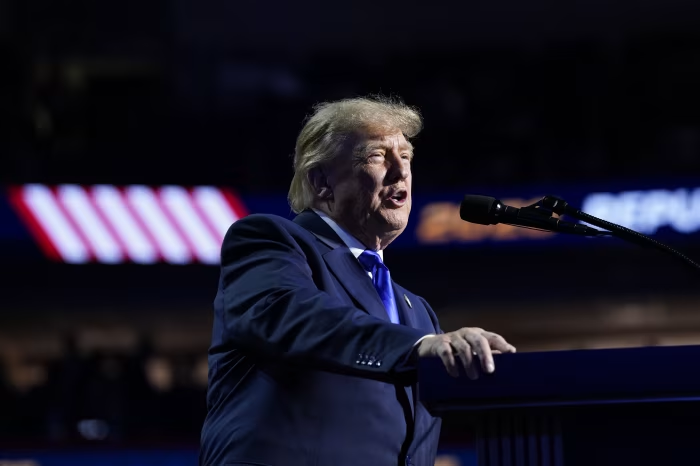

WASHINGTON, DC — US President Donald Trump has renewed his promise to pay $5,000 to every adult American citizen if Republicans win control of both chambers of Congress in the November midterm elections, placing a major financial incentive at the centre of his campaign message.
Trump outlined the proposal in a video shared on X on Saturday, arguing that revenue from tariffs and what he described as strong economic performance would enable his administration to distribute the money.
However, the proposed payment remains a political pledge rather than an established federal benefit. Questions about its financing, legislative approval and implementation could determine whether the plan ever reaches American households.
The president has branded the proposed payment the “Trump dividend” and presented it as a reward that Americans could receive if Republican candidates secure victories in both the House of Representatives and the Senate.
Trump Says Tariffs Could Finance the Proposed Dividend
In his video, Trump argued that his administration was collecting substantial revenue through tariffs and generating significant investment in the United States.
Trump maintained that these economic developments would make the payments achievable, contrasting his proposal with what he predicted would happen under Democratic control.
He also warned that a Democratic victory could trigger an economic depression similar to the 1929 crisis, while portraying a Republican victory as a path towards greater prosperity.
Those statements represent the president’s political claims. The investment figure does not, by itself, establish how much money the federal government has available to finance direct payments, and announced investments are not necessarily equivalent to government revenue.
A $5,000 Promise With a Potential Price Tag Above $1 Trillion
The proposed payment would represent a substantial federal financial commitment.
Estimates published by independent fact-checkers and economic policy analysts suggest that providing $5,000 to approximately 245 million eligible adult citizens would cost more than $1.2 trillion. The final amount would depend on the eligibility rules and the number of people covered.
That scale raises an important question: can tariff revenue realistically cover the entire programme?
Tariffs are taxes on imported goods, generally collected from importers. Businesses may absorb some of the additional cost, but they can also pass part of it on to consumers through higher prices. The amount collected by the government therefore does not automatically translate into an equivalent pool of money available for nationwide cash payments.
The Tax Foundation, a US tax policy research organisation, has argued that tariff revenue would be insufficient to finance the proposed payments at the scale Trump has described.
The administration would also need to explain whether the money would come exclusively from tariff collections, whether other funding sources would be used, and how the programme would interact with the federal budget.
Why Congressional Control Matters
Trump has explicitly tied the proposed dividend to the outcome of the November midterm elections.
Under his stated condition, Republicans must win both the House of Representatives and the Senate for the promise to apply. A Republican victory would not, on its own, establish a legal entitlement to the money or guarantee that payments would be distributed.
Congress plays a central role in federal spending and taxation. A programme of this size would require a workable legal and budgetary framework, including clarification of the administration’s authority to make payments and the source of the funding.
Important details also remain unanswered, including when payments might begin, whether income limits would apply, how eligibility would be verified and whether recipients would receive physical cheques or electronic transfers.
Until those details are established, Americans should not treat the announcement as confirmation that money is on its way.
Trump Points to Previous Military Payments
During his remarks, Trump also referred to a $1,776 payment made to US military personnel, presenting it as evidence that his administration could deliver financial benefits despite doubts about feasibility.
The figure references 1776, the year associated with the founding of the United States.
However, a payment programme covering military personnel is different from a proposed universal benefit for hundreds of millions of adults. The two initiatives may have different eligibility rules, funding arrangements and legal requirements.
Consequently, the existence of a previous military payment does not establish that the proposed $5,000 dividend has been approved or that the government has secured enough money to finance it.
What the Proposal Could Mean for American Households
If implemented, a $5,000 payment could provide short-term financial relief for eligible households facing expenses such as housing, groceries, transport and utility bills.
Its broader economic impact would depend on how the programme was financed and how recipients spent the money. A large injection of government-funded payments could increase consumer spending, but it could also add pressure to the federal budget. The effect on prices would depend on economic conditions, the availability of goods and services, and the funding arrangements.
Tariff policies could also affect the purchasing power of the proposed payment. If import taxes contribute to higher prices for certain products, some households could face increased costs even as the government considers direct financial assistance.
For voters, the central issue is therefore not simply the amount being promised, but whether the plan can be implemented without creating other significant economic costs.
What Happens Next?
The next key developments to watch are whether the White House publishes a detailed funding proposal, whether legislation is introduced in Congress, and whether budget analysts identify a credible way to finance the payments.
The November midterm results will determine the balance of power in Congress, but they will not automatically trigger a transfer of $5,000 to eligible citizens.
For now, Trump’s announcement remains a conditional election promise with major financial and legislative questions still to be resolved.
Americans seeking confirmation of any future payment should rely on formal announcements from the White House, the US Treasury Department and relevant federal agencies rather than social media claims or unofficial payment-registration links.
Kindly Share:

Discover more from LMSINT MEDIA
Subscribe to get the latest posts sent to your email.

