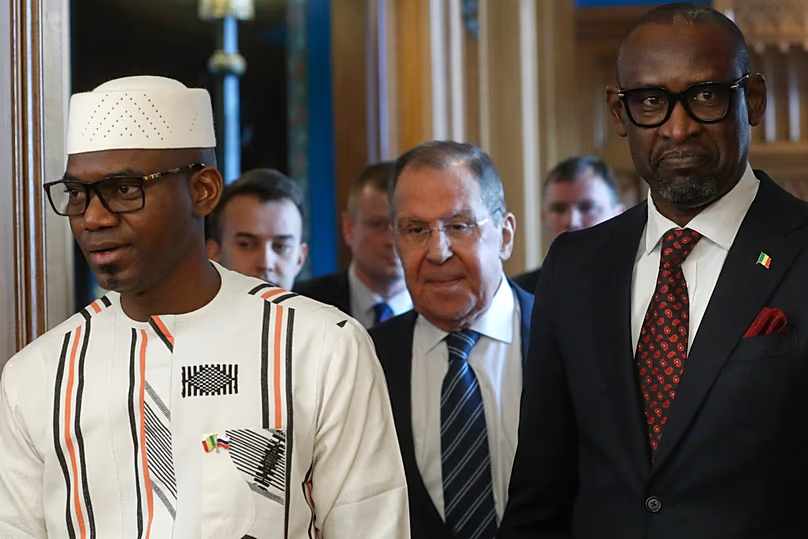
Mali’s Junta Faces Growing Crisis as Rebels Seize Key Towns and Military Bases After Killing Defense Minister

On Sunday, the government of Mali confirmed the tragic death of Defense Minister, General Sadio Camara, following a brutal assault by rebels and jihadist groups. The attack, which occurred on Saturday, marks another significant chapter in the ongoing conflict plaguing the junta-run nation, where militant groups linked to al-Qaida and ISIS, as well as a separatist movement in the north, have long been active. In a Facebook post, the Ministry of Defense announced Camara’s passing, extending condolences to his family. The state-run television also aired a message confirming the death, delivered by spokesperson General Issa Ousmane Coulibaly. According to official reports, General Camara’s residence was the target of a suicide car bombing and subsequent attacks on Saturday. “He fought back, engaging with the assailants, some of whom he managed to neutralize,” the government statement said. “During the exchange of gunfire, he sustained serious injuries and was taken to the hospital, where he sadly succumbed to his wounds.” This killing comes in the wake of one of the largest coordinated attacks on Mali’s military forces in recent history. The violence stretched across the capital city, Bamako, as well as several towns and cities in the region, challenging Mali’s security allies, including Russian forces stationed in the country. The attack left 16 people, both military personnel and civilians, injured, and several militants were also killed in the crossfire, according to government spokesperson General Coulibaly. Although the government reported that the attacks appear to be over, the situation remains tense with many unanswered questions about the future of Mali’s security landscape. Separatists Claim Control of Kidal A spokesperson for the Tuareg-led Azawad Liberation Front (FLA), a separatist group fighting for the independence of northern Mali, announced that after the attacks on Saturday, the Russian-backed Malian military and their allies withdrew from the northern city of Kidal. An agreement was reportedly reached to allow their peaceful departure from the area. “Kidal is now free,” declared Mohamed El Maouloud Ramadan, spokesperson for the FLA. Late on Sunday, General Oumar Diarra, the head of Mali’s armed forces, confirmed that the army had indeed left Kidal and repositioned its troops to Anefis, located about 100 kilometers (62 miles) south of Kidal. The city of Kidal has long been a stronghold for the separatist movement, which has been fighting for years to establish an independent state in northern Mali. The region was captured by government forces and Russian mercenaries in 2023, marking a significant victory for the junta and its Russian allies. The Alliance Between Separatists and Militants The attacks on Saturday marked a new phase in the conflict as separatist fighters aligned with the al-Qaida-linked group JNIM (Group for the Support of Islam and Muslims). This is the first time the separatists and JNIM have united in an effort to challenge the Malian government. JNIM confirmed its involvement in the attacks, which included targeting Kidal, a town near Bamako, and three other cities. According to Ramadan, the FLA’s spokesperson, this operation was conducted “in partnership with JNIM, which is also committed to defending the people against the military regime in Bamako.” The separatists have called on Russia to reconsider its support for the Malian junta, accusing its actions of exacerbating the suffering of the civilian population. Tightening Security Measures In response to the escalating violence, the Malian government imposed a curfew in the Bamako district from 9 p.m. to 6 a.m. for three consecutive nights. This curfew is part of the government’s efforts to restore order and protect the remaining civilian and military infrastructure from further attacks.

ECOWAS Faces Uncertainty as Niger, Mali, and Burkina Faso Withdraw

The withdrawal of Mali, Niger, and Burkina Faso from the Economic Community of West African States (ECOWAS) is set to take effect on January 29, 2024, following a year of rising political tensions. This decision marks a significant shift in the regional landscape, leaving ECOWAS’s future in doubt. After a formal notification on January 29, 2024, these three countries, led by military regimes, have made it clear they are determined to leave the bloc, despite ECOWAS’s request to extend the notification period by six months to negotiate a resolution. The departure, which will take effect on Wednesday, will leave the region fragmented, with these nations now forming a new alliance known as the Alliance of Sahel States (AES). Accusations Against ECOWAS The military leaders of Mali, Niger, and Burkina Faso argue that ECOWAS’s sanctions, deemed “inhuman, illegal, and illegitimate,” were imposed after the military coups that brought them to power. These countries have criticized the West African organization for failing to provide adequate support in their ongoing fight against jihadist violence, and they believe ECOWAS’s alignment with former colonial power France has fueled tensions. Consequently, these nations are now forging partnerships with countries like Russia, Turkey, and Iran, rejecting the influence of France. A Weakened ECOWAS The rupture was triggered by the 2023 coup in Niger, after which ECOWAS imposed severe economic sanctions and threatened military intervention to reinstate the ousted president. These sanctions have since been lifted, but the withdrawal of three founding members severely undermines ECOWAS’s capacity to address political crises in the region. According to Gilles Yabi, the founder of West African think tank Wathi, this move will weaken ECOWAS’s ability to maintain stability in the area. As part of their separation from ECOWAS, Niger, Mali, and Burkina Faso will introduce a common passport and a unified army of 5,000 soldiers, aiming to combat jihadist insurgencies in the region. Tensions in the Sub-region The political landscape in the region is shifting, with countries such as Togo and Ghana increasingly engaged with the AES. Togo, already playing a role as a mediator and providing vital port services to landlocked AES members, has seen its diplomatic influence rise. Togo’s foreign minister has even suggested the possibility of joining the AES, which could further weaken ECOWAS if it loses a maritime-accessing member. Meanwhile, Ghana, under the leadership of newly elected President John Dramani Mahama, has also begun reaching out to the AES, exploring the possibility of balancing membership in both ECOWAS and AES. This development signals a shift in the region’s diplomatic alliances. The Future of ECOWAS The split has sparked debates about the future of ECOWAS. Many are calling for reform, advocating for an ECOWAS focused more strictly on economic cooperation, while others suggest that ECOWAS must evolve into a more people-centric organization, free from the influence of political ideologies. Some former ministers believe that AES could remain a part of a reformed ECOWAS, ensuring that economic ties are preserved while addressing the growing security challenges in the region. Despite the fracture, it remains crucial to maintain economic relations between AES and ECOWAS countries, as the region continues to grapple with jihadist violence. This violent extremism, which has taken tens of thousands of lives in Mali, Niger, and Burkina Faso, is now spilling over into coastal countries such as Benin and Togo, threatening to destabilize the entire region. READ ALSO: Follow the LMSINT MEDIA channel on WhatsApp: Join Our WhatsApp Group Hear: Chat on WhatsApp Join our Telegram Chanel.