U.S. Cancels 8,000 Student Visas and 2,500 Specialized Work Permits in a Year

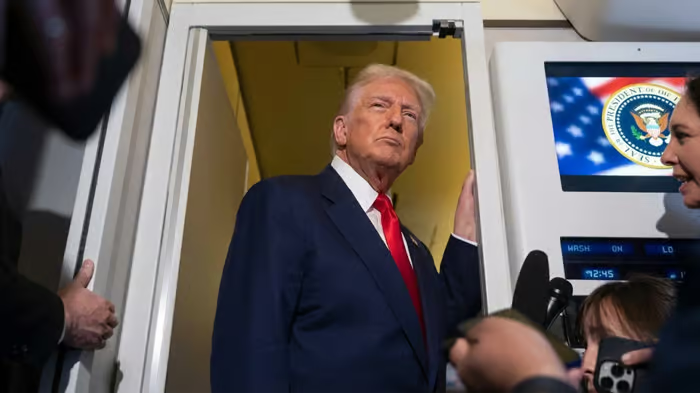
The United States government has revoked a substantial number of visas in the first year of President Donald Trump’s second term, according to the U.S. State Department. Official reports indicate that over 100,000 visas were canceled, including roughly 8,000 student visas and 2,500 specialized work permits. This action is part of a broader initiative targeting foreign nationals with criminal backgrounds or legal violations. The revocations reflect the administration’s emphasis on national security and immigration enforcement. State Department spokesperson Tommy Pigott emphasized the priority of protecting U.S. citizens. He stated, “The Trump administration’s top priority is safeguarding Americans and upholding U.S. sovereignty. We will continue to remove individuals who threaten the safety of our country.” Many of the visa cancellations were reportedly linked to offenses such as assault, drunk driving, and other criminal activities. Pigott noted that this step is part of a larger campaign involving mass deportations, supported by an increased presence of federal immigration agents. In addition to visa revocations, the administration has strengthened visa screening procedures. These measures include more thorough background checks and the review of social media activity for applicants seeking entry into the United States. The visa cancellations coincide with President Trump’s second inauguration on January 20, 2025. The administration continues to prioritize strict immigration policies. Data from the Department of Homeland Security reveals that over 605,000 individuals have been deported under the second-term administration, with an estimated 2.5 million people remaining in the U.S. under various legal conditions. Secretary of State Marco Rubio also defended the visa revocations affecting students who had protested against Israel. Rubio cited U.S. law that allows the government to deny entry to foreigners perceived as acting counter to American foreign policy objectives. This move has sparked widespread discussions on immigration reform, national security, and the implications for international students and skilled workers. Analysts suggest that these measures may reshape the landscape for foreign nationals planning to study or work in the United States.

Birthright Citizenship: Nigerians in Diaspora Speak Out Against Trump’s Policy as Illegal

Nigerians living abroad have strongly criticized former President Donald Trump’s executive order aimed at ending birthright citizenship in the United States. They argue that amending a constitutional provision cannot be achieved through an executive order alone, emphasizing that the courts, especially the U.S. Supreme Court, must ultimately determine its legality. This article explores the controversial policy, its implications, and the reactions from Nigerians in the diaspora. The Controversial Executive Order On his first day in office, Trump signed an executive order targeting the long-standing practice of granting U.S. citizenship to anyone born on American soil. The new order seeks to prevent children born to undocumented or temporarily staying parents from automatically gaining citizenship. Key Details of the Order: This controversial move has already sparked legal challenges, with 22 Democratic states and several civil rights organizations filing lawsuits to halt its implementation. Reactions from Nigerians in the Diaspora Is the Executive Order Legal? Mr. Ralu Ajekwe, a Nigerian resident in the U.S., questioned the legality of the executive order. He highlighted that while governments have the right to protect national interests, such policies must align with existing laws. He added, “The key questions should be: Is the order aligned with American values? Does it ensure the greatest good for the majority? And most importantly, is it legal under the constitution?” Criticism of Trump’s Intentions A Nigerian legal practitioner based in Canada dismissed the move as mere political posturing. He argued that Trump’s reliance on executive orders to address constitutional issues could only go so far, as the U.S. Constitution remains the supreme law. Citing the 14th Amendment, he noted that it explicitly states: “All persons born… in the United States and subject to the jurisdiction thereof, are citizens of the United States.” He questioned whether children of temporary residents or undocumented migrants could truly be excluded from the “jurisdiction” of the U.S., highlighting potential legal hurdles for the policy. Legal Challenges and Implications Many experts believe that the judiciary will ultimately decide the fate of this policy. According to Peter Obiora, an online editor and U.S. resident, “The constitution supersedes any executive order. To make such a change permanent, the constitution must be amended.” He added that Trump had previously proposed a similar idea during his first tenure, which was met with legal opposition. Obiora expressed skepticism about the policy’s survival, predicting ongoing legal battles. Comparisons with Other Countries Canada has also been exploring similar restrictions on birthright citizenship. However, unlike Trump’s approach, the Canadian government has opted for a parliamentary process to address the issue. A Nigerian-Canadian resident explained, “Canada’s approach is more procedural. They are working through parliament rather than executive fiat. It’s a better way to ensure legal compliance.” Advice for Nigerians Seeking Dual Citizenship Johnpaul Nwafidelie, another Nigerian in Canada, urged his fellow citizens to adapt to the new policy landscape. He stated that while the birthright citizenship loophole has closed, Nigerians who desire dual citizenship for their children can still achieve it by following proper legal channels. He explained, “The change doesn’t mean the door is completely shut. It just means you must go through the appropriate process. Nigerians should remain patient and follow the rules.” Conclusion The debate over birthright citizenship highlights complex issues of legality, national interest, and immigration control. While Trump’s executive order has drawn significant criticism and legal challenges, the ultimate decision will rest with the U.S. courts. For Nigerians and other immigrants, the focus must shift to understanding and navigating the evolving policy landscape to achieve their goals legally and responsibly. READ ALSO: Follow the LMSINT MEDIA channel on WhatsApp: Join Our WhatsApp Group Hear: Chat on WhatsApp Join our Telegram Chanel.