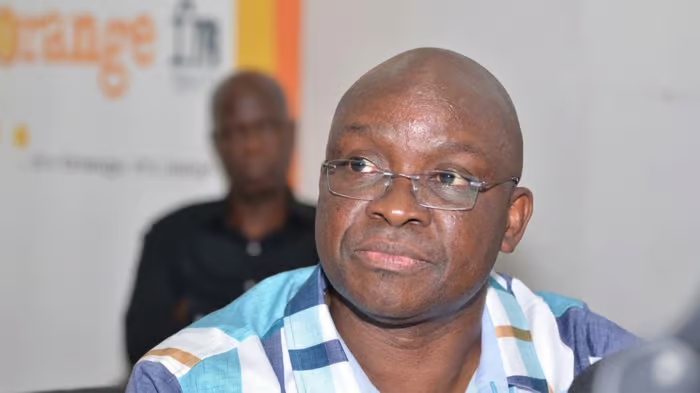
Former Governor of Ekiti State, Ayo Fayose, has expressed his view that President Bola Ahmed Tinubu is unlikely to dismiss the Minister of the Federal Capital Territory (FCT), Nyesom Wike, in favour of Rivers State Governor Siminalayi Fubara amid the ongoing political tensions in Rivers State. Fayose shared his thoughts during a detailed interview with ARISE Television on Tuesday, responding to questions surrounding the continuing power struggle between Fubara and his predecessor, Wike, which has fueled political instability in Rivers State since late 2023. According to Fayose, “The Asiwaju that I know will not remove a Wike to accommodate a Fubara. Wike, who hails from Rivers, came to support President Tinubu, and his efforts are recognized.” He emphasized that Wike’s influence with the president is rooted in his performance as FCT Minister and his proven ability to deliver favorable electoral outcomes for the All Progressives Congress (APC). “Wike is actively performing in Abuja, and the improvements are evident. Even a casual observer cannot deny the progress made under his watch,” Fayose added. Citing the recent local government elections in Rivers State, Fayose noted that the APC’s victories were largely due to Wike’s political clout and predicted a similar impact in forthcoming local elections in Abuja. He posed a rhetorical question to critics, asking, “So, what more could the President expect from Wike?” Fayose also commented on reports that Governor Fubara allegedly sought President Tinubu’s intervention. He suggested that such actions indicate political miscalculation. “If Governor Fubara traveled to meet the President in France, it reflects a lack of strategic foresight. When one refuses humility and peace, they often run in circles, seeking solutions that may not exist outside themselves,” Fayose explained. Regarding the challenges facing the opposition Peoples Democratic Party (PDP), Fayose dismissed claims that President Tinubu had influenced their internal crisis. Instead, he attributed the party’s struggles to its own internal divisions. “The PDP is facing a self-inflicted insurrection. When a party is internally fragmented, survival becomes a test of strength among its members,” he said. Wike Responds: My Removal Is the President’s Decision In a related development, Minister Wike addressed calls for his removal, stressing that any decision regarding his position lies solely with President Tinubu. During a “thank you” visit to Obio-Akpor Local Government Area on Sunday, he stated: “Do not be concerned about individuals calling for my removal. If my appointor feels that I can no longer contribute effectively, it is his prerogative. It is not the role of the public to dictate such decisions.” Wike highlighted the president’s recognition of his political value and reaffirmed his commitment to advancing Tinubu’s agenda. Local officials, including Kingsley Chinda, minority leader in the House of Representatives, and Gift Worlu, Chairman of Obio-Akpor Council, also reiterated their support for the minister, pointing to his significant contributions to the community and the area’s electoral influence. The comments by Fayose and Wike come as impeachment proceedings against Governor Fubara continue in the Rivers State House of Assembly. The House cited alleged misconduct, including extra-budgetary spending and defiance of a Supreme Court ruling. Reports indicate that while Wike is not directly involved, the president has reportedly intervened to manage the escalating dispute. Key Takeaways
Former Governor of Lagos State, Babatunde Raji Fashola (SAN), has revealed that President Bola Ahmed Tinubu played a significant role in shaping both his political career and that of the current Lagos State Governor, Babajide Sanwo-Olu, over two decades ago. Speaking during the official launch of the Omi Eko Initiative held in Lagos on Saturday, Fashola explained that Tinubu had mentored and entrusted him and Sanwo-Olu with major responsibilities at the time when Lagos was evolving into one of Nigeria’s most dynamic cities. According to him, that trust and mentorship from Tinubu provided the foundation upon which their political leadership skills were built. Tinubu’s Mentorship in Lagos Leadership Fashola, who served as governor of Lagos between 2007 and 2015, recounted that Tinubu’s mentorship style involved delegating real authority and responsibility to those he trusted, creating an environment where innovation and governance excellence could thrive. “President Tinubu mentored us over 20 years ago. He gave us opportunities to take responsibility and today, we have grown to hold different leadership positions,” Fashola said during his speech at the event. The former governor noted that this mentorship culture has contributed immensely to the continuous leadership growth and development of Lagos State, a model that has since become a reference point across Nigeria. Continuity in Leadership Vision Governor Babajide Sanwo-Olu, who currently leads Lagos State, is among those who benefited directly from Tinubu’s leadership ideology of grooming future leaders. The continuity in governance, from Tinubu to Fashola and then to Sanwo-Olu, has often been praised as one of the key reasons Lagos continues to experience stable economic growth and infrastructural transformation. Political observers believe Tinubu’s mentoring approach is one of the strongest political blueprints in Nigeria’s democratic system, fostering succession planning, effective governance, and development continuity. Omi Eko Launch: A Vision for Sustainable Development The Omi Eko initiative, where Fashola made the statement, focuses on sustainable urban development and environmental conservation across Lagos. The project aims to enhance water management systems, improve infrastructure, and strengthen the state’s resilience to flooding and environmental challenges. Fashola emphasized that the initiative reflects Tinubu’s long-term vision for Lagos — one that prioritizes urban renewal, economic growth, and community development. Tinubu’s Political Influence Beyond Lagos President Bola Ahmed Tinubu, widely regarded as a master political strategist, has mentored several political leaders across Nigeria who have gone on to occupy prominent positions at both state and federal levels. His political influence extends beyond Lagos, shaping Nigeria’s leadership landscape for over two decades. Fashola’s remarks not only celebrate Tinubu’s mentorship but also highlight how consistent political grooming and trust in capable leaders can ensure sustainable development and continuity in governance.

