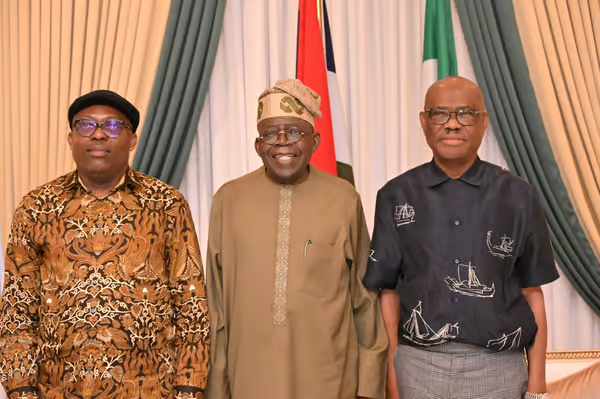
Another warning signal has emerged from Rivers State. Another escalation. Another headline suggests that the fragile calm has once again broken down. For many families tied economically to Rivers State, these political battles are not abstract. They are deeply personal. If the impeachment attempt succeeds, will contracts that small businesses depend on in Port Harcourt be paused again? Will long-delayed payments to construction firms slide even further into uncertainty? This pattern is familiar. In Rivers State, political conflict often brings economic paralysis long before any legal conclusion is reached. From Abuja, far removed from street protests and legislative confrontations, the reality is clear: although the Wike–Fubara dispute is rooted in Rivers State, its ripple effects stretch far beyond its borders. A recurring Rivers narrative At its heart, the renewed crisis follows a storyline Rivers people have witnessed repeatedly. A powerful political figure installs a successor. That successor seeks autonomy. The benefactor resists losing control. Former Rivers State governor and current Minister of the Federal Capital Territory, Nyesom Wike, played a decisive role in installing Siminalayi Fubara as governor in 2023. The expectation was continuity—control over political structures, key appointments, and financial influence. Fubara’s determination to operate independently shattered that arrangement. By the end of 2023, the dispute had moved from private disagreement to public institutional breakdown. The Rivers State House of Assembly split into opposing factions. The legislative complex was set on fire. Impeachment threats became routine political tools rather than constitutional safeguards. President Bola Tinubu initially intervened through mediation efforts. When those failed, an extraordinary measure followed: a six-month state of emergency imposed in 2025. From March to September, Rivers State was administered by a sole administrator, sidelining elected officials. For a brief period, governance resumed without political combat. That calm, however, proved temporary. How party politics changed everything Fubara’s defection to the All Progressives Congress (APC) in late 2025 fundamentally altered the dynamics. What had previously been an internal crisis within the Peoples Democratic Party (PDP) became a national ruling-party dilemma. The conflict was no longer just about Rivers State. It became a strategic problem with implications for federal power balance, party unity, and the 2027 general elections. Budgets, laws, and the deeper struggle The latest confrontation was triggered by financial disputes. Lawmakers aligned with Wike pushed for a supplementary appropriation bill to revise the ₦1.48 trillion 2025 budget that had been approved during emergency rule. Governor Fubara rejected the proposal, maintaining that the existing budget was adequate. He escalated matters further by declining to present the 2026 budget to the House of Assembly, accusing legislators of acting in bad faith. Under Nigerian constitutional practice, this refusal is highly consequential. The Assembly, dominated by lawmakers loyal to Wike, responded by initiating impeachment proceedings against Governor Fubara and his deputy, Ngozi Odu, citing allegations of “gross misconduct.” Shortly before this, Wike publicly declared a “fresh war,” pledging to block Fubara’s second-term ambition and threatening to reveal details of their earlier political agreements. For ordinary residents and businesses in Rivers State, the signal was unmistakable: governance had once again taken a back seat to political warfare. Abuja watches cautiously The crisis has now shifted firmly to Abuja. Wike remains a crucial figure in President Tinubu’s political calculations, having played a key role in delivering Rivers State during the 2023 presidential election. That contribution earned him a strategic cabinet position. At the same time, Fubara is now an APC governor. As the ruling party prepares for 2027, losing an incumbent governor through impeachment or prolonged instability would be a significant setback. Tinubu’s dilemma: Every option has a price President Tinubu faces a set of choices, none without serious political consequences. He can attempt another round of mediation, despite the collapse of previous peace deals. He can enforce party discipline and restrain lawmakers driving the impeachment process. He can allow the courts to determine the outcome, risking months or years of administrative paralysis. Or he can intervene decisively, a move that would revive accusations of federal overreach and authoritarianism. Each path carries risks that extend beyond Rivers State and into the national political landscape. Who ultimately pays the price? The success or failure of the impeachment remains uncertain. Constitutionally, removal requires a two-thirds legislative majority, the appointment of a seven-member investigative panel by a chief judge selected by Governor Fubara, and judicial validation. Without alignment across institutions, the process could stall indefinitely. Yet even a stalled impeachment has real consequences. Development projects freeze. Government payments are delayed. Civil servants wait anxiously. Contractors accumulate debt. Students are left unsure about bursaries and scholarships. Across Nigeria, families with economic ties to Rivers State feel the impact without ever appearing in official political statements. What lies ahead? In the short term, impeachment may fail, especially if signals from Aso Rock quietly encourage restraint. A temporary compromise—perhaps a budget presentation in exchange for dropped impeachment proceedings—remains possible. In the long term, however, the conflict is drifting steadily toward the 2027 elections. Wike has openly committed to blocking Fubara’s re-election. Fubara, strengthened by incumbency, APC backing, and strong Ijaw support, appears equally determined to resist. Rivers State once again stands at the intersection of power, loyalty, and consequence—where political battles are fought at the top, but the economic burden falls on ordinary people.
A respected elder statesman in Rivers State, Kingsley Wenenda Wali, has appealed to residents to remain calm and avoid emotional reactions amid the ongoing political disagreement between Governor Siminalayi Fubara and the Minister of the Federal Capital Territory, Nyesom Wike. Wali described the tension currently playing out in the state as a routine political occurrence, stressing that disagreements of this nature are common when political power is involved. According to him, the situation should not be exaggerated or misinterpreted as a sign of instability or failure in Rivers State. He explained that the disagreement reflects a fallout between two political stakeholders who jointly secured political power but later became divided over the terms and benefits tied to that political arrangement. In his view, the issue is not unusual in political settings where alliances are formed for electoral success. Despite this, Wali expressed concern over the alleged agreement that was reportedly reached between Governor Fubara and Minister Wike before the 2023 governorship election. He noted that the refusal of both parties to publicly clarify the content of that agreement has made it difficult for Rivers people to properly understand the root of the disagreement. According to Wali, transparency is essential if citizens are to make informed judgments about the situation. He argued that without knowing the exact terms agreed upon, it would be unfair for the public to take sides or apportion blame. He maintained that the ongoing dispute should not be seen as a crisis but rather as a political disagreement between individuals who once shared a common goal. “What is happening in Rivers State is purely political, and I don’t believe people should be overly distracted by the behavior of politicians,” Wali stated. He further explained that both Governor Fubara and Minister Wike were involved in discussions and reached an agreement before the election, yet neither has come forward to explain what was agreed upon. “If we are told the terms of their agreement, then we can properly evaluate who may have acted in bad faith,” he said. Wali added that it would be inappropriate for him or anyone else who was not part of those discussions to make absolute judgments about individuals who are now in conflict over political benefits. He emphasized that it is unjust for any political actor to enter into an agreement, benefit from it, and later abandon its terms while still seeking public sympathy. According to him, if such an agreement was not in the best interest of Rivers people, the responsible party has a moral duty to acknowledge it and take corrective steps. Wali questioned whether the agreement truly served the long-term interest of Rivers State, stating that political integrity demands accountability and honesty. He referenced former President Umaru Musa Yar’Adua, who openly admitted that the election that brought him into office was flawed and committed himself to electoral reforms. Wali cited this as an example of leadership that prioritizes truth and national interest over personal gain. He also criticized attempts to portray the current governor as completely innocent, arguing that no individual can benefit from the excesses or misconduct of a previous administration and later claim moral superiority. Wali recalled events surrounding the 2023 governorship election, alleging that supporters of the Peoples Democratic Party (PDP) camped for several weeks at the office of the Independent National Electoral Commission (INEC). According to him, this action was aimed at preventing the All Progressives Congress (APC) candidate, Tonye Cole, from obtaining certified true copies of election documents needed for his legal challenge. He argued that benefiting from such actions and later claiming innocence or moral authority amounts to hypocrisy. “You cannot benefit from wrongdoing and expect to be described as innocent,” Wali said. He stressed that the public should not forget how electoral processes were allegedly manipulated, noting that anyone who benefited from such actions should not expect to be viewed as blameless. Wali urged Rivers people to critically assess both pre-election and post-election activities and to reflect on whether those actions truly served the long-term interest of the state. He further observed that Rivers residents have, over time, become accustomed to political pressure and governance challenges, describing the current situation as a continuation of familiar political patterns. In conclusion, Wali expressed confidence that the disagreement between Governor Fubara and Minister Wike would eventually resolve itself. He emphasized that the matter remains a political issue and should not be allowed to divide or destabilize Rivers people.

