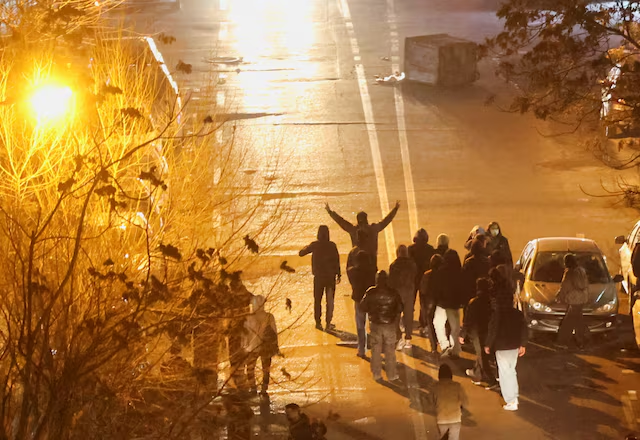
Why Iran’s Clerical Leadership Remains Firm Amid Widespread Protests

Despite months of nationwide demonstrations and mounting international pressure, Iran’s clerical leadership shows no sign of losing its grip on power. Analysts say the Islamic Republic’s security forces remain cohesive, preventing cracks in a government widely regarded as one of the most resilient in the Middle East. Massive Unrest Yet No Defections at the Top The protests, which erupted in response to soaring living costs, escalated into broader opposition against the clerical establishment. Iranian officials report that nearly 2,000 people have died in the unrest, including civilians and security personnel, while thousands more have been arrested. Human rights organizations, including HRANA, have verified hundreds of deaths, with over 10,000 arrests documented so far. U.S. President Donald Trump has repeatedly threatened military intervention in response to Iran’s crackdown, adding external pressure to an already volatile situation. However, diplomats and regional analysts suggest that without defections among Iran’s elite security forces, foreign influence alone is unlikely to topple the regime. A Robust Security Apparatus Iran’s multi-layered security structure, centered on the Revolutionary Guards and Basij paramilitary forces—collectively numbering close to one million personnel—makes the state remarkably resilient. Vali Nasr, an Iranian-American scholar specializing in Middle East conflicts, explains: “For this sort of regime change to succeed, street protests must persist over a long period, and segments of the state, particularly the security forces, would need to break ranks.” The regime has survived at least five major uprisings since 2009, demonstrating cohesion even amid economic and political crises. Analysts note that Iran’s combination of loyalist institutions, a significant domestic support base, and its vast geographic and demographic scale complicates efforts to force a political collapse. Deepening Economic and Strategic Pressures While survival is evident, stability is far from guaranteed. The Islamic Republic faces one of its most serious crises since its founding in 1979. International sanctions continue to strangle Iran’s economy, with no clear pathway for recovery. Militarily and strategically, the country faces significant constraints: its nuclear program has been damaged by foreign actions, and its network of regional proxies—commonly referred to as the “Axis of Resistance”—has weakened following heavy losses in Lebanon, Syria, and Gaza. Protests that began on December 28 over rising prices have transformed into a broad critique of clerical rule, further eroding public legitimacy. According to HRANA, 503 protesters and 69 security personnel have been confirmed dead, with over 10,000 arrests nationwide. Analysts emphasize that while the Islamic Republic is not yet at the “moment of fall,” it is navigating an unprecedented period of difficulty and uncertainty. Looking Ahead Observers warn that Iran’s survival does not equate to long-term stability. For the regime to maintain power, the protests would need to lose momentum while the clerical leadership continues to leverage its entrenched institutions and loyalist security forces. The situation remains fluid, with the potential for significant domestic and regional repercussions depending on how both protesters and foreign powers respond in the coming months.

Iran Ground to a Halt as Protesters Storm Government Offices, Shouting “Death to Khamenei”

Iran entered a virtual standstill this week as widespread demonstrations escalated into violent confrontations, prompting a government-ordered closure of businesses, universities, and official offices across much of the country. The disruption occurred amid a growing wave of public anger over worsening political instability and economic hardship. Footage circulating on social media and shared by opposition groups shows intense clashes in major cities including Tehran, Shiraz, Isfahan, Kermanshah, and Fasa. Protesters and security personnel engaged in heated street battles with demonstrators chanting anti‑government slogans and openly criticizing the regime’s leadership. Many of the scenes show crowds chanting fiery slogans like “Death to Khamenei!”—a phrase historically used to express deep resentment toward Supreme Leader Ayatollah Ali Khamenei and his grip on power. Amid the unrest, demonstrators hurled objects at security forces, and chaotic sounds of confrontation and possible gunfire were reported from several locations. In the city of Fasa, protesters reportedly forced their way into the governor’s compound, leading to a serious escalation. According to armed groups opposing the government, members of the Islamic Revolutionary Guard Corps (IRGC) opened fire in response to the breach of the building. Protests Fueled by Economic Strain The protests did not arise in isolation. They come amid mounting economic difficulties, including sharp inflation, currency instability, and declining living standards that have sparked frustration among traders, students, and ordinary citizens alike. Many businesses closed in protest after the Iranian rial hit record lows, causing import costs to surge and deepening financial strain for households nationwide. Shopkeepers in Tehran’s Grand Bazaar, traditionally a powerful economic bloc with deep historical influence, were among the first to shut their doors, triggering a broader movement of bazaar strikes and public demonstrations that quickly spread to other sectors of society. Government Reaction and Leadership Changes In a bid to steady the situation, President Masoud Pezeshkian ordered an official shutdown affecting 21 of Iran’s 31 provinces. The regime also replaced the governor of the Central Bank, appointing former economy minister Abdolnaser Hemmati amid intense scrutiny and ongoing economic turmoil. State media acknowledged that this new role would be “extremely difficult and complex” given current conditions. At the same time, Supreme Leader Ayatollah Ali Khamenei made key leadership appointments within the IRGC, signaling efforts to strengthen the government’s security response as protests continued. Widespread National Impact The unrest continued into its fourth consecutive day, with nationwide demonstrations, strikes, and clashes with security forces showing no clear sign of slowing. Protesters from different backgrounds—including market merchants, students, retirees, and other citizens—have united under shared economic and political grievances, making the current uprisings among the broadest seen in recent years. Military helicopters were spotted flying low over cities, a move that many analysts interpret as an attempt by the authorities to intimidate local populations and contain the spread of unrest.