Tusks of Terror: Elephant Attacks Plunge Ogun Community into Fear

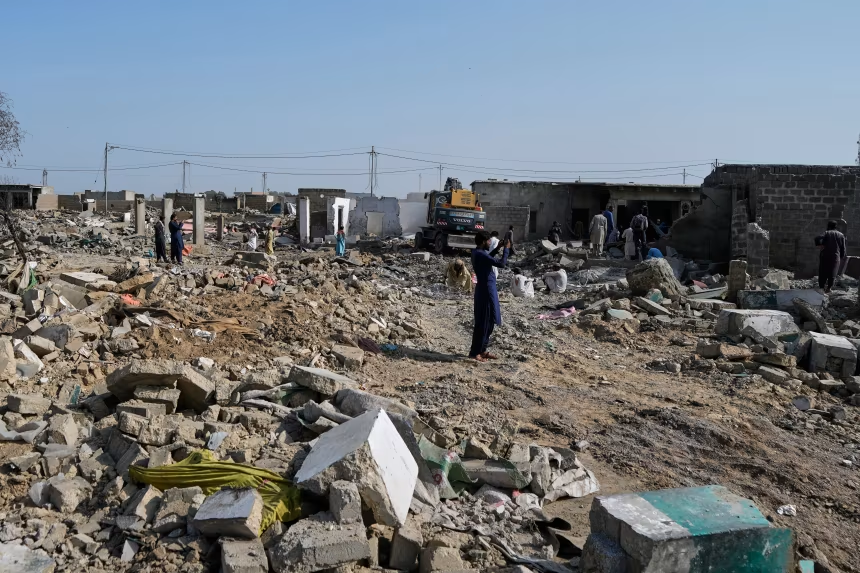
Sixteen-year-old Musa Korede could barely hold back tears as he narrated the chilling moment that forever changed his life. “I heard the loud struggle between my father and the elephant. I ran back to the village for help, but when we returned, we found him on the ground, his intestines out, one leg broken, and bruises covering his body,” Korede recalled with deep pain. His father, Musa Yahaya Kala, a 49-year-old father of five, was fatally attacked by elephants in Itasin community, Ijebu East Local Government Area, Ogun State, on Monday, July 28, 2025. While some villagers described the victim as a farmer, others said he was a logger cutting trees in the elephants’ territory. According to Korede, two elephants charged at them just as they began their day’s work. In fear, they ran in opposite directions. “I managed to hide safely, but I soon heard my father’s cries. When I traced the path back with another villager, we found him weak and bleeding. The elephants appeared again, forcing us to retreat. By the time we returned with more people, my father had already died,” Korede said. A Community Living in Fear Once known for fishing and farming, Itasin, Imobi has turned into a community living in dread. The elephants, which wandered into the area seven years ago, were initially harmless—roaming freely and feeding on plantains and bananas. But in recent years, they have grown violent, attacking people, farms, and property. Now, the thundering sound of elephants in the forest strikes fear into the villagers. Already battling bad roads, lack of electricity, poor water supply, and deteriorating infrastructure for over a decade, the residents now face an added terror—wandering elephants estimated to number about 100. Since 2018, farms, fishing equipment, and properties have been destroyed repeatedly, with the latest tragedy being the death of Musa Kala. Endless Losses Since 2018 For Oluwaremi Oluwafunke, a widow in the community, the elephants have left a trail of destruction. “In 2018, I borrowed over ₦250,000 for farming. Just a day after planting, elephants destroyed everything. This year, I tried again, but they ruined my farm again. I am a widow, farming is my only survival,” she lamented. Similarly, palm kernel farmer Ajumosu Odunaike said their livelihoods have been crippled. “We plant, but never harvest. Elephants eat everything. Even fetching firewood or processing cassava into garri has become dangerous. Recently, they killed another man, leaving his wife and children helpless,” she revealed. Survivors Share Their Pain Bello Kunle, a woodcutter, survived an elephant attack on March 15, 2023. “People say elephants don’t attack first—it’s a lie. I didn’t provoke it. That night, while hunting snails and bush meat, an elephant attacked me, leaving deep injuries. Since then, I cannot work fully. I have two wives and children, but my strength is gone,” he confessed. Another victim, Kazeem Badmus, a chainsaw operator, said he was attacked by four elephants while logging in 2024. He underwent surgery and could not work for almost a year. Community Leaders and Lawmakers Call for Action The Adele Oba of Itasin, High Chief Adedoyin Ajayi, urged the government to urgently intervene. “Business activities here have collapsed, and debts keep rising. The elephants should be relocated to restore peace. Families of victims must be supported, especially children who lost their fathers,” he appealed. Also, Owode Ifedolapo, member of the Ogun State House of Assembly, pressed for preventive measures. “This is a wake-up call for balance between conservation and human safety. Government, conservation agencies, and local authorities must act quickly,” he said. Government Defends Elephant Conservation However, the Ogun State Commissioner for Forestry, Oludotun Taiwo, emphasized that the area is a wildlife conservation zone, not farmland. “The forest spans over 6,000 hectares and was approved strictly for elephant conservation. Sadly, people keep returning illegally for logging and farming despite warnings, signboards, and demolitions. These elephants are naturally not aggressive unless provoked,” he explained. While expressing sympathy, he urged residents to respect conservation boundaries to prevent further tragedy. Conclusion The battle between humans and elephants in Itasin, Ogun State, reflects a larger conflict between conservation and survival. While elephants are protected, villagers—mostly farmers and fishermen—are left vulnerable, losing lives and livelihoods. The community waits anxiously for government action that balances wildlife protection with human safety.

Benue Insecurity: Shut Down Ade-Igwu Trailer Park, It Has Become Bandits’ Hideout – Onjeh Warns

Comrade Daniel Onjeh, the All Progressives Congress (APC) candidate for Benue South Senatorial District in the 2023 general elections, has raised a fresh alarm over worsening insecurity in Ogbadibo Local Government Area. Onjeh, in a strongly worded statement on Friday, urged the Benue State Government to urgently shut down the Ade-Igwu Trailer Park in Orokam, describing it as a notorious haven for bandits, kidnappers, and criminal networks operating across the region. According to him, the trailer park has become a safe hideout for Fulani bandits, violent kidnappers, and other criminal gangs who relocated from the South East and North Central regions following recent military operations and security crackdowns. A Community Under Siege Onjeh lamented that killings and kidnappings in Orokam have escalated to alarming levels. He revealed that criminals no longer restrict themselves to ambushing victims on the highways but now trail their targets into their homes, abducting some and killing others. He cited the recent gruesome murder of Mrs. Anthonia Adah Adejo, an elderly and seriously ill woman, alongside her son, Shaibu Gabriel Adejo, who had returned from Abuja to take her for medical treatment. “These criminals, with the active support of local collaborators, carried out this inhumane attack,” Onjeh disclosed. He said the situation has left Orokam residents living in constant fear, with families and community leaders afraid to speak out against the menace due to fear of reprisals. Ade-Igwu Trailer Park: A Hub for Criminal Operations Onjeh revealed that intelligence reports and eyewitness accounts have consistently linked the Ade-Igwu Trailer Park to criminal activities. He described the facility as a strategic base where criminals store weapons, trade drugs, plan coordinated attacks, and disguise as drivers or traders. “The trailer park is now beyond the control of its operators. It has grown into a monster — a criminal hideout, armoury, and operational base for bandits and kidnappers. The only real solution is to shut it down permanently and demolish the structures criminals use as cover,” he stated. He stressed that while the park may generate some economic benefits, the threat to human lives outweighs any financial gain. Security Agencies Must Act Onjeh called on the Department of State Services (DSS) and the Nigeria Police Force to take immediate action, warning that they cannot feign ignorance of the park’s role as a criminal den unless they are neglecting their constitutional responsibilities. He further emphasized that insecurity in Ogbadibo worsened following President Tinubu’s recent visit to Benue State, which triggered heavy security crackdowns across the region. “The Ade-Igwu trailer park has become an open zone where anyone, including fleeing bandits, can seek refuge. It is one of the greatest threats to Ogbadibo and the entire state,” he added. Moral Decay and Community Breakdown Beyond insecurity, Onjeh alleged that the park has also fueled moral decay in surrounding communities. He pointed to the rise of illicit activities such as prostitution, drug abuse, and youth involvement in criminal networks, which have eroded the once peaceful and family-oriented culture of Orokam. He warned that unless the government acts decisively, the town risks being completely overrun by criminals, with many prominent indigenes unable to return home without heavy security escorts. “Orokam is becoming a ghost town. Ordinary families live in fear, and no one is safe unless this park is shut down,” he warned. A Call for Unity and Lasting Peace Onjeh urged security agencies to clear all hideouts, not just forests, but also urban enclaves like the trailer park. He also warned opportunistic politicians against exploiting the crisis for personal gain, urging residents to remain united until peace is restored. “The only lasting solution is to close down the park. Once it is demolished, the criminals will lose their base, and collaborators within the community will be exposed. That is the only way peace and security can return to Ogbadibo,” Onjeh declared.

Hope Behind Bars Africa Urges Immediate Prison Reform Amid Rising Jailbreaks

Hope Behind Bars Africa (HBBA), a human rights advocacy group, has raised alarm over the recent escape of 16 detainees from the Medium Security Custodial Centre in Keffi (New), occurring in the early hours of Tuesday. The incident also left five staff members wounded, two of whom required urgent medical attention. HBBA described this escape as part of a worrying trend of security breaches in correctional establishments nationwide. In May, seven prisoners fled the Ilesha Custodial Centre in Osun; in March, 12 escaped from Koton Karfe Correctional Centre in Kogi. The group asserts that these recurring jailbreaks reflect deep-seated issues within Nigeria’s justice and corrections systems, necessitating comprehensive reform. The organization emphasizes the urgent need for major investment in facility infrastructure, modernization of aging custodial centres, decongestion through alternatives to imprisonment, and strategic policy changes to address systemic weaknesses. HBBA is calling on the federal government to act swiftly and decisively. They urge the National Assembly to pass robust correctional reform legislation, aiming to upgrade and fortify facilities. The group also highlights the importance of reducing prison populations through sentencing reform and promoting alternatives to incarceration—critical steps toward tackling the insecurity afflicting correctional environments. As HBBA stressed: “The time for urgent, coordinated action on the state of corrections in Nigeria is now.” Context & Ongoing Reforms Why These Reforms Matter

FCTA Demolishes Cashew Garden and Illegal Shanties in Apo to Boost Security

In a continued effort to protect and maintain order in the Federal Capital Territory (FCT), the City Sanitation Operation team has intensified its crackdown on illegal structures and unapproved shanties scattered across the capital city. This sweeping exercise, aimed at safeguarding lives and property, recently targeted a popular location known as Cashew Garden in the Apo district of Abuja. The demolition was supervised by the Director of Development Control, Mukhtar Galadima, who led the team to dismantle unauthorized constructions in the area. Speaking during the operation, Galadima reassured Abuja residents that the exercise was a crucial part of the administration’s strategy to eliminate criminal hideouts and ensure public safety. “You will recall,” he stated, “that we have previously carried out similar exercises in areas such as Zone 3, Wuse, and UTC, following directives from the FCT Security Committee. Today, our focus is Apo — removing shanties and dislodging individuals who pose security threats to residents.” Galadima clarified that the FCT Administration (FCTA) had never granted permission or approval for the structures demolished in Apo. He further warned that any land allocation used to harbor criminal activities would be revoked without hesitation. He explained that the Apo site was originally designated for residential purposes, with formal allocations already made to legitimate landowners. However, some allottees failed to develop their plots within the stipulated timeframe, leaving the area vulnerable to illegal occupation. “As directed by the FCT Security Committee, we are reclaiming the land. This area has already been planned with a properly defined road corridor, demarcated by a deep trench. We intend to take full possession of it,” Galadima emphasized. Also present at the demolition was Adamu Gwary, the Director of the FCTA Security Services Department. Describing the action as a vital clean-up exercise, Gwary noted that it would significantly reduce the operational space for criminals and discourage illegal activities in the territory. Representing the Secretary of Command and Control, Dr. Peter Olumuji, Gwary expressed concern that some individuals occupying these shanties were involved in illicit drug activities, posing a heightened security risk. He assured residents that the ongoing operations would continue until the capital city was free from such threats, making the FCT a safer environment for all.

Ibom Air Passenger Comfort Emmanson Begins Life at Kirikiri Prison as NBA Intervenes

LAGOS — Comfort Emmanson Bob, the female passenger involved in the recent disturbance aboard an Ibom Air flight at Murtala Muhammed Airport in Lagos, has now transitioned into life behind the walls of Kirikiri Prison’s female section. According to official reports, she was escorted into the facility around 6:30 p.m. on Monday by officers from the Airport Command in Ikeja, acting on a valid court remand order. The order will remain in force until October 6, marking the period she is to stay in custody unless further legal actions alter her status. NBA Decries Treatment and Lifetime Ban On Tuesday, the Nigerian Bar Association (NBA) strongly criticised what it described as “reckless and unlawful” handling of the matter. The legal body expressed outrage over viral footage showing the young woman’s sensitive body parts being exposed during the incident. The NBA further condemned the indefinite “no-fly” ban imposed on Ms. Emmanson by both Ibom Air and the Airline Operators of Nigeria (AON), insisting the decision was unjust, arbitrary, and executed without affording her the right to a fair hearing. The Association also dismissed comparisons between this case and the ValueJet incident involving Fuji musician Wasiu Ayinde Marshal (Kwam 1). The Nigerian Civil Aviation Authority (NCAA) echoed the NBA’s stance, clarifying that the two cases were fundamentally different. Life Behind Bars: First-Time Offender Processing A reliable source within Kirikiri Prison revealed that the 26-year-old, reportedly a student, was calm upon arrival and displayed no visible distress. She was classified as a first-time offender, which ensured she was kept separate from the general inmate population. The source explained: “She arrived with her personal luggage and was taken through the standard orientation process for female inmates. Our senior officers briefed her on prison rules and regulations, and she was informed of available skill-acquisition programs, which all inmates—whether convicted or awaiting trial—can participate in. We run vocational schools here to keep inmates productive and engaged, even if they are in custody for just a short time.” Prison officials confirmed that Ms. Emmanson has already received visits, though the identities of her visitors remain confidential, in line with facility policy. Eyewitness Account from the Flight One passenger, Olubunmi Balogun Shonubi, shared her account on Facebook, noting she was seated across the aisle from Ms. Emmanson in an emergency row. She claimed that the initial air hostess who interacted with Ms. Emmanson was polite and professional, instructing her to switch off her phone for take-off. However, tensions reportedly arose when another flight attendant spoke in what the passenger described as a condescending manner. According to Shonubi’s account, Ms. Emmanson explained she could not turn off her phone because the power button was faulty and asked the attendant to assist. She allegedly added, “Please, take my phone and do it. I cannot read.” NBA’s Detailed Position on the Case In an official statement signed by NBA President Mazi Afam Osigwe, SAN, and Secretary-General Dr. Mobolaji Ojibara, the Association condemned both the physical removal of Ms. Emmanson and the public exposure of her body, calling it degrading and unlawful. The NBA stressed that Ibom Air’s decision to impose a lifetime ban, supported by the AON, was procedurally flawed because Ms. Emmanson had not been given a proper platform to present her side of the story. They emphasised that only statutory aviation regulators have the legal authority to suspend or revoke a passenger’s flying rights. The statement further demanded that Ibom Air: The Association also vowed to provide Ms. Emmanson with pro bono legal representation. NCAA Explains Regulatory Boundaries Responding to public comments, NCAA’s Director of Public Affairs and Consumer Protection, Mike Achimugu, clarified that the regulatory body had not directed Ibom Air to prosecute or ban the passenger. He noted that Ibom Air acted independently, citing available evidence of physical altercations between the passenger and crew members. Achimugu acknowledged that while airlines can impose temporary or permanent bans during ongoing investigations, such measures may later be reviewed or lifted. He also drew attention to the human element, stressing that airline staff deserve the same respect and safety guarantees as passengers. Peter Obi Questions Selective Justice Former presidential candidate Peter Obi criticised the decision, describing it as an example of Nigeria’s justice system being harsher on the less privileged while sparing the influential. Obi questioned whether due process was followed and if reconciliation had been considered. He noted the irony that a young woman could be permanently banned from flying while more serious offenders in positions of power face no real consequences. Labour Party’s View on Unequal Treatment The Labour Party (LP) also condemned the incident, arguing that selective justice is no justice at all. The party compared the rapid disciplinary action taken against Ms. Emmanson with the seemingly lenient handling of the ValueJet incident involving Kwam 1. They described the treatment of Ms. Emmanson—being stripped, detained, and banned within 24 hours—as a violation of her constitutional right to personal dignity. Senate Promises Investigation In a final development, the Senate Committee on Aviation, chaired by Senator Abdulfatai Buhari, announced plans to investigate recent conflicts between airlines and passengers. The committee aims to close procedural gaps, ensure fairness in enforcement, and rebuild public trust in Nigeria’s aviation sector

Tinted Glass Permit: Nigeria Police Give Reason for Extending Enforcement Deadline

The Nigeria Police Force (NPF) has officially clarified why it decided to extend the enforcement deadline for the Tinted Glass Permit regulation on vehicles with tinted windows. According to the NPF, the extension became necessary due to a remarkable increase in public compliance, as more vehicle owners have recently applied for permits through the approved platform. Originally, the enforcement deadline was scheduled for August 12, 2025, but the police have now shifted it forward to October 2, 2025. The Force Public Relations Officer (FPRO), Muyiwa Adejobi, issued this update in an official statement on Monday. Adejobi explained that the surge in permit applications indicates a growing awareness and willingness by Nigerians to comply with the tinted glass regulation. “This decision follows a significant increase in applications via the official platform, showing heightened public compliance,” Adejobi stated. He further emphasized that the extended period will enable the police to thoroughly review and verify all pending applications. This scrutiny is aimed at ensuring that tinted glass permits are only granted to eligible individuals, in strict alignment with national security protocols and safety considerations. The FPRO also highlighted that this process is part of the broader strategy to balance citizen convenience with the country’s security requirements, especially in curbing criminal activities that sometimes involve vehicles with tinted windows. Vehicle owners are therefore encouraged to complete their applications promptly to avoid enforcement measures once the new deadline expires.

Armed herders kill civilians; Boko Haram strike kills soldiers in Nigeria

Authorities in Abuja report that yesterday, three individuals were fatally shot by presumed armed herdsmen while tending farms in Yelewata community, Guma LGA, Benue State. A prior massacre in the same location had already claimed more than 200 lives weeks earlier—despite President Tinubu’s visit and the establishment of a peace committee aimed at halting the ongoing violence. An anonymous official revealed victims were ambushed while working on their farms. Three others were wounded; several others escaped unharmed. The attack prompted residents—mostly women—to blockade the Makurdi–Lafia roadway, protesting the continued bloodshed and demanding stronger protection for the displaced 3,000 people who remain hesitant to return to their homes. Joseph Har, the Governor’s security aide, confirmed the attack occurred near Yelewata, stating three people were killed and three wounded. He also noted that the obstructed road has since been cleared. Maurice Orwough, the Guma LGA chairman, corroborated the events and appealed for peaceful solutions. In Borno State’s Kirawa community, suspected Boko Haram militants assaulted a military outpost late Saturday, killing two soldiers, according to sources who asked to remain unnamed. The Emir of Gwoza and the state police spokesperson affirmed the attack occurred around 9:30 p.m., with militants entering via Valle village and a local fuel station. Residents criticized the absence of the commanding officer at the time of the onslaught. Additional reports claim one soldier and several insurgents died, and a female student was abducted. Many villagers fled into Cameroon. However, Major General Abdulsalam Abubakar of Operation Hadin Kai later disputed the attack on Nigerian troops, stating instead that a Cameroonian base was targeted—and shared evidence including burned vehicles to substantiate his point. Meanwhile in Plateau State, Senator Diket Plang—chair of the Senate Committee on Labour, Employment and Productivity—blamed foreign militants and local accomplices for recent violence in Bokkos LGA, specifically in Mushere chiefdom. He described these raids as efforts to displace residents, erode farmlands, and encourage occupation of their ancestral lands. Operations have persisted since April and forced thousands to flee. Plang commended security forces but urged expanded outreach, improved infrastructure (like roadways for troop movement), establishment of permanent military installations, and enhanced collaboration between community leaders and vigilante groups. He also encouraged humanitarian response from NEMA and the Red Cross. In Zamfara State, data from the Zamfara Circle Community Initiative reveals that between August 4 and 10, 15 communities suffered attacks: 144 people were kidnapped, 24 killed, and 16 wounded across LGAs including Bakura, Tsafe, Mafara, Gummi, and Bukkuyum. However, the Nigerian Air Force, under Operation Fasan Yamma, declared success in a joint air and ground offensive in Makakkari Forest that neutralized several bandit leaders and their foot soldiers, citing ISR data indicating over 400 armed suspects poised to attack villages. On a broader scale, U.S. Ambassador to the UN, Dorothy Shea, urged West African and Sahel nations to unite against regional terrorist threats—including Boko Haram and ISIS affiliates—during a Security Council briefing on Peace Consolidation. Emphasizing that terror transcends borders, she called for military cooperation, intelligence sharing, and stronger UN-facilitated dialogue via UNOWAS and ECOWAS. Additionally, she warned that the Sudan crisis—and its resultant arms proliferation—could further destabilize the Sahel.

BREAKING: EFCC Detains Former Sokoto Governor Aminu Tambuwal Over Alleged ₦189 Billion Fraud Case

The Economic and Financial Crimes Commission (EFCC) has taken Aminu Waziri Tambuwal, the former governor of Sokoto State and current Senator, into custody in Abuja for questioning over what is alleged to be a massive financial fraud case. According to a report published by The Cable, Tambuwal is being interrogated in connection with cash withdrawals and financial transactions amounting to approximately ₦189 billion during his tenure as governor. Sources indicate that the EFCC is examining bank records, state expenditure documents, and high-value payment authorisations linked to the period he served as the state’s chief executive. This development follows mounting political tensions and accusations of selective anti-corruption investigations in Nigeria. The African Democratic Congress (ADC) recently alleged that the EFCC’s actions against certain politicians are not impartial but rather targeted at members of opposition parties. In a statement signed by Mallam Bolaji Abdullahi, the ADC’s National Publicity Secretary, the party accused the EFCC of politically motivated moves. According to Abdullahi, several recent EFCC summons issued to high-ranking members of the opposition coalition were influenced by political considerations and party alignments rather than purely legal grounds. The ADC further claimed that some of these corruption probes are not based on fresh evidence but involve reopening old investigation files from several years ago. This, the party says, raises questions about the commission’s commitment to unbiased anti-corruption enforcement and whether its resources are being used for political gain. The case against Tambuwal is still developing, with the EFCC expected to provide official statements as investigations progress. Meanwhile, political analysts believe this incident may fuel further debates over anti-corruption transparency, rule of law, and the political neutrality of federal agencies in Nigeria.

EDITORIAL: Internally Displaced Persons and Declining Donor Support — A Call for Sustained Action

For years, the rationing of food — often leading to severe malnutrition — has been a grim routine in Internally Displaced Persons (IDP) camps across Nigeria. For over two decades, the country has been engulfed in humanitarian crises of staggering proportions, largely triggered by non-state armed groups. Insurgencies by Boko Haram and the Islamic State West Africa Province (ISWAP), combined with widespread banditry, mass kidnappings, and deadly attacks by armed herdsmen, have uprooted millions. Natural disasters such as flooding have compounded the crisis, displacing even more people. As a result, regions like Borno, Adamawa, and Yobe States in the North-east — the epicenter of jihadist violence — alongside Benue, Plateau, and Niger States in the North-central, as well as Zamfara, Kebbi, Sokoto, Katsina, and Kano States in the North-west, have endured devastating humanitarian challenges, leaving communities struggling to survive. The primary burden of supporting these displaced populations has fallen on international agencies such as the United Nations Office for the Coordination of Humanitarian Affairs (OCHA), the World Food Programme (WFP), and other global donor organizations. These bodies have provided essential food supplies and primary healthcare services to the displaced. According to the Internally Displaced Monitoring Centre (IDMC), there were 3.7 million internally displaced persons in Nigeria by the end of 2024 — a figure that continues to rise amid renewed violence in states like Benue and Plateau. Donor Funding Decline and Rising Hunger Unfortunately, aid from key donors such as the WFP has dwindled significantly due to global funding shortfalls, worsened by the United States’ withdrawal of support during the Trump administration. This has left humanitarian agencies struggling to sustain life-saving programs. Trust Mlambo, WFP’s Head of Operations in the North-east, told the BBC: “We don’t have any more to give after this month’s cycle. Our warehouses are empty, and we are desperate for any generous donations.” To sustain IDP feeding programs and related emergencies in Nigeria and the Sahel, $620 million is urgently needed, according to WFP estimates. Prior to this funding collapse, food rationing and child malnutrition were already severe. Médecins Sans Frontières (MSF) reported that 652 malnourished children died in the first half of 2025 — double the number recorded in the same period of 2024. Critical Healthcare Under Threat The North-east alone hosts 1.4 million IDPs and relies on about 150 donor-funded clinics treating malnourished citizens, mostly children. These facilities face imminent closure if funding is not restored. MSF’s Nigeria representative, Ahmed Aldikhari, revealed that this crisis has been looming since 2024, when major donors like the US, UK, and EU either withdrew or drastically reduced their contributions. Historically, the United States has accounted for about 60% of OCHA’s humanitarian funding in Nigeria. The UN’s 2025 humanitarian report warns that 1.8 million children in Borno, Adamawa, and Yobe risk acute malnutrition without urgent intervention. Borno’s Local Response — A Model for Others Borno State Governor Babagana Zulum has embraced an aggressive resettlement strategy, beginning with the relocation of 5,000 IDPs to five communities — Goniri, BulaKunye, Mayanti, Abaram, and Darajamal — enabling them to resume farming this year. This initiative is supported by the construction of 1,000 housing units and the digging of defense trenches to safeguard residents. Zulum has also approved a six-month allowance for newly recruited Civilian Joint Task Force (CJTF) members to help secure communities. Over four years, Borno State has spent ₦40 billion on food and essential supplies for IDPs. This proactive approach should be replicated across other affected states. Philanthropy and National Responsibility Philanthropists such as Aliko Dangote, Abdul Samad Rabiu, Femi Otedola, and Tony Elumelu should urgently respond to WFP’s appeal for increased donations. Without intervention, starvation — and the potential radicalization of hungry, vulnerable youths — could become a greater security threat. In 2024, frustrated IDPs in Dikwa and Mafa threatened to “enter the bush,” a euphemism for joining armed insurgent groups. WFP’s Margret Van der Velden, Director for West Africa, has warned: “Food security is national security.”Her call echoes the urgent need for more donor support. Agencies have been visiting state governors to emphasize the seriousness of this crisis. The Bill and Melinda Gates Foundation is particularly encouraged to step in, given its long history of funding humanitarian interventions in Nigeria. Structural Failures and the Way Forward Globally, IDP camps are intended to be temporary, and the Kampala Convention outlines standards for their eventual closure. Yet in Nigeria, prolonged displacement persists due to poor governance, misplaced priorities, and corruption. The 2021 IDP Transition Framework must be fully implemented to ensure displaced persons have access to shelter, education, and livelihoods. The National Emergency Management Agency (NEMA) should strengthen its accountability, as past cases have shown relief materials being diverted. For example, in 2024, Benue State Governor Hyacinth Alia intercepted a truckload of aid intended for the needy. President Bola Tinubu recently urged governors to prioritize grassroots welfare and enhance food security — a subtle rebuke of inadequate governance. Security First — Humanitarian Support Second While Borno State’s 2025–2027 Strategy for Durable Solutions is commendable, it cannot replace the need to address the root causes of displacement. The Nigerian government must intensify efforts to end insurgency, kidnapping, and rural banditry. A country cannot claim true sovereignty while large parts of its population remain exposed to violence and degradation, relying solely on foreign charities for survival. This represents both a moral failure and a governance crisis. The Tinubu administration must act decisively — not only to improve the living conditions of IDPs but also to eliminate the insecurity that drives displacement in the first place.

Kano Police Launch Investigations into Governor’s Aide’s Murder and Mob Justice Incident

The Kano State Police Command has confirmed that it is currently investigating two separate but serious criminal cases that recently occurred within the Kwalwa Quarters area of Kano Municipal Local Government Area, Kano State. According to official police reports, the first case unfolded on Monday, August 4, 2025, at approximately 7:30 p.m.. Unidentified armed attackers stormed the residence of Sadiq Shu’aibu, popularly referred to as Sadiq Gentle. During the violent intrusion, the assailants stabbed him multiple times and robbed him of his personal belongings. Immediately after the attack, he was rushed to Murtala Muhammed Specialist Hospital in Kano for urgent medical treatment. Sadly, despite medical efforts, he succumbed to his injuries and was pronounced dead on Thursday, August 7, 2025. The Police Command has since launched a comprehensive investigation into the murder, urging members of the public to provide any credible information that could assist in apprehending those responsible. The second incident happened in the early hours of Sunday, August 3, 2025, around 2:00 a.m. In this case, 24-year-old Mas’ud Dahiru was alleged to have unlawfully broken into the home of Musa Hassan with the intention of committing armed robbery. According to the police statement, Dahiru allegedly attempted to stab Musa Hassan’s wife with a knife. However, their 18-year-old son, Muhammad Musa, intervened to protect her, during which Dahiru stabbed the teenager on the back and face. The commotion attracted the attention of neighbours, leading to an alarm being raised. A crowd quickly gathered and managed to apprehend Dahiru and his accomplice, identified as 38-year-old Alhaji Haruna. Both men were beaten by the irate mob before being handed over to the authorities. The suspects were taken to Murtala Muhammed Specialist Hospital for medical attention. Dahiru was later confirmed dead by medical personnel, while his accomplice, along with the injured Muhammad Musa, is still undergoing treatment at the facility. Kano State Commissioner of Police, CP Ibrahim Adamu Bakori, PhD, assured the public that both cases would be handled with the highest level of transparency and professionalism. “The Kano State Police Command remains committed to upholding law and order, safeguarding lives and property, and ensuring that justice is served in accordance with the law,” the Commissioner stated. The Police Command has also reiterated its appeal to residents to cooperate fully with law enforcement agencies by providing timely and accurate information that could assist in curbing criminal activities in the state.

Governor Abba Yusuf Mourns Slain Aide, Orders Immediate Security Operation in Kano

Kano State Governor, Abba Kabir Yusuf, has expressed deep sorrow over the tragic death of one of his aides, Sadiq Gentle, who reportedly succumbed to severe machete injuries inflicted by suspected criminal assailants. The late Gentle, who served as a Senior Special Reporter under the Ministry of History and Culture, died on Thursday while receiving treatment at the Murtala Muhammad Specialist Hospital, following a brutal attack at his residence that occurred late Sunday night. In a press statement released through the Governor’s official spokesperson, Sunusi Bature DawakinTofa, Yusuf paid glowing tribute to Gentle, describing him as a committed and principled media practitioner whose sudden demise marked a grave loss to the state. “The announcement of Malam Sadiq Gentle’s passing filled me with profound grief and emotional distress. He was a selfless public servant, known for his peaceful demeanor and unwavering integrity,” Governor Yusuf declared. He went on to condemn the killing in strong terms, labeling the incident as “heinous, barbaric, and completely intolerable.” The Governor extended heartfelt condolences to Gentle’s family, professional associates, and the wider community impacted by the tragedy. In response to the alarming event, Governor Yusuf issued a directive to all security agencies operating within the state to urgently investigate and apprehend those responsible for the violent act. He emphasized the necessity of bringing the attackers to justice without delay to prevent future recurrence. This distressing incident underscores the growing security challenges facing Kano State, prompting renewed calls for proactive policing and tighter community protection measures.

Emir Sanusi Recounts Where He Was During the Assassination of Murtala Mohammed

The Emir of Kano, Muhammadu Sanusi II, has offered a rare and personal reflection on one of Nigeria’s most significant historical tragedies—the assassination of General Murtala Ramat Mohammed, Nigeria’s fourth military Head of State. In a recent television appearance, the former Central Bank Governor recounted precisely where he was when the shocking incident occurred. Sanusi revealed that he was a student at King’s College in Lagos on the day the military coup, orchestrated by Lt. Col. Bukar Suka Dimka, led to the killing of Murtala Mohammed. The event, which unfolded on February 13, 1976, remains one of the darkest episodes in Nigeria’s post-independence political history. A Personal Bond Beyond Politics Speaking on Politics Today, a popular political talk show on Channels Television, Sanusi paid an emotional tribute to the late Murtala Mohammed, referring to him not only as a national hero but also a beloved family member. According to the Emir, “Murtala Mohammed was more than a national figure to me; he was my uncle. My father served in Nigeria’s foreign service, so I was raised in the household of my great uncle, Alhaji Inuwa Wada, who was also an uncle to Murtala. We knew him within the family as Uncle Kawu Murtala.” Sanusi recounted his formative years in Lagos, particularly how he was sent to King’s College in 1973. During that time, Murtala Mohammed became his legal guardian. “Naturally, he took up the responsibility of my welfare. I spent almost every weekend, midterm break, and part of my holidays at his residence, bonding closely with his children. I was truly part of his household,” he said. Gentle Beneath the Tough Exterior Reflecting on Murtala’s personality, Sanusi painted a picture that contrasts with the rigid and often intimidating public persona the late Head of State is remembered for. “He had this widely accepted image of being firm, decisive, and unyielding—but to those of us who lived with him, he was a gentle soul. He was humorous, considerate, and had a warm heart,” Sanusi recalled. Sanusi concluded by noting that he was physically at King’s College on the very day his guardian, Murtala Mohammed, was assassinated. The traumatic memory of that day still lingers for him. This heartfelt revelation gives Nigerians a deeper, more intimate view of the iconic leader, showing that beyond his military achievements and political impact, Murtala Mohammed was also a caring family man whose legacy still resonates within his extended family and the nation at large.

EFCC Charges Katsina Revenue Officials and Bank Manager for Alleged Diversion of ₦1.2 Billion Tax Funds

In a recent high-profile legal action, the Economic and Financial Crimes Commission (EFCC), through its Kano zonal office, has brought formal charges against five top-ranking officials from the Katsina State Board of Internal Revenue along with a First Bank manager, over allegations of misappropriating a staggering ₦1.2 billion in state tax revenue. Details of the EFCC’s Legal Action in Katsina On Tuesday, before Justice Musa Danladi of the Katsina State High Court, the EFCC arraigned the following individuals: These individuals are facing a seven-count charge centered on criminal conspiracy and the alleged misdirection of public tax revenues totaling ₦1,235,330,000. Source of the Misappropriated Funds According to a statement released by the EFCC on Wednesday, the funds in question were originally tax remittances from international humanitarian and health-focused non-governmental organizations (NGOs). These organizations include: These remittances were allegedly siphoned off from January 2022 to August 2024, using a Sterling Bank account labeled “BOIRS.” This account, according to the EFCC, was authorized by Rabiu Abdullahi, who is now serving as a Permanent Secretary in the state. Company Link and Money Laundering Allegations The EFCC further stated that the diverted funds were traced to NADIKKO General Suppliers, a corporate entity owned and operated by Nura Lawal, one of the accused revenue officials. This company reportedly served as the final destination for the laundered money, underlining a deliberate and systematic attempt to mask the financial misconduct. Court Proceedings and Bail Conditions All six defendants firmly denied the charges and pleaded not guilty during the court session. Following their arraignment, Justice Danladi granted bail to each of the accused persons, setting the amount at ₦5 million per defendant, with the additional requirement of providing one surety each. The matter has now been adjourned to October 27, 2025, when the trial is expected to begin in earnest, possibly unveiling more information on the financial irregularities and network behind the alleged crime.