
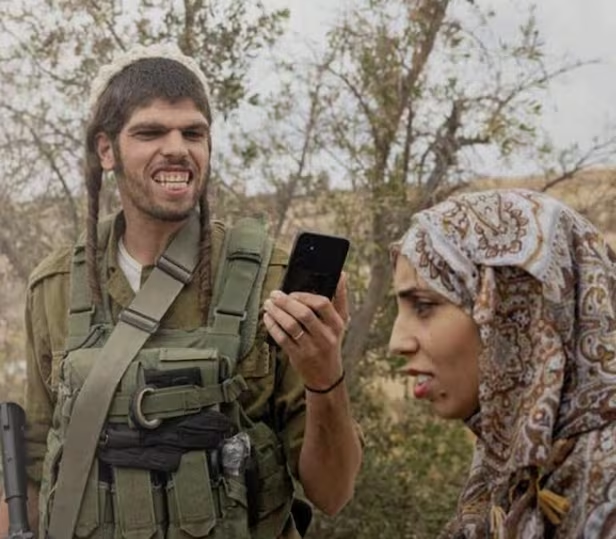

An Italian weekly publication has come under intense scrutiny after releasing a cover image that ignited widespread backlash and political debate.
The disputed visual appeared on April 10 in L’Espresso, accompanied by the headline “L’Abuso” (translated as Abuse). The image portrays an armed Israeli individual aiming a mobile phone at a visibly distressed Palestinian woman. The contrast between the man’s exaggerated grin and the woman’s fearful expression has been widely discussed, with many interpreting it as a stark and unsettling representation of power imbalance.
Beneath the image, a caption outlines accusations tied to regional developments, referencing the annexation of the West Bank, destruction in Gaza, expansion toward Lebanon, alleged border violations in Syria, tensions with Iran, and claims of ethnic cleansing and violence. The wording suggests a broader critique of policies associated with Israel’s right-wing political direction and its vision of what it describes as a “Greater Israel.”
According to the publication, the photograph was captured in October of the previous year in the West Bank—an area under Israeli control. The editorial explanation framed the image as a depiction of everyday hardships faced by individuals living under occupation, emphasizing the notion of persistent pressure and instability experienced by local populations.
The response from Israeli officials was swift and critical. Representatives argued that the image presents a distorted narrative and contributes to harmful generalizations. Diplomatic voices stressed that such portrayals fail to reflect the complexity of the ongoing conflict and risk encouraging bias. Concerns were also raised about the ethical responsibility of media organizations to maintain balance and accuracy when addressing sensitive geopolitical issues.
Additional criticism emerged from commentators who questioned the authenticity and context of the image. Some suggested the visual resembled propagandistic material and called for greater transparency regarding its origin. Doubts were also expressed about the appearance and attire of the individual depicted, with claims that certain elements did not align with standard Israeli military representation.
In response to these allegations, the magazine issued a formal clarification, asserting that the photograph is genuine and not generated through artificial intelligence. The image was credited to photographer Pietro Masturzo.
Masturzo publicly defended his work, explaining that the photo was taken on October 12 in the village of Idhna, situated in the Hebron Governorate. He described the circumstances surrounding the shot, stating that the day coincided with the beginning of the olive harvest—a time traditionally associated with community activity. However, he recounted that armed settlers arrived unexpectedly and disrupted the process, preventing Palestinian residents from collecting olives. He further described behavior he characterized as dehumanizing, noting that the individual in the image acted in a manner he likened to herding animals.
The Palestinian diplomatic mission in Italy supported this account, indicating that they had verified the incident by contacting the woman featured in the image, identified as Mayaad. According to their statement, she confirmed the photograph captured a moment of direct intimidation. Officials emphasized that the scene represents only a small portion of a broader pattern of challenges faced by residents in the area.
At the core of this controversy lies the longstanding issue of Israeli settlements in the West Bank. Since the Six-Day War, settlement expansion has continued to reshape the region. This development has led to repeated displacement of Palestinian communities, limiting access to land, housing, and essential resources. In certain regions, ongoing tensions and security measures have disrupted traditional livelihoods, particularly in agriculture.
The international community has consistently raised concerns over these activities. The United Nations Security Council adopted Resolution 2334, urging a halt to settlement expansion. Furthermore, the International Court of Justice issued a 2024 ruling declaring such policies inconsistent with international law. Despite this, Israeli authorities continue to describe the West Bank as a disputed territory rather than an occupied one, framing their actions within the context of national security and historical claims.
This incident highlights the powerful role of media imagery in shaping global narratives, especially in deeply complex conflicts. It also underscores the ongoing tension between freedom of expression, journalistic responsibility, and political sensitivity in international reporting.
Kindly Share:

Discover more from LMSINT MEDIA
Subscribe to get the latest posts sent to your email.