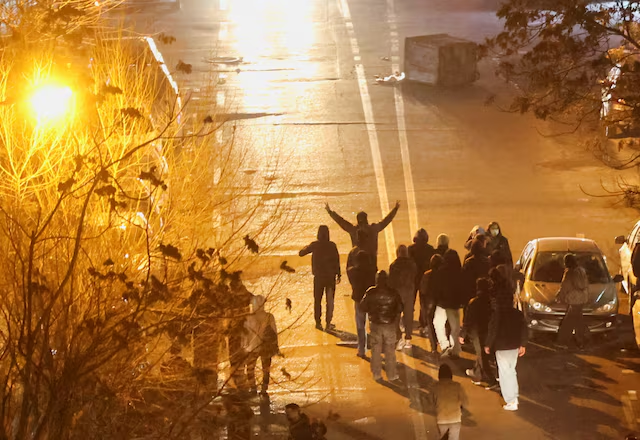
Despite months of nationwide demonstrations and mounting international pressure, Iran’s clerical leadership shows no sign of losing its grip on power. Analysts say the Islamic Republic’s security forces remain cohesive, preventing cracks in a government widely regarded as one of the most resilient in the Middle East.
Massive Unrest Yet No Defections at the Top
U.S. President Donald Trump has repeatedly threatened military intervention in response to Iran’s crackdown, adding external pressure to an already volatile situation. However, diplomats and regional analysts suggest that without defections among Iran’s elite security forces, foreign influence alone is unlikely to topple the regime.
A Robust Security Apparatus
Iran’s multi-layered security structure, centered on the Revolutionary Guards and Basij paramilitary forces—collectively numbering close to one million personnel—makes the state remarkably resilient. Vali Nasr, an Iranian-American scholar specializing in Middle East conflicts, explains:
“For this sort of regime change to succeed, street protests must persist over a long period, and segments of the state, particularly the security forces, would need to break ranks.”
Deepening Economic and Strategic Pressures
While survival is evident, stability is far from guaranteed. The Islamic Republic faces one of its most serious crises since its founding in 1979. International sanctions continue to strangle Iran’s economy, with no clear pathway for recovery. Militarily and strategically, the country faces significant constraints: its nuclear program has been damaged by foreign actions, and its network of regional proxies—commonly referred to as the “Axis of Resistance”—has weakened following heavy losses in Lebanon, Syria, and Gaza.
Protests that began on December 28 over rising prices have transformed into a broad critique of clerical rule, further eroding public legitimacy. According to HRANA, 503 protesters and 69 security personnel have been confirmed dead, with over 10,000 arrests nationwide. Analysts emphasize that while the Islamic Republic is not yet at the “moment of fall,” it is navigating an unprecedented period of difficulty and uncertainty.
Looking Ahead
Observers warn that Iran’s survival does not equate to long-term stability. For the regime to maintain power, the protests would need to lose momentum while the clerical leadership continues to leverage its entrenched institutions and loyalist security forces. The situation remains fluid, with the potential for significant domestic and regional repercussions depending on how both protesters and foreign powers respond in the coming months.
Kindly Share:

Discover more from LMSINT STORE
Subscribe to get the latest posts sent to your email.


