Dangote Refinery and the Power of Entrepreneurship in Driving Private Sector Transformation

The story of the Dangote Refinery and Petrochemicals (popularly known as the Dangote Refinery) is not just about building Africa’s largest refinery—it is a case study on the unmatched strength of entrepreneurship and private sector innovation. Austrian economist Joseph Schumpeter (1883–1950) once defined entrepreneurship with two enduring statements: Schumpeter was more than a capitalist theorist; he was a versatile economist grounded in sociology, political theory, and philosophy. His insights highlight that entrepreneurs are the true drivers of change and innovation in any economy. Global Innovators and Africa’s Leading Example Across the world, names like Bill Gates, who transformed digital technology with Windows 95, and Elon Musk, who continues to reshape multiple industries, are synonymous with innovation. In Africa, Aliko Dangote represents this spirit of entrepreneurship. His bold investments and ventures into industries others considered impossible have positioned him as a pioneer who inspires emerging African entrepreneurs. Dangote’s milestones include: His efforts demonstrate how entrepreneurship can reshape industries, create jobs, and drive national self-sufficiency. Dangote Refinery: Facts and Scale According to data from Dangote Industries, the refinery’s scale is monumental: Notably, the refinery has also pioneered local production of aviation fuel—something Nigeria’s state-owned refineries under the NNPC failed to achieve in over four decades. Private Enterprise vs. Public Sector Performance The success of the Dangote Refinery underscores a critical truth: private enterprise is more efficient than government-owned corporations. Unlike the four NNPC refineries, which remain inactive despite decades of investment, Dangote’s private initiative has delivered results. His achievement demonstrates the private sector’s ability to mobilize capital, manage risks, and complete mega-projects with value for money and within timelines. This efficiency has far-reaching implications. For instance, President Bola Ahmed Tinubu’s economic reforms—including the removal of fuel subsidies and the floating of the naira—would have caused unbearable fuel costs and greater naira depreciation without the stabilizing effect of local refining. Thus, the refinery indirectly provides a buffer against economic hardship and political instability. Lessons for Nigeria: Privatisation as a Path to Growth The contrast between Dangote’s refinery and NNPC’s failures makes a compelling case for privatisation of government enterprises. As NNPC Limited’s Group CEO, Bayo Ojulari, highlighted in a Bloomberg interview, government should step aside where private operators excel. Global precedents support this stance: Nigeria can learn from these models by fully embracing private enterprise across critical sectors like power generation, steel, and petroleum. The Future: Innovation and Private Sector as Catalysts The global economy is entering an era shaped by climate change, clean energy, artificial intelligence, and smart technologies. For Nigeria to build a $1 trillion economy, government must empower the private sector to drive industrial transformation, job creation, and poverty reduction. The Dangote Refinery stands as proof that when private initiative is unleashed, it delivers not only industrial breakthroughs but also economic resilience for entire nations.

Peter Ameh Criticizes Tinubu’s Economic Policies: A Two-Year Review

Peter Ameh, National Secretary of the Coalition of United Political Parties (CUPP), has openly criticized President Bola Tinubu’s administration, asserting that the President has dismantled the nation’s economic foundations within his two-year tenure. In a recent interview on Arise News, Ameh expressed concern over the abrupt removal of fuel subsidies, labeling the decision as insensitive and lacking foresight. He emphasized that such a significant policy shift should have been accompanied by a comprehensive plan to mitigate its impact on the populace. “The removal of the fuel subsidy without a clear policy direction has led to unprecedented hardship,” Ameh stated. He highlighted the surge in fuel prices from N197 to approximately N1,000 per liter, attributing this spike to the government’s hasty actions. Ameh also questioned the ruling party’s awareness of the citizens’ struggles, suggesting that they might be disconnected from the realities on the ground. He pointed out that the liberal economic policies adopted have disproportionately affected the underprivileged, leading to increased transportation costs and inflation. Furthermore, Ameh criticized the administration’s failure to implement its promises, such as cultivating 500,000 hectares of land to boost agriculture. He argued that the lack of a structured approach to policy implementation has exacerbated the nation’s economic woes. In conclusion, Ameh called for a more thoughtful and inclusive approach to governance, urging the administration to consider the plight of ordinary Nigerians in its policy decisions.

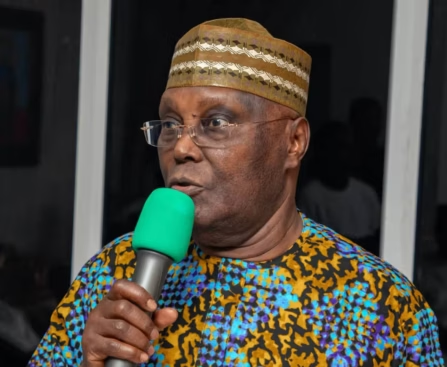
Atiku Abubakar: The Political Leader Nigeria Needs – PDP Chieftain, Adewale

Segun Adewale, a prominent figure within the Peoples Democratic Party (PDP) and former Lagos State chairman, has described former Vice-President Atiku Abubakar as the “messiah” Nigeria urgently needs to resolve its economic challenges. In a recent interview with the News Agency of Nigeria (NAN) in Lagos, Adewale firmly stated that Abubakar should not be dismissed politically or asked to leave the PDP. He expressed that critics of Abubakar’s presidential aspirations, including former PDP Deputy National Chairman Chief Olabode George and former Ekiti State Governor Ayo Fayose, were wrong in advising the ex-VP not to run on the PDP platform in 2027. George had recently called for Abubakar’s immediate resignation from the PDP, accusing him of anti-party activities, while Fayose has declared that he would work against Abubakar’s presidential ambition if he chooses to contest in 2027. However, Adewale, popularly known as Aeroland, countered these claims, asserting that Abubakar’s political journey should not be dictated by anyone. According to Adewale, Abubakar’s dedication to Nigeria and his extensive experience in governance make him a crucial figure for the country’s future. “He has been tested and tried and remains one of the few politicians who are content with their accomplishments, never motivated by the desire for wealth,” Adewale noted. He further criticized other politicians who, in his view, seek power for personal gain rather than the betterment of the nation. Adewale lamented the opposition within the PDP itself, with members of the party working against Abubakar’s coalition efforts to challenge the ruling All Progressives Congress (APC) and reclaim power for the PDP. “Anyone in the PDP opposing Atiku’s 2027 presidential bid is working against the party and Nigeria. They are driven by personal interest, not the country’s welfare,” Adewale emphasized. He also stated that no opposition party, including the Labour Party’s Peter Obi, could defeat the APC on its own, calling for a significant overhaul of Nigeria’s electoral system to strengthen democracy. Adewale recalled his personal experience with alleged electoral injustices in Lagos, highlighting the flaws in the current system. “The issue is not about individual popularity or intelligence; it’s about the system. We need to work together to fix the system before the 2027 elections,” Adewale stressed. He concluded by pointing out that Nigerians are tired of poor governance and are calling for change and a fresh approach. Atiku Abubakar’s political journey BUY ANYTHING ON KONG BUY NOW Follow the LMSINT MEDIA channel on WhatsApp: Join Our WhatsApp Group Hear: Chat on WhatsApp Join our Telegram Channel

Nigeria Regressing Under Tinubu’s Leadership – El-Rufai Raises Concerns

El-Rufai Challenges Tinubu’s Administration Nasir El-Rufai, former governor of Kaduna State and a senior figure within the Social Democratic Party (SDP), has openly criticized the administration of President Bola Ahmed Tinubu. In an interview conducted by Deutsche Welle Hausa, El-Rufai claimed that Nigeria has been on a downward spiral since Tinubu assumed office in 2023. This statement comes amidst growing dissatisfaction from citizens regarding security concerns, economic hardship, and claims of nepotism in federal appointments. El-Rufai’s Key Claims Against Tinubu’s Government Speaking from Katsina, El-Rufai lamented that Nigeria has deteriorated in major areas, including: Increased Insecurity He alleged that cases of violence, terrorism, and banditry have worsened since Tinubu’s swearing-in. The once marginal improvements made under previous governments have reportedly eroded. Economic Decline The former governor criticized Tinubu’s economic policies, asserting that they have led to a significant drop in living standards. According to him, many well-to-do Nigerians are now struggling to survive. Learn more about how fuel subsidy removal impacts Nigeria’s economy. Favoritism in Appointments El-Rufai also accused the president of prioritizing tribal and personal relationships over national unity in his selection of public officials. He claimed that appointments are largely given to individuals from the president’s ethnic group or close circle. “You may deny it, but Nigerians see it clearly. If your name isn’t recognizable or you’re from the ‘wrong’ region, you’re unlikely to be appointed,” El-Rufai said. Context: El-Rufai’s Fallout With APC El-Rufai, once a prominent member of the All Progressives Congress (APC), appears to have distanced himself from the party’s leadership and direction. His current role in the SDP highlights a growing divide within Nigeria’s political elite. This is not the first time El-Rufai has spoken critically of the APC. In the past, he has voiced concerns over the party’s deviation from its founding vision. Read more on APC’s founding goals on the Premium Times Nigeria. Conclusion: A Call for Reflection and Reform El-Rufai’s comments reflect widespread public sentiment in Nigeria—a deepening frustration over rising living costs, insecurity, and perceived injustice. Whether one agrees or not, the allegations underscore the urgent need for transparent governance and inclusive leadership in Africa’s most populous country. BUY ANYTHING ON KONGA BUY NOW READ ALSO: Follow the LMSINT MEDIA channel on WhatsApp: Join Our WhatsApp Group Hear: Chat on WhatsApp Join our Telegram Channel

Made-in-Aba Products Gain National Respect – Former President Goodluck Jonathan

The Rise of Aba-Made Goods in Nigeria Former Nigerian President, Goodluck Jonathan, has praised the evolving reputation of Aba-made products, noting that what was once a source of ridicule has now become a mark of quality and innovation. Speaking during the University of Port Harcourt (Uniport) 1980s Alumni Reunion and Award Ceremony held in Umuahia, Jonathan—represented by Ambassador Godknows Igali—highlighted the rapid growth and rising credibility of locally manufactured goods from Aba, thanks to strategic governance in Abia State. Governor Alex Otti’s Leadership and Impact According to Jonathan, the narrative shift surrounding Aba’s manufacturing sector is a direct result of Governor Alex Otti’s intentional leadership and commitment to development. “The presence of Alex Otti in Abia State shows intentionality in leadership,” Jonathan stated. “He came prepared. Before now, anything labeled ‘Aba-made’ used to be laughed at. But today, people are scrambling for them.” This transformation is not only improving Abia State’s economic landscape but also repositioning it as a major contributor to Nigeria’s local manufacturing growth. For context on how leadership can impact regional economic development, check this World Bank report on economic governance and local production. University of Port Harcourt’s Alumni Pride The former president further emphasized the accomplishments of the University of Port Harcourt, proudly noting that it remains the only Nigerian institution to have produced six state governors, a vice president, and a president. Appreciation from Governor Otti Governor Alex Otti expressed gratitude to the Uniport Alumni Association for choosing Abia State for their reunion and for taking the time to visit various ongoing projects within the state. He reiterated his administration’s dedication to transforming the state through infrastructural development and industrial support. “We’re focused on rebuilding and restoring confidence in locally-made goods,” Otti said. For more updates on Abia State projects, visit the official Abia State Government website. Dignitaries in Attendance The event saw the presence of several prominent figures, including: Why This Matters The renewed credibility of Aba products is more than just a local win—it signals a broader acceptance of made-in-Nigeria goods, which can reduce import dependency and stimulate the national economy. This development reflects the power of visionary leadership and focused governance in shifting public perception and enhancing regional productivity. For more related stories on leadership and economic transformation, check our article on The Role of Leadership in Reviving Local Economies. READ ALSO: Follow the LMSINT MEDIA channel on WhatsApp: Join Our WhatsApp Group Hear: Chat on WhatsApp Join our Telegram Channel

Reno Omokri Fires Back at Peter Obi’s ‘Nigeria Collapse’ Statement

Omokri Says Obi’s Political Career Is What’s Truly Falling Apart In a heated political exchange, Reno Omokri, a vocal advocate for President Bola Tinubu, has criticized Peter Obi, the 2023 presidential candidate of the Labour Party (LP), for claiming that Nigeria is collapsing under the current administration. Omokri argued that it’s not the nation but Obi’s presidential ambition that is crumbling. “No Bitter Obi, Nigeria is not collapsing. Instead, we are expanding,” Omokri posted on X (formerly Twitter). Peter Obi’s Visit to INEC Sparks Controversy Obi’s visit to the Independent National Electoral Commission (INEC) headquarters, alongside Governor Alex Otti of Abia State and some factional LP members, aimed to submit the Supreme Court ruling that removed Julius Abure as the party’s national chairman. Prior to the visit, Obi had declared during an LP National Executive Committee (NEC) meeting that Nigeria was on the verge of collapse and required urgent rescue efforts. Omokri’s Response: Nigeria Is Expanding, Not Collapsing Reno Omokri challenged Obi’s narrative, pointing to several economic indicators as evidence of national progress under Tinubu’s leadership. Here are key highlights from his argument: 1. Record Surplus by the Central Bank of Nigeria (CBN) According to Omokri, the CBN recorded a $6.89 billion surplus, a stark contrast to the $2 billion quarterly deficit reported during the Buhari administration.? Related: Understanding Nigeria’s CBN Surplus – BusinessDay 2. GDP Growth Surpasses US and UK He noted that Nigeria’s GDP rose by 3.84% in 2024, outperforming economies like the United States and the United Kingdom.? Long-tail Focus Keyword: Nigeria GDP growth under Tinubu 2024 3. Lagos State’s Economic Boom Under Tinubu’s governance, Lagos State’s economy surged from $100 billion to $259 billion, despite criticism from some economic commentators.? Image Keyphrase: Lagos economy growth under Tinubu 4. Inflation Drops as Fuel Subsidy Removed The removal of fuel subsidies, Naira flotation, and a decline in national debt led to a significant drop in inflation—from 34.80% to 24.48% by February 2025.? Long-tail Focus Keyword: inflation rate in Nigeria 2025 Tinubu effect 5. Increased Allocation for Anambra State Omokri added that Obi’s home state, Anambra, now receives three times more federal allocation compared to the Buhari era. Final Blow: Omokri Questions Obi’s Political Stability In a sharp closing statement, Omokri implied that even Peter Obi is personally benefiting from Tinubu’s economic reforms. He referenced a threefold increase in the value of Obi’s shares in an unnamed bank, stating that Obi is “richer because of Tinubu.” “In conclusion, Peteru, the only thing that has collapsed is your Presidential ambition,” Omokri declared. What This Means for Nigeria’s Political Landscape This back-and-forth highlights the intensifying political tensions as Nigeria continues to adjust under Tinubu’s administration. With increasing economic indicators suggesting progress, debates over governance effectiveness are likely to continue. Read Also: How Tinubu’s Reforms Are Reshaping the Economy Explore our latest post on how Nigeria’s inflation rate affects everyday citizens Conclusion:While Peter Obi insists on the narrative of national collapse, Omokri counters with statistics and economic data pointing to growth. The political rivalry continues to shape Nigeria’s future as both camps remain steadfast in their beliefs. READ ALSO: Follow the LMSINT MEDIA channel on WhatsApp: Join Our WhatsApp Group Hear: Chat on WhatsApp Join our Telegram Channel

Creative Sector to Generate $25bn – Cardoso

The governor of the Central Bank of Nigeria (CBN), Olayemi Cardoso, has projected that Nigeria’s creative sector could generate up to $25 billion, following the completion of the National Arts Theater (NAT) upgrade. This historic edifice, refurbished by the Bankers Committee, is expected to serve as a major catalyst for economic growth through the creative industry. The Economic Impact of the National Arts Theater Upgrade Cardoso emphasized the significant economic potential of the creative sector during a tour of the renovated NAT. He highlighted how the theater could trigger collaborations that would further strengthen Nigeria’s economy. “It is estimated that the creative sector can potentially generate about $25 billion. The prosperity of the creatives will serve as a powerful signal for collaboration opportunities. Once something like this is successful, others will take a cue, and it will speak for itself,” Cardoso stated. The CBN governor also praised the partnership between the private and public sectors, noting that the collaboration, combined with the spirit of the Nigerian people, could elevate the nation’s creative industry to new heights. The Legacy of the National Arts Theater Reflecting on the history of the NAT, Cardoso recalled its significance during the 1977 FESTAC event. He expressed pride in the theater’s transformation from a state of disrepair to a world-class structure. He added, “For me as a Lagosian, I saw this in 1977 when we had FESTAC. Sadly, due to lack of maintenance, the iconic edifice fell into disrepair. To witness this massive transformation to a world-class structure is a testament to the Nigerian spirit.” A Bright Future for Nigeria’s Creative Industry Cardoso believes the revamped theater will provide a professional home for creatives and enhance the industry’s potential. The initiative showcases the dedication and commitment of the sponsors and the Nigerian people to preserve history and culture. For more insights on the impact of the creative industry on Nigeria’s economy, visit The Guardian Nigeria READ ALSO: Follow the LMSINT MEDIA channel on WhatsApp: Join Our WhatsApp Group Hear: Chat on WhatsApp Join our Telegram Channel

Lagos Rent Crisis: Rising Costs Push Residents to the Brink

Lagos, Nigeria’s economic hub, is facing an unprecedented rent crisis, with both high-end and affordable housing experiencing sharp increases in rental costs. The situation is exacerbating economic hardships for residents, impacting families, businesses, and commuting patterns across the city. Housing Shortage and Economic Reforms Driving Rent Increases Lagos has long struggled with a housing deficit, and despite government assurances, the problem persists. The removal of fuel subsidies and the floating of the naira have further strained household budgets, forcing many tenants to reconsider their living arrangements. With a population exceeding 20 million and an influx of about 3,000 new residents daily, demand for housing continues to outstrip supply. As landlords grapple with inflationary pressures, they pass increased costs onto renters, leading to skyrocketing lease prices. The impact is felt both in high-end locations like Victoria Island and in more affordable mainland areas. Tenants Struggle Amid Drastic Rent Hikes Yemisi Odusanya, a cookbook author, faced a staggering 120% rent increase in Lekki, leaving her with few affordable options. Similarly, Bartholomew Idowu, a transportation worker, saw his annual rent surge from ₦350,000 ($232) to ₦450,000, prompting him to consider relocating despite uncertainty over his next move. Personal trainer Jimoh Saheed was forced out of his Ikoyi apartment after his landlord doubled the rent to ₦2.5 million per year. His relocation to the mainland increased commuting expenses and disrupted his children’s education. Legal experts emphasize that rental increments should be subject to negotiations, but many landlords impose arbitrary hikes without recourse. Attorney Valerian Nwadike highlights a rise in landlord-tenant disputes, although legal enforcement remains weak without lawsuits. Lagos’ Real Estate Market: A Divide Between Luxury and Affordability Lagos’ real estate development continues at a rapid pace, but much of the new housing stock caters to high-income earners, including expatriates and oil industry professionals. Economist Steve Onyeiwu explains that this bifurcated market prevents luxury housing supply from benefiting lower-income residents. Meanwhile, property developers face bureaucratic hurdles, and high mortgage interest rates put homeownership out of reach for most Nigerians. Many landlords also deal with dollar-denominated expenses, pushing them to increase rents dramatically to compensate for the naira’s depreciation. Future Outlook: Solutions to Alleviate Housing Costs While government economic reforms aim to stabilize the economy in the long term, immediate relief for renters remains uncertain. Improved public transportation, including the new Lagos-Ibadan rail line, may help reduce housing pressures in central areas by enabling more residents to live farther from the city center. Real estate agents report rental spikes of up to 200% in prime locations, reinforcing the urgent need for comprehensive housing policies. As noted by Ismail Oriyomi Akinola, “Access to decent shelter is essential, not just for the wealthy but for all Lagosians.” : Nigeria’s Economic Outlook 2024 READ ALSO: Follow the LMSINT MEDIA channel on WhatsApp: Join Our WhatsApp Group Hear: Chat on WhatsApp Join our Telegram Channel

Bismarck Rewane, CBN’s Forex Policies, and the Naira’s Stability

Bismarck Rewane, the highly regarded CEO of Financial Derivatives Company, is well known for his expertise in economic analysis. His insights are frequently sought after by leading media platforms. However, as seen in recent events, his statements can sometimes be taken out of context or misrepresented, leading to public misinterpretation. In a recent appearance on Channels Television, Rewane provided an in-depth assessment of the ongoing improvements in the Nigerian naira’s stability. Unfortunately, many newspapers presented selective interpretations of his statements, potentially misinforming their readers. Media Misrepresentation and Selective Reporting One of the headlines from a major publication read: “Naira’s Rally is Temporary, Don’t Get Carried Away—Rewane Warns.” The article quoted him as stating, “We’re seeing that the naira is strengthening but with caution. Let’s not be too hasty because it’s going to correct itself…” This was followed by details on Nigeria’s forex reserves and external borrowings. Another publication on Monday ran a front-page story titled: “How FG Spent $8bn to Support Naira – Rewane.” The article claimed that the government had expended approximately $8 billion to stabilize the naira, attributing this statement to Rewane without adequate context. To balance its report, the newspaper attempted to reach out to the Central Bank of Nigeria (CBN) spokesperson, Mrs. Hakama Sidi Ali, but was unsuccessful. Presidential Special Adviser Bayo Onanuga dismissed the claim, labeling it inaccurate. CBN’s Commitment to Forex Stability Despite media sensationalism, CBN’s forex policies under Governor Olayemi Cardoso have been instrumental in strengthening Nigeria’s financial sector. Since 2023, the central bank has initiated reforms aimed at: One of the most significant initiatives is the Nigeria Foreign Exchange Code (FX Code), designed to uphold transparency, fairness, and efficiency in forex transactions. Rewane’s Clarification on Naira’s Valuation Rewane, known for his data-driven approach, clarified his stance during an interview on Arise TV. He emphasized that the naira’s recent appreciation was not solely due to direct CBN interventions but rather a combination of policy-driven improvements. His analysis highlighted key indicators such as: Additionally, Rewane explained that the Purchasing Power Parity (PPP) analysis placed the naira’s fair value at ₦1,102.15/$, indicating a 26.35% undervaluation. While market interventions can distort an overvalued currency, supporting an undervalued one helps correct misalignment. Strengthening Economic Policies for Sustainable Growth Increased synergy between Nigeria’s monetary and fiscal authorities continues to drive economic stability. At the recent Monetary Policy Forum, organized by CBN, discussions centered on achieving price stability and long-term economic growth. Rewane’s insights reinforce the importance of data-driven policy implementation. As Nigeria moves forward, CBN’s continuous efforts in forex management and financial reforms will play a crucial role in ensuring the naira’s stability and economic sustainability. Conclusion While media narratives can sometimes misrepresent statements, it is essential to rely on verified economic analyses. Rewane’s evaluation underscores that CBN’s forex policies are yielding positive outcomes, positioning the naira for long-term stability. As the financial landscape evolves, continued policy refinement will be key to maintaining economic resilience. READ ALSO: Follow the LMSINT MEDIA channel on WhatsApp: Join Our WhatsApp Group Hear: Chat on WhatsApp Join our Telegram Channel

2027: The North Faces an Uphill Battle Against Tinubu (Part I)

As Nigeria inches closer to the second anniversary of the 2023 elections, the political landscape is already heating up with speculations and maneuvers for 2027. Politicians and citizens alike are beginning to shift their focus toward the next presidential race, a testament to the dynamic nature of democracy. Northern Political Divide Over Tinubu’s Second Term Recent statements from key Northern politicians and activists reveal a growing opposition to President Bola Tinubu’s potential re-election. However, the North, particularly its politically dominant Muslim bloc, remains deeply divided on the matter. In 2023, this same faction, alongside the South West, played a crucial role in Tinubu’s electoral victory. Now, discontent is brewing due to economic hardship, escalating insecurity, and perceived nepotism under his administration. Adding fuel to the fire, Tinubu’s ambitious tax reforms, especially the VAT derivation policy favoring revenue-generating states, have sparked tensions with many Northern leaders. The resistance is evident across party lines, with some openly threatening to use the North’s electoral power against Tinubu in 2027. Bala Mohammed: A Potential Challenger or a Deal Maker? Among those leading the charge is Governor Bala Mohammed of Bauchi State, the Chairman of the PDP Governors’ Forum. He recently warned that the North would show Tinubu their “hue” in the next election. Bala, who contested the PDP presidential primaries in 2022 before securing his second-term governorship ticket, is widely believed to be positioning himself as the North’s main contender against Tinubu. However, Bala’s political history suggests he is also a shrewd negotiator. As a former ANPP Senator, he played a pivotal role in the Doctrine of Necessity, which allowed Goodluck Jonathan to assume the presidency after Umaru Yar’Adua’s death. Jonathan later rewarded him with the FCT Ministerial position. Bala’s track record of party-switching and backdoor negotiations raises the possibility that he may yet strike a deal with Tinubu before 2027, especially if political survival demands it. Yerima Shettima: A Noisemaker Without Electoral Influence In stark contrast to Bala Mohammed, Yerima Shettima, leader of the Coalition of Northern Groups (CNG) and the Arewa Youths Consultative Forum (AYCF), lacks any real political influence but continues to stoke regional sentiments. His history of controversial outbursts, including the infamous 2017 “Igbo quit notice”, has earned him notoriety rather than respect. Despite sharing a last name with Vice President Kashim Shettima, Yerima has no significant political standing. His inflammatory rhetoric against the Igbo, including a leaked conversation with former Ogun Governor Ibikunle Amosun, has only fueled ethnic divisions rather than contributed to any meaningful national discourse. Unlike leaders who actively seek solutions to the North’s challenges—such as poverty, insecurity, and the almajiri crisis—Yerima thrives on regional antagonism and should not be taken seriously. The Reality of Power in Nigeria Contrary to claims that the North can singlehandedly unseat Tinubu, Nigerian democracy necessitates strategic alliances. Even during the military era, power transitions required broad-based support. Today, a Northern candidate must forge coalitions with major voting blocs, such as the South West, South East, or South-South, to pose a real challenge. Moreover, ousting an incumbent president in Nigeria’s political landscape is an uphill battle. Unless there is a national crisis or a widespread loss of confidence, the sitting president enjoys a significant advantage. Tinubu, despite his governance challenges, is unlikely to relinquish his second-term bid without a fierce fight. In the second part of this analysis, we will explore further political dynamics and conditions that could influence the 2027 elections. READ ALSO: Follow the LMSINT MEDIA channel on WhatsApp: Join Our WhatsApp Group Hear: Chat on WhatsApp Join our Telegram Chanel.

Nigeria Boasts Over a Billion Barrels of Oil Reserves, Says Adewale Tinubu at WEF 2025

Exploring Nigeria’s Energy Potential Adewale Tinubu, Group Chief Executive of Oando Plc, has highlighted the transformative potential of Nigeria’s energy sector, emphasizing the role of indigenous energy companies in taking over divested assets from International Oil Companies (IOCs). Speaking at the prestigious World Economic Forum (WEF) in Davos, Switzerland, Tinubu revealed that Oando Plc is prepared to harness artificial intelligence (AI) and other advanced technologies to optimize its upcoming drilling campaigns. The goal? To tap into over 1 billion barrels of oil reserves effectively while strengthening decision-making and reducing exploration costs. Nigeria Shines at WEF 2025 The WEF, an exclusive gathering of world leaders, global executives, and non-governmental organizations, offered a platform for the Nigerian delegation to engage with global stakeholders. Key attendees from Nigeria included Vice President Kashim Shettima, Finance Minister Wale Edun, Industry and Trade Minister Jumoke Oduwole, and Adewale Tinubu himself. This meeting brought together leaders from business, academia, and civil society to address pressing global challenges and explore collaborative solutions. Unlocking Nigeria’s Untapped Energy Resources Tinubu shared insights on the Nigerian energy sector, emphasizing that indigenous energy companies are now at the forefront of driving innovation and efficiency in oil exploration. Oando Plc, one of the first Nigerian companies to successfully acquire an IOC’s onshore assets (AGIP), is well-positioned to unlock the sector’s full potential. “As a company, we have over a billion barrels of reserves, 300,000 barrels per day of processing capacity, and 2 billion cubic feet of daily gas capacity. The net present value of these assets exceeds $10 billion,” Tinubu stated. By leveraging local expertise, advanced technologies, and strategic partnerships, Nigerian firms like Oando are poised to accelerate resource extraction and maximize value from the nation’s abundant energy reserves. The Role of Government and Regulators Tinubu emphasized the critical need for government support and regulatory alignment to fully harness the potential of the oil and gas sector. This collaboration is key to addressing economic challenges, boosting foreign investment, and improving Nigeria’s balance of trade. “We need to increase exports significantly to strengthen the Naira and improve trade balances. The oil and gas industry offers the quickest route to achieving this,” he explained. A Just Energy Transition for Africa On the global front, Tinubu addressed the ongoing discussions about decarbonization and energy transition. He reiterated that Africa contributes minimally to global carbon emissions despite representing about 20% of the world’s population. Nevertheless, Oando Plc is committed to sustainability by integrating carbon capture technologies to reduce its carbon footprint. “We’re working to ensure that every molecule of carbon we emit is mitigated through effective carbon capture techniques,” Tinubu added. Conclusion Adewale Tinubu’s remarks at WEF underscore Nigeria’s immense energy potential and the transformative role of indigenous companies in driving economic growth and sustainability. By adopting advanced technologies, fostering government collaboration, and prioritizing environmental responsibility, Nigeria can position itself as a global energy leader. READ ALSO: Follow the LMSINT MEDIA channel on WhatsApp: Join Our WhatsApp Group Hear: Chat on WhatsApp Join our Telegram Chanel.

Telecom Tariff Hike: NLC Challenges FG Over Neglect of Citizens’ Welfare

The Nigeria Labour Congress (NLC) has condemned the Federal Government’s 50% telecom tariff hike, calling for a nationwide boycott and emphasizing its adverse impact on workers and citizens. Labour Union Threatens Nationwide Boycott to Resist Telecom Tariff Hike The Nigeria Labour Congress (NLC) has expressed strong disapproval of the Federal Government’s decision to approve a 50% increase in telecom tariffs. This move, which comes amidst widespread economic hardship, has been described as an unjustifiable burden on Nigerian workers and citizens. In a statement released by the NLC President, Comrade Joe Ajaero, the tariff hike, approved by the Nigerian Communications Commission (NCC), was criticized as a direct attack on workers’ welfare and a neglect of the masses’ needs in favor of corporate interests. A Call to Action: NLC Urges Nationwide Resistance Ajaero stressed the need for collective action, including the possibility of a nationwide boycott of telecommunication services, to compel the government to reverse the hike. “This increase undermines our dignity and survival as a people. We urge all Nigerians to join forces and reject this punitive hike that prioritizes corporate profits over citizens’ welfare.” Telecom Costs Strain Nigerian Workers The NLC revealed alarming statistics highlighting the hike’s impact on workers: The NLC insists telecommunication services are essential and must remain accessible. Ajaero criticized the government for showing urgency in approving the tariff hike while delaying decisions that benefit workers, such as the minimum wage increment. Questions of Accountability The NLC President raised critical questions regarding government priorities: Ajaero noted that while the NLC is not entirely against tariff reviews, the 50% increase is unreasonable and unacceptable. He urged the Federal Government, NCC, and National Assembly to suspend the implementation and engage in dialogue for a fair resolution. NLC’s Position: A Fight for Equality and Fairness The NLC reaffirmed its commitment to defending the interests of Nigerian workers and citizens. It pledged to resist policies that deepen poverty and inequality, emphasizing the importance of government accountability in protecting the rights and welfare of its people. “Together, we will fight this injustice and demand that the government aligns its policies with the interests of the people, not corporate elites.” READ ALSO: Follow the LMSINT MEDIA channel on WhatsApp: Join Our WhatsApp Group Hear: Chat on WhatsApp Join our Telegram Chanel.

Petrol Prices May Rise to N1,200 – Primate Ayodele Warns

Primate Elijah Ayodele, the leader of the INRI Evangelical Spiritual Church, has issued a stark warning to Nigerians and President Bola Tinubu’s administration regarding the worsening economic situation in the country. Speaking on Friday, Primate Ayodele cautioned that petrol prices, which recently dropped to N945 per litre, could surge to N1,200 per litre if pressing economic issues are not addressed promptly. The Warning In a statement released by his media aide, Oluwatosin Osho, Primate Ayodele highlighted the looming challenges facing the nation, predicting further increases in the cost of essential commodities. He urged the government to implement long-term solutions to alleviate the hardship that Nigerians are currently enduring. Commodities Becoming Unaffordable The cleric painted a grim picture of the future, stating that key staples and even spiritual items may soon be out of reach for the average citizen: Primate Ayodele attributed these projections to the government’s failure to take necessary steps, including reopening the country’s borders and investing in agricultural development. Criticism of Government Actions The prophet did not hold back in his critique of President Tinubu’s administration, particularly condemning the rice palliative program. According to Primate Ayodele, distributing rice through political channels does not address the root causes of poverty but instead fuels corruption. “The rice palliative is only encouraging corruption; it is not alleviating any hardship. Hardship isn’t from heaven but from the actions of those in power. Without urgent intervention, I foresee hardship worsening across all sectors,” he stated. Urgent Recommendations To combat the looming economic challenges, Primate Ayodele proposed the following measures: Call to Action Primate Ayodele warned that failure to act swiftly could result in dire consequences, including mass unrest. “If the government isn’t careful, people will start stoning them. This hardship is man-made, and only proactive measures can resolve it,” he warned. Conclusion The Nigerian government has been urged to take decisive action to avert a deeper economic crisis. As Primate Ayodele’s warnings resonate with the public, it remains to be seen whether President Tinubu’s administration will rise to the occasion and implement meaningful changes. Meta Description: Primate Ayodele warns of rising petrol prices, urging President Tinubu to address economic hardship in Nigeria. Learn about his predictions and proposed solutions. #NigerianEconomy #PetrolPriceHike READ ALSO: Follow the LMSINT MEDIA channel on WhatsApp: Join Our WhatsApp Group Hear: Chat on WhatsApp Join our Telegram Chanel.