It Will Strengthen Airlines — Oyedele Refutes Onyema’s Claims on New Aviation Tax Policies

The Chairman of the Presidential Fiscal Policy and Tax Reforms Committee, Taiwo Oyedele, has pushed back against claims made by the Chairman and Chief Executive Officer of Air Peace, Allen Onyema, regarding the impact of Nigeria’s newly introduced tax reforms on the aviation sector. Oyedele maintained that the revised tax framework is structured to ease operational pressure on airlines rather than damage the industry. Oyedele explained that the reforms are aimed at correcting deep-rooted fiscal problems that have affected airline operators for years. According to him, the new tax laws should not be linked to increasing airfare costs or projected shutdowns within the aviation space. This response followed Onyema’s comments during an interview on Arise Television on Sunday, where he warned that domestic airline operators might be forced out of business within a few months if the tax reforms, expected to commence on January 1, 2026, are implemented without further adjustments. During the interview, Onyema blamed high ticket prices on numerous taxes and statutory charges imposed on airlines. He specifically raised concerns about a 7.5 percent Value Added Tax (VAT) on airline tickets, suggesting that such charges could push economy-class fares to as much as ₦1.7 million, thereby limiting access to air travel for many Nigerians. Reacting to these assertions, Oyedele released a statement on X (formerly Twitter) on Monday, acknowledging the operational and financial struggles currently facing Nigeria’s aviation industry. However, he clarified that the federal government, through the Presidential Fiscal Policy and Tax Reforms Committee, has been in continuous discussions with airline operators to reduce cost pressures and introduce long-term relief measures. One of the most significant changes highlighted by Oyedele is the removal of the 10 percent withholding tax previously applied to aircraft leasing arrangements. He noted that this tax had been a major contributor to high operating expenses for airlines, particularly because it was non-recoverable under the old tax system. Under the new tax structure, the withholding tax on aircraft leases has been replaced with a rate that will be determined through regulation. This adjustment allows for the possibility of a full exemption or, at the very least, a substantial reduction, thereby lowering operational costs for airline operators. Oyedele further explained that the reforms will ensure full VAT neutrality for airlines. This means that airlines will be able to reclaim VAT paid on imported aircraft, locally sourced equipment, aviation fuel, consumables, and essential services. Such a system, he said, would prevent VAT from becoming a hidden cost within airline operations. Additionally, he disclosed that any excess input VAT incurred by airline operators would either be refunded within 30 days or credited against other tax obligations. This mechanism is expected to improve cash flow, enhance liquidity, and support sustainable airline operations. Oyedele emphasized that the tax reforms are designed to be part of the solution rather than the cause of the aviation sector’s challenges. He stressed that several long-standing tax-related cost drivers affecting the industry have either been eliminated or structurally addressed under the new tax laws. He reaffirmed the government’s recognition of the multiple taxes, levies, and regulatory charges confronting the aviation industry and assured stakeholders that ongoing engagements would continue to focus on easing these burdens and strengthening the sector.

US Airstrikes: Sheikh Gumi Says $2m Bomb Should Build Schools for Herdsmen

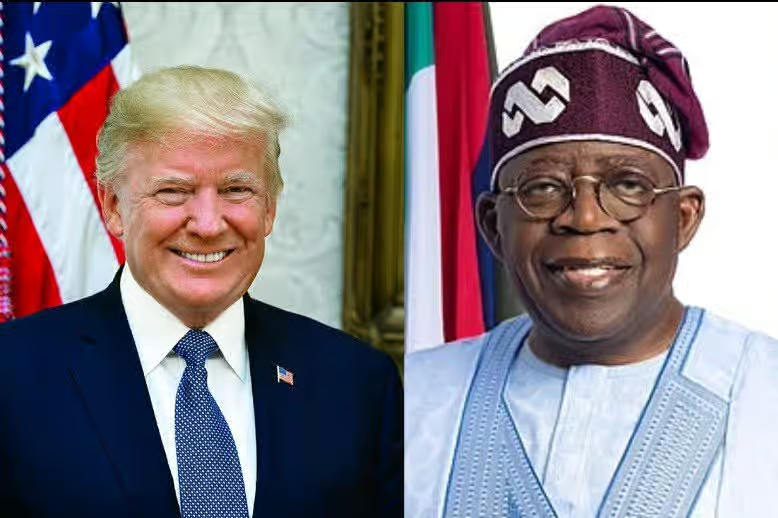
Popular Islamic scholar, Sheikh Ahmad Gumi, has openly criticized the United States government over its use of expensive military weapons, urging the country to focus on education and social development for herders rather than deploying multi-million-dollar bombs. According to the cleric, many herders are trapped in ignorance and require enlightenment, not violence. He argued that bombing communities does not solve the root problem, which he described as a lack of education and awareness. Sheikh Gumi made this statement while reacting to a viral video showing a Fulani herder who reportedly stumbled upon a barrel believed to be part of a missile fired during a U.S. military operation. The cleric expressed concern that the man in the video appeared unaware of the danger posed by unexploded military devices. Reacting publicly, Gumi explained that the herder’s actions reflected deep-rooted ignorance rather than intentional wrongdoing. He emphasized that such individuals often lack basic knowledge, including understanding religious principles and recognizing life-threatening hazards such as unexploded bombs. Taking to his official Facebook page, the cleric stated that most herders need deliverance from ignorance rather than bombardment. He added that the individual in the video neither understood the core teachings of Islam nor grasped the serious danger associated with unexploded military weapons lying in open fields. Gumi further revealed that his response to this long-standing issue has been to build schools and support educational initiatives for herders, stressing that education is a sustainable solution. He argued that the amount of money used to drop a single bomb—estimated at $2 million—could instead be channeled into constructing schools and providing basic amenities that would positively transform lives. The comments followed reports that on Christmas Day, the United States military, acting on the directive of President Donald Trump, conducted airstrikes in Sokoto State, Nigeria. The operation was reportedly aimed at neutralizing ISIS and Lakurawa terrorist groups, but the mission failed to hit its intended targets. The Nigerian government later confirmed the incident, describing it as a coordinated military operation. Authorities also disclosed that President Bola Ahmed Tinubu had approved the mission, emphasizing that it was carried out in collaboration with international partners. Despite the official explanation, Sheikh Gumi maintained that military force alone cannot address insecurity, insisting that education, awareness, and social development remain the most effective tools for lasting peace.

APC, PDP Clash Over N50 Billion Ibadan Explosion Relief Fund Utilisation

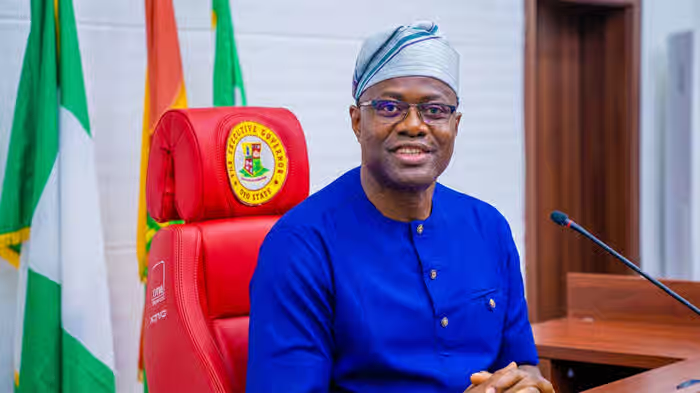
The political tension in Oyo State has intensified as the All Progressives Congress (APC) yesterday demanded that Governor Seyi Makinde provide a detailed account of how he managed the N50 billion relief fund allegedly received from President Bola Tinubu. The fund was intended to assist victims of the catastrophic explosion that devastated parts of Bodija GRA in Ibadan in January 2024. APC went further to assert that Governor Makinde should resign if he fails to account for the funds. The controversy resurfaced after former Ekiti State Governor, Ayodele Fayose, claimed during a live broadcast on Friday that Governor Makinde collected the N50 billion from President Tinubu to support those affected by the tragic incident. According to Fayose, Makinde neither acknowledged the receipt of the funds publicly nor utilised them to aid victims who lost lives and properties. Oyo APC, through its Publicity Secretary Olawale Sadare, condemned Governor Makinde for making disparaging comments about President Tinubu and his Minister of Power, Chief Adebayo Adelabu. During a recent media engagement, Makinde reportedly criticized the President for allegedly requesting that he organise the APC in the state and accused the Minister of Power of lacking capacity to deliver on his mandate. In response, Fayose released official documents to substantiate his claims, revealing that the N50 billion was approved as emergency financial support after the deadly explosion. Makinde had previously denied these allegations, challenging Fayose to provide proof of the funds’ disbursement. The released documents suggest that only N4.5 billion of the relief fund was distributed to the victims of the Bodija GRA explosion, while the remaining money was allegedly diverted to support Governor Makinde’s purported political ambitions, including plans for a presidential run. Fayose stated that he made the documents public to enable Nigerians to independently assess the credibility of the Oyo State government. He also invited Makinde to pursue legal action against him, maintaining that other financial aid sent by the Tinubu administration to Oyo State had not been publicly disclosed. However, the debate has also drawn reactions from within Governor Makinde’s party. A faction of the Peoples Democratic Party (PDP) in Oyo State, known as the Oyo PDP-Visionaries, criticized Fayose, labeling him “a disgrace to public service for failing to distinguish between a request and an approval.” The group issued a statement after Fayose published a letter allegedly showing Oyo State’s request for N50 billion for the reconstruction of the Dejo Oyelese/Adeyi Avenue area post-explosion. Qudus Olayide, coordinator of the Oyo PDP-Visionaries, criticized Fayose for attempting to justify his previous claims by presenting a Ministry of Finance document that merely reflected the state’s request for funds, not the actual approval or disbursement. The PDP faction described Fayose’s actions as shameful, stating that his attempt to mislead the public was both demeaning and concerning. They challenged him to release an authentic document showing the federal government’s approval of the N50 billion, insisting that the public deserves transparency regarding how emergency funds are allocated and utilised. This latest development highlights the ongoing political friction in Oyo State, as both APC and PDP continue to contest the narrative surrounding the relief funds meant for explosion victims. It also underscores broader concerns about accountability, transparency, and governance in the allocation of federal emergency support to states during crises.

Hunger, Not Money or Defections, Will Determine Tinubu’s 2027 Fate – PDP Chieftain

Niyi Aborisade, a human rights lawyer based in the United Kingdom and a prominent member of the Peoples Democratic Party (PDP), recently shared his insights on the current political landscape in Nigeria. In an exclusive conversation with ROTIMI AGBOLUAJE, he accused the ruling All Progressives Congress (APC) of deliberately instigating internal crises within opposition parties, aiming to weaken them ahead of the 2027 general elections. Concerns About the Opposition and PDP’s Future When asked about the challenges facing Nigeria’s opposition parties, particularly the PDP, Aborisade affirmed his commitment to the party but expressed deep concern over its present state. He stated, “I am still a registered and active member of the PDP. Yet, the current dynamics within the party make it extremely challenging to foresee its future.” He emphasized that political parties are meant to serve as vehicles for ideological expression, organizational cohesion, and the aggregation of collective interests. “Sadly, what we are seeing today is a PDP struggling to define its identity, maintain internal cohesion, and even protect its existence. For someone like me who strongly believes in opposition politics as a cornerstone of democracy, witnessing this decline is both troubling and painful.” Is the PDP Facing an Existential Crisis? Aborisade was cautious but realistic when discussing whether the PDP could survive its internal turmoil. He noted, “I am not claiming to predict the future. Politics is fluid, and unexpected turnarounds can occur. However, when evaluated objectively, the PDP faces an existential crisis.” Internal conflicts have reached unprecedented levels. Factions within the party have solidified, reconciliation attempts have repeatedly failed, and trust among party leaders is virtually nonexistent. “The uncertainty is so profound that many members, from grassroots operatives to senior leaders, are unsure if the PDP will be able to field candidates in upcoming elections,” Aborisade added. Such instability is lethal for any political organization. Without guaranteed participation in elections, a party cannot effectively mobilize members, raise funds, or inspire voter confidence. Aborisade warned that without urgent corrective measures, the PDP could face a structural collapse. Root Causes of the PDP Crisis Aborisade identified internal power struggles and personal ambition as the core drivers of the party’s crisis. He explained that some members prioritize individual gain over collective survival, seeing the PDP as a ladder for personal advancement rather than a platform for national service. “Once personal ambitions are threatened, some actors are willing to jeopardize the entire party. This is particularly tragic because mechanisms for conflict resolution were available. Even interventions by the Independent National Electoral Commission (INEC), including a roundtable discussion led by its chairman, failed to produce meaningful results. Instead of compromise, entrenched positions hardened further.” The conflict has escalated beyond party structures, reaching the Court of Appeal, and may eventually move to the Supreme Court. According to Aborisade, “Relying on prolonged litigation to determine a party’s fate is a dangerous gamble for anyone whose political career is tied to that platform.” How Can the PDP Salvage Its Situation? The PDP’s salvation, Aborisade believes, lies in genuine compromise. “Politics is negotiation, not warfare. For the PDP to survive, leaders must set aside ego, bitterness, and the desire to win every internal skirmish. Both sides must be willing to make concessions to save the party.” He added that no court judgment, media strategy, or propaganda campaign can replace internal reconciliation. Litigation may bring technical victories, but unity is achieved only through dialogue, concessions, and goodwill. Without such measures, the PDP will continue to decline, regardless of court orders or public statements. The Wike Saga: Suspension and Counter-Suspension The suspension and counter-suspension involving former Rivers State Governor Nyesom Wike, Aborisade argued, have turned into a political circus. “Certain party organs claim to have suspended Wike, while he claims to have suspended those who allegedly suspended him. Yet, he continues to consider himself a PDP member while actively undermining the party.” Wike’s reported parallel party structures, support for rival platforms, and threats of alternative conventions have created confusion both in Rivers State and nationally. “At this point, predicting who will prevail is nearly impossible. Beyond the drama, however, lies a deeper political dimension,” Aborisade noted. The Hidden Forces Behind the Crisis Aborisade invoked a Yoruba proverb to illustrate the situation: “The insect dancing on the surface of water is responding to the drummer beneath.” The visible actors may be obvious, but the true drivers of the crisis—the “drummers”—remain hidden yet powerful. He implied that forces beyond the PDP itself are sustaining the turmoil. When pressed about the identity of these forces, Aborisade pointed directly to the APC-led Federal Government and the Presidency. “The facts are telling: Wike is a serving minister under the APC government, Rivers State Governor Siminalayi Fubara has defected to the APC, and governors in Plateau and Taraba states have also abandoned the PDP for the APC.” This, he contends, suggests a deliberate effort by the ruling party to weaken opposition structures and consolidate power ahead of the 2027 elections.

FG Moves to Stabilize Markets Amid U.S. Airstrikes on Nigerian Soil

The recent U.S. military operations targeting alleged terrorist strongholds in Sokoto have propelled Nigeria into a sensitive stage of its counter-terrorism efforts. The strikes have sparked a robust debate on the balance between national sovereignty, governance gaps, and the appropriateness of foreign intervention in domestic security matters. Economic Repercussions and Government Response The implications extend far beyond security and politics. Investor confidence has been unsettled, prompting the Federal Government to act swiftly to reassure local and international markets that these operations will not compromise Nigeria’s economic stability or its ongoing reform programs. Officials emphasize that Nigeria remains committed to preserving its fiscal integrity and sustaining reforms aimed at attracting foreign investment. Support from Pan-Yoruba Coalition The Alliance for Yoruba Democratic Movements (AYDM), a coalition of approximately 130 pan-Yoruba organizations, praised the intervention as a necessary initiative to curtail the escalating threat of violent extremism. In a statement signed by General Secretary Popoola Ajayi and Rasaq Arogundade, the coalition encouraged Nigerian authorities to maintain intelligence-led cooperation with international allies, noting that combating terrorism effectively requires global partnerships. “We commend the actions against terrorists attempting to dominate Nigerian territories,” AYDM stated. “These measures highlight Nigeria’s progress in establishing impactful international partnerships. Yet, airstrikes alone will not resolve the crisis.” Calls for Arrest of Ideological Leaders AYDM also directed strong criticism at Islamic cleric Sheikh Ahmad Gumi, accusing him of being the intellectual architect behind extremist activities in the country. The coalition demanded his immediate arrest and indicated its intent to campaign both locally and internationally for his prosecution at the International Criminal Court (ICC). “Sheikh Gumi should face justice. He presents himself as an Islamic scholar but propagates terrorist ideology,” the group added, highlighting the urgency of holding ideological leaders accountable. Security Alert for South-West States The coalition issued warnings to governors in the South-West, emphasizing that retaliatory attacks from terrorist factions could shift toward the region. Lagos, as Nigeria’s commercial hub and President Bola Ahmed Tinubu’s political stronghold, was particularly highlighted as a potential target. Calls for Structural Reforms AYDM framed the rising Islamic extremism as a “violent clash of civilizations,” advocating for extensive constitutional reforms. The group proposed decentralization and restructuring of Nigeria to enable ethnic self-determination, allowing groups with differing governance philosophies—democratic versus theocratic—to coexist within their own sovereign regions. “It is time to restructure Nigeria so that communities valuing democracy and those favoring a theocratic framework can exist independently within their own sovereign republics,” the statement urged. Expanding Security Partnerships The coalition further recommended that Nigeria diversify its international security collaborations. Beyond the U.S., nations such as Russia and Israel—known for their counter-terrorism expertise—should be engaged to strengthen Nigeria’s security framework. “Nigeria requires all possible allies to combat terrorism effectively. Engaging Russia, given its counter-terrorism operations in the Sahel, is essential if Nigeria aims to confront these threats decisively,” AYDM emphasized. Criticism from Political Activists Contrastingly, Gbenga Hashim, a former presidential candidate and political activist, characterized the U.S. strikes as a damning critique of Nigeria’s security architecture. Hashim highlighted that the airstrikes reflect global concern over Nigeria’s deteriorating security environment, particularly in the North-West, where terrorist groups are allegedly expanding territorial influence. “The intervention by the United States is a stark indictment of our national security framework and the failures of the APC-led administration,” Hashim remarked, urging the government to strengthen domestic security operations to regain public and international confidence.

Train Derailment in Southern Mexico Leaves 13 Dead and Scores Injured

Asunción Ixtaltepec, Mexico – A tragic train accident occurred in southern Mexico on Sunday, claiming the lives of at least 13 people and injuring dozens more. The Interoceanic Train, which connects Oaxaca and Veracruz, partially derailed near a curve close to the town of Nizanda, according to officials. The train, carrying a total of 250 individuals—nine crew members and 241 passengers—went off the tracks in the early hours of the day. Mexican Navy authorities confirmed that 98 people sustained injuries in the accident. Sadly, 13 passengers lost their lives at the scene. Among those injured, 36 remained under medical care while the rest were reported to be stable. Mexican President Claudia Sheinbaum took to social media platform X (formerly Twitter) to share updates on the incident. She noted that at least five of the injured were in critical condition and emphasized the immediate deployment of the Mexican Navy and Civil Protection units to assist victims and their families. President Sheinbaum further stated that the Ministry of Interior was coordinating the overall emergency response and ensuring that affected individuals receive necessary support. Rescue operations were challenging, as emergency teams faced difficulties reaching the accident site due to the terrain. Local news outlet Uno Noticias Television reported that first responders were on-site but struggled with accessibility issues, delaying some of the rescue efforts. Authorities from Mexico’s Attorney General’s Office announced the initiation of a formal investigation to determine the exact cause of the derailment. Officials are examining whether track conditions, train maintenance, or operational errors contributed to the disaster. The Interoceanic Train has been a crucial transit link between Oaxaca and Veracruz, used by hundreds of passengers daily for both commuting and tourism. The derailment has raised concerns over railway safety standards in southern Mexico and has prompted calls for stricter oversight and safety protocols. Local communities and emergency responders continue to assist the victims, while national authorities work to stabilize the injured and support grieving families. The Mexican government has pledged to provide full assistance to those affected and to prevent similar incidents in the future.

Rhapsody of Realities December 29th, 2025, WE REIGN BY HIS RIGHTEOUSNESS

Pastor Chris Oyakhilome DSc DSc DD For if by one man’s offence death reigned by one; much more they which receive abundance of grace and of the gift of righteousness shall reign in life by one, Jesus Christ (Romans 5:17). Did you notice from our opening scripture that righteousness is a gift from God? It’s not something you’re going to work out or attain by your good works or “performance.” Rather, it’s a gift you have to receive. It’s been given to the whole world, but have you received it? You’ve got to receive it if you haven’t done so; all you have to do is believe on the Lord Jesus Christ and say, “Lord, I accept and receive your righteousness. I confess that you’re Lord of my life, believing in my heart that God raised you from the dead. Amen.” He makes you as righteous as Himself because what He gives you is His own righteousness. 2 Corinthians 5:21 says, “For he hath made him to be sin for us, who knew no sin; that we might be made the righteousness of God in him.” Also, Romans 5:1 says, “Therefore being justified by faith, we have peace with God through our Lord Jesus Christ.” Notice it didn’t say being justified by how much money you have or how much you struggle to please God. Rather, it says being justified by faith, we have peace with God through our Lord Jesus Christ. What is it to be justified? It means to be declared righteous. It actually means to be declared not guilty, discharged and acquitted. How gracious the Lord is! He acquitted us; so, what about our sins? Before we were born again, they were washed in His blood; when we believed and confessed His Lordship, we became new creatures without a past and thus justified. Hallelujah! Then He tells us something remarkable that happens with those who receive this gift of righteousness: they reign in life: “…much more surely will those who receive [God’s] overflowing grace (unmerited favor) and the free gift of righteousness…reign as kings in life…” (Romans 5:17 AMPC). In Christianity, we’re not victims, paupers or beggars. In true Christianity, we reign in life by Jesus Christ. He gave us His Name to live by; so, we live and walk in His Name, reigning by grace through righteousness. Hallelujah! PRAYERDear Father, thank you for the abundance of grace and the gift of righteousness by which I reign in life through Jesus Christ. I live triumphantly every day, walking in your righteousness, excellence, and exercising dominion over Satan and the systems of this world, in Jesus’ Name. Amen. FURTHER STUDY‭‭2 Corinthians 5:21 NIVGod made him who had no sin to be sin for us, so that in him we might become the righteousness of God. ‭‭Romans 5:17-21 KJVFor if by one man’s offence death reigned by one; much more they which receive abundance of grace and of the gift of righteousness shall reign in life by one, Jesus Christ.) [18] Therefore as by the offence of one judgment came upon all men to condemnation; even so by the righteousness of one the free gift came upon all men unto justification of life. [19] For as by one man’s disobedience many were made sinners, so by the obedience of one shall many be made righteous. [20] Moreover the law entered, that the offence might abound. But where sin abounded, grace did much more abound: [21] That as sin hath reigned unto death, even so might grace reign through righteousness unto eternal life by Jesus Christ our Lord. ‭‭Revelation 5:10 KJVAnd hast made us unto our God kings and priests: and we shall reign on the earth. DAILY SCRIPTURE READING1-Year Bible Reading PlanRevelation 20 & Zechariah 12-14 2-Year Bible Reading PlanActs 5:1-11 & Ezra 8 DAILY AFFIRMATION: God has made my life beautiful! I’ll never walk in sickness or defeat! The victorious and glorious life is mine now. Christ is my assurance of health and life eternal. I have dominion in Christ, I rule over my body with the Word of God and in the Name of Jesus. I disallow infirmity and I cut off any abnormality from my body. Continually, situations and circumstances align to God’s perfect will for me. I am divinely connected to the One who is the way, the truth, and the life. The Word of God is life to me and health to my flesh. Eternal life is working in me, radiating to all in my world. I operate from the mountaintop, from the realm of limitless possibilities and unending victories. My body is invigorated by the Spirit of God who lives in me. I give thanks to God for He has made me superior to Satan, sickness, disease, and infirmity. My mind is flooded with the light of God’s Word, and I walk daily in the consciousness of my oneness with Jesus Christ. I have the life of Christ. That life makes me indestructible and impervious to sickness. Everywhere I go, I influence my world with the healing power of God. The Lord God is mighty in me, and He has blessed me with everlasting life—a life of grace, truth, and agelessness. My life is one of ever-increasing glory and peace in Jesus’ mighty Name. Amen. Thank You, precious Father, for my triumphant life in Christ. Thank You for the Holy Spirit who lives in me and through whom I can do all things. I rejoice knowing that I am Your treasured possession, ordained to show forth Your wonderful deeds and display Your virtues and perfections. Every day of my life is full of God’s glory, beauty, excellence, and grace. God loads me daily with benefits, and His favour continually lifts me. Eternity is alive in me, and I live above infirmities and the harsh elements of this world because the One who lives in me is greater than he that is in the world, in the Name of Jesus Christ. Amen. Speak

The Tragic Murder of Orphan Saabirin Sparks Urgent Calls for Child Protection in Somalia

The recent murder of 14-year-old orphan Saabirin Saylaan in Somalia has ignited national outrage and put a harsh spotlight on the persistent issue of child abuse in Somalia. The shocking circumstances surrounding her death have prompted both protests in Galkayo and renewed discussions about strengthening child protection measures in the country. Saabirin, who lost both parents before reaching the age of two and later her grandmothers, had been under the care of her late mother’s aunt. She received an education and attended a traditional Quranic school. However, her life took a devastating turn in September when she was placed in the care of a family that required home help, under an agreement with her great-aunt. During her brief stay, police investigations revealed that she endured routine physical abuse, including beatings and torture. Evidence recovered from Hodan Mohamud Diiriye’s phone, including videos and audio recordings documenting repeated acts of violence, painted a horrifying picture. In one recording, Diiriye was heard saying, “I’m enjoying your pain.” The post-mortem report revealed multiple injuries and deep stab wounds consistent with prolonged abuse. The brutality of Saabirin’s murder has resonated deeply in Somalia, a country where many cases of child abuse remain unreported, especially when they occur within extended families. For the public, this tragedy symbolized systemic failures in protecting vulnerable children and highlighted the slow implementation of legal safeguards meant to prevent such incidents. Legal Proceedings and Conviction The 34-year-old Hodan Mohamud Diiriye was convicted of murder and is currently awaiting execution, marking one of the rare instances in Somalia where the ultimate legal penalty has been applied in a child abuse case. Her husband, Abdiaziz Nor, 65, was acquitted of murder but received a one-year prison sentence and a $500 fine for negligence. Despite Diiriye denying the charges and filing an appeal, the case has brought child protection laws into sharp focus. Regional police commander Mohamud Abdihakim emphasized that if additional evidence implicating others emerges, the law will be applied fully. Public Outcry and Protests In Galkayo, one of Puntland’s largest cities, hundreds of women and young people held demonstrations carrying signs that read “Justice for Saabirin”. Protests were organized outside the hospital morgue where her body lay, demanding that all those responsible be prosecuted. Unfortunately, clashes with police during these protests resulted in the shooting death of a young man, although it remains unclear who fired the fatal shot. Social media also became a platform for solidarity campaigns, with hashtags invoking Saabirin’s name circulating widely. One protester, 18-year-old Aniiso Abdullahi, stated tearfully: “No child should die like this. We reject attempts by traditional elders to resolve this case through clan customs or behind closed doors.” In Somalia, clan elders often mediate disputes to prevent revenge or further violence. While these processes prioritize community peace, victims’ voices—particularly women and children—are frequently marginalized, leaving many crimes unaddressed. Child Abuse in Somalia: A Hidden Epidemic Extended families in Somalia are traditionally seen as safe spaces, where the state is expected not to interfere. Unfortunately, this perception has allowed child abuse to remain hidden within households. Many cases only reach authorities when the abuse is extreme. According to Najeb Wehelie, director of the child rights organization Dhoodaan, Saabirin’s case “highlights the profound gaps that still exist in safeguarding children’s most basic human rights.” He emphasized that most incidents of abuse inside homes never reach law enforcement. For instance, in June of this year, Somali police received a report of a three-year-old boy being severely abused by his father’s wife in Mogadishu. The alleged abuser was promptly arrested, demonstrating the challenges and sporadic successes of child protection enforcement. Similarly, Save the Children reported three horrifying acts of violence against children in Somalia during October and November: the murder of four children in Hargeisa through arson, the violent rape of an 11-year-old girl in Puntland, and the killing of a mother and her three daughters in central Somalia. Legislative Framework and Challenges On October 1, Somalia’s parliament ratified the African Charter on the Rights and Welfare of the Child, with overwhelming support: 130 lawmakers in favor, 10 opposed, and 5 abstaining. The charter aims to protect minors by: However, shortly after ratification, the Ministry of Family and Human Rights Development issued a statement clarifying that the charter’s implementation would be guided by Islamic law and the Somali constitution. Measures contrary to religious teachings would not be enforced. The ministry also noted that parental authority is fundamental, and the charter’s restriction on marriage before 18 contradicts Sharia law, which permits marriage at puberty (though practically, the minimum age is often 15). Fadumo Ahmed, a Somali women’s and children’s rights activist, criticized the weak enforcement of child protection measures. She explained that police often lack the resources to handle cases, social services are limited, and clan interference undermines justice. Many children are unaware that they can report abuse, and schools seldom educate them on their rights. Shukri Ahmed Hussein, coordinator for Puntland’s Ministry of Women’s Development and Family Affairs, stressed that authorities are not neglecting their responsibilities, highlighting programs for youth previously recruited into armed groups and initiatives for street children. She admitted, however, that awareness campaigns are essential so that the public understands children can be removed from unsafe households. The Road Ahead Saabirin’s tragic death has ignited overdue conversations on child safety in Somalia. While the conviction provides a measure of justice, many in the local community remain cautious, questioning whether justice will truly be served. One young protester, Abdikadir Ali, shared on social media: “There is nothing to celebrate yet. We need clarity. We want to see justice with our own eyes, not just hear about it. Delays are unacceptable.” This tragic incident has highlighted both the urgent need for effective child protection systems and the challenges in enforcing them in Somalia’s complex socio-cultural landscape. It is a stark reminder that child abuse remains a pressing issue, demanding immediate attention from both authorities and communities alike.

PL: Rio Ferdinand Predicts Senne Lammens Could Guard Manchester United for a Decade

Manchester United icon, Rio Ferdinand, has expressed confidence that goalkeeper Senne Lammens has the potential to remain at the club for the next ten years. The talented Belgian shot-stopper made the switch to Manchester United last summer, with the Red Devils reportedly paying an initial £18 million transfer fee to secure him from Royal Antwerp. At the time of his transfer, some fans and pundits questioned whether Lammens, who had only featured in 52 senior games for Royal Antwerp, possessed the experience needed to thrive in one of the world’s most competitive leagues. However, the 23-year-old goalkeeper has quickly dispelled doubts with impressive performances during his debut season in England. His recent display in Manchester United’s narrow 1-0 win over Newcastle United in the Premier League highlighted his composure, agility, and shot-stopping ability. Reflecting on Lammens’ progress, Ferdinand shared his thoughts on his podcast, praising the young keeper’s reliability and long-term potential. “Do you know what, Lammens is a solid addition to this squad,” Ferdinand said.“He’s going to be Manchester United’s keeper for the next ten years, no doubt. He is as solid as a rock.” Lammens’ rapid adaptation to the rigors of English football demonstrates why Manchester United invested in him despite his limited experience. With his strength, reflexes, and decision-making, Lammens is positioned to become a cornerstone of the team for years to come. For fans following Manchester United news and transfer updates, Lammens’ emergence represents a promising start to a long-term solution between the posts. His performances have already sparked conversations about his future as the club’s first-choice goalkeeper, potentially filling a role similar to legends who have defined the position at Old Trafford. This development also reinforces Manchester United’s growing trend of investing in young talent from European leagues, ensuring a blend of immediate impact and future sustainability.

Arsenal Struggle to Capitalize on Chances as Ian Wright Highlights Worrying Issue in Premier League Title Chase

Arsenal legend Ian Wright has voiced his concerns about the Gunners’ inability to consistently convert goal-scoring opportunities, warning that this could become a major problem in their pursuit of the Premier League title. The former England international expressed his frustration after watching Arsenal narrowly defeat Brighton 2-1 in a tense Premier League clash on Saturday. Despite claiming victory, Arsenal’s finishing issues remain evident. Currently, Arsenal sits at the top of the Premier League table, holding a slim two-point advantage over Manchester City, following their hard-fought win against Brighton. Meanwhile, Manchester City also secured a 2-1 triumph over Nottingham Forest in an earlier kickoff on the same day, keeping the title race intensely competitive. During the match, Martin Ødegaard scored in the first half, and Brighton contributed an own goal by Georginio Rutter, which proved decisive in securing all three points for Arsenal. Brighton’s Diego Gomez managed to pull one back, but the Gunners held on for the win. Despite the victory, Wright highlighted Arsenal’s inefficiency in front of goal. He noted that the team needs to develop a more clinical approach during games to avoid unnecessary pressure and maintain their title charge. “I think David Raya probably saved our blushes with that incredible save,” Wright told Premier League Productions. “But it’s a recurring problem. For some reason, despite creating numerous chances, we don’t capitalize on them. This leads to anxiety on the pitch, and the energy feels more like a basketball match than football.” Arsenal are chasing their first Premier League title in 24 years, having finished second in the previous three seasons. With Manchester City breathing down their neck, improving their finishing efficiency could be crucial in deciding the championship. Key Takeaways:

AFCON 2025: Uganda Coach Paul Put Acknowledges Tough Challenge Against Nigeria’s Super Eagles

The journey to AFCON 2025 knockout stages is proving to be a formidable challenge for Uganda, as head coach Paul Put prepares his team for a critical clash against Nigeria’s Super Eagles, according to LMSINT MEDIA. After two matches, the Uganda Cranes are still searching for their opening win in this year’s Africa Cup of Nations, making their upcoming game against Nigeria a do-or-die encounter. Uganda’s AFCON 2025 Campaign So Far The Cranes began their tournament with a 3-1 loss to Tunisia’s Carthage Eagles, a result that dampened early hopes of progressing smoothly. In their second fixture, Uganda managed a 1-1 draw against Tanzania’s Taifa Stars, leaving them with just one point from two games. With the group stage nearing its end, a victory over Nigeria has become essential if Uganda hopes to secure a place in the Round of 16. Nigeria Already Secured Knockout Spot The Super Eagles, on the other hand, have already confirmed their progression to the knockout stage after successful wins against Tanzania and Tunisia in their opening matches. Nigeria head coach Éric Chelle is expected to rotate his squad, giving chances to fringe players while still maintaining a strong lineup capable of challenging the Cranes. Paul Put Prepares for a Tough Encounter Ahead of the high-stakes clash, Paul Put acknowledged the difficulty of the matchup. “I told the players we must keep believing and fight until the last game. We are disappointed with our previous results, but we have to reset and prepare thoroughly for Nigeria. It won’t be easy,” he said. The Cranes’ focus now is on tactical discipline, mental resilience, and exploiting any opportunity to score, as their only realistic path to the knockout stage depends on defeating one of Africa’s strongest teams. For fans and sports enthusiasts following AFCON 2025 fixtures, this Uganda vs Nigeria showdown is expected to deliver high intensity, drama, and a test of endurance for both teams.

AFCON 2025: Complete Results from Sunday and Full Fixtures for Monday

The latest updates from the 2025 Africa Cup of Nations (AFCON) are in, as football fans eagerly track the progress of their favorite teams. Yesterday, Sunday, brought thrilling action across Groups E and F, setting the stage for an intense continuation of the tournament. In Group F, the defending champions Ivory Coast faced a resilient Cameroon side in a gripping encounter that ended in a 1-1 draw. Amad Diallo put the Ivorian side ahead with a well-taken strike, but an unfortunate own goal by Ghislain Konan allowed Cameroon to equalize, ensuring both teams shared a point each. Also in Group F, Mozambique emerged victorious against Gabon in a high-scoring clash, winning 3-2. This victory places Mozambique in third position on the group standings with three points, keeping their hopes alive for qualification into the knockout stages. Meanwhile, in Group E, Algeria managed a narrow 1-0 win over Burkina Faso, thanks to a clinical first-half penalty by team captain Riyad Mahrez. The match showcased Algeria’s tactical discipline and Mahrez’s precision from the spot. Sudan, on the other hand, secured a vital 1-0 victory against Equatorial Guinea, strengthening their position in the tightly contested group. Looking ahead, more exciting fixtures are scheduled for Monday. Football fans can expect thrilling matchups including: AFCON 2025 continues to deliver excitement, with surprises, last-minute goals, and emerging stars capturing the attention of fans across the continent. Stay tuned as the tournament progresses, with every match potentially shaping the path to the knockout rounds.

Top Politicians and Other Influential Nigerians Who Died in 2025

The year 2025 came with moments of deep sorrow for Nigeria as several influential political figures and respected national leaders passed away within the year. These individuals, who entered the new year with optimism, could not see its end, leaving behind legacies that shaped governance, advocacy, and public service across different regions of the country. While some of these prominent Nigerians died early in 2025, others took their final bow toward the end of the year. Their deaths triggered nationwide reactions, with tributes pouring in from political leaders, traditional rulers, civil society groups, and ordinary citizens who had followed their journeys for decades. LMSINT MEDIA revisits the deaths of seven notable politicians whose passing deeply affected the nation in 2025. Hon. Adewunmi Onanuga – Deputy Chief Whip, House of Representatives The first major political loss recorded in 2025 was that of Honourable Adewunmi Onanuga, who was serving as the Deputy Chief Whip of the House of Representatives at the time of her death. Onanuga, a respected lawmaker representing Ikenne/Sagamu/Remo North Federal Constituency of Ogun State, died on January 15, 2025, following a brief illness. Her death came as a shock to colleagues and constituents, given her active participation in legislative affairs. She had been re-elected into the House in 2023 and later appointed Deputy Chief Whip of the 10th National Assembly. The seasoned parliamentarian passed away at the age of 60, cutting short a political career marked by dedication to grassroots representation and legislative discipline. Pa Ayo Adebanjo – Afenifere Leader and Yoruba Nationalist Barely two months into the year, Nigeria lost one of its most vocal elder statesmen, Pa Ayo Adebanjo, a renowned nationalist and leader of the Pan-Yoruba socio-cultural organization, Afenifere. Adebanjo died peacefully at his residence in Lekki, Lagos State, on February 14, 2025, at the age of 96. Known for his unwavering stance on restructuring, democracy, and true federalism, his death marked the end of an era in Yoruba and Nigerian political advocacy. After weeks of tributes and memorial activities, the late elder statesman was laid to rest on May 3, 2025, in his hometown, Isanya Ogbo, near Ijebu-Ode in Ogun State. Chief Edwin Kiagbodo Clark – Ijaw Leader and Former Federal Commissioner Just days after Adebanjo’s passing, Nigeria was again thrown into mourning with the death of Chief Edwin Kiagbodo Clark on February 17, 2025. Clark, a former Federal Commissioner for Information and a prominent leader of the Ijaw ethnic nationality, died at the age of 98 after a brief illness at a private hospital in Abuja. His death came as a rude shock to many, especially as he had recently been seen attending public engagements without visible signs of ill health. Reports later revealed that he developed breathing complications on the night of February 16, prompting his emergency transfer to the hospital where he eventually passed on. The elder statesman was buried on May 13, 2025, in Kiagbodo, Delta State, amid tributes from across the Niger Delta and beyond. Doyin Okupe – Politician and Media Strategist Veteran politician and communication strategist Doyin Okupe died on March 7, 2025, at the age of 72, after battling a prolonged illness. Okupe served as a presidential spokesperson to former Presidents Olusegun Obasanjo and Goodluck Jonathan, and was widely regarded for his influence in Nigeria’s political media space. He later emerged as the Director-General of Peter Obi’s 2023 Presidential Campaign. He passed away in Lagos State, and was buried on March 28, 2025, in his hometown, Iperu-Remo, located in Ikenne Local Government Area of Ogun State. Cornelius Olatunji Adebayo – Former Governor of Kwara State Another major political loss recorded in mid-2025 was the death of Cornelius Olatunji Adebayo, a former senator and ex-governor of Kwara State. Adebayo, who governed Kwara State during the Second Republic, died on June 25, 2025, at the age of 84. Beyond his role as governor, he also served as Minister of Communications and Transportation under former President Olusegun Obasanjo between 2003 and 2006. The elder statesman was later buried in his hometown in Isin Local Government Area of Kwara State. Muhammadu Buhari – Former President of Nigeria Nigeria’s immediate past president, Muhammadu Buhari, died in London, United Kingdom, on July 13, 2026, at the age of 82, following a brief illness. Despite his death occurring abroad, arrangements were swiftly made for his burial in Nigeria. Buhari was laid to rest on July 15, 2025, in his hometown of Daura, Katsina State. His burial attracted several dignitaries from within and outside Nigeria, including sitting presidents, former heads of state, and top government officials who gathered to pay their final respects. Lawrence Ewhrudjakpo – Deputy Governor of Bayelsa State Towards the end of 2025, tragedy struck Bayelsa State with the sudden death of its Deputy Governor, Lawrence Ewhrudjakpo, on December 11. Ewhrudjakpo reportedly slumped while working in his office and was confirmed dead shortly afterward. In response, the state governor, Senator Douye Diri, ordered an autopsy to medically establish the cause of death. As a mark of respect, the governor declared a three-day mourning period across the state and directed that all flags be flown at half-mast, reflecting the deep sense of loss felt by the government and people of Bayelsa.