Guardiola Issues Stern Warning to City Attackers: “We Can’t Depend on Haaland Alone”

Manchester City’s head coach, Pep Guardiola, has urged his wingers and attacking midfielders to take more responsibility—and to score more goals—for the club. He insists that the team cannot rely solely on Erling Haaland to carry the load in front of goal. Speaking after Manchester City’s 2–0 victory over Everton in the Premier League, Guardiola acknowledged the match-winning double from Haaland but used the moment to admonish the rest of the squad. “We can’t just rely on him,” Guardiola commented post-match. “Wingers, attacking midfielders—they have to step up and score goals.” He added with a touch of frustration, “I’m disappointed he didn’t score four or five,” while also admitting he was pleased overall. Haaland’s performance was again decisive—his two goals took his season tally across all competitions to 23, and he now leads the Premier League scoring charts with 11 goals in just eight matches. But Guardiola highlighted the danger of overdependence, noting that no other City player has scored more than once in league play so far this season. He specifically referenced wasted opportunities by Savinho, Jeremy Doku, and Tijjani Reijnders, urging them to convert the clear chances they have been given. Defender Ruben Dias echoed the manager’s tone: while Haaland is crucial, the team must be more collectively threatening, not just in possession but in finishing. Guardiola also praised Haaland’s movement and presence, noting the importance of leveraging his abilities. But he stressed that if the team is to reach its ambitions, the attacking burden must be shared. Tactical & Psychological Implications

Lagos: Tinubu Mentored Me and Sanwo-Olu Over 20 Years Ago – Fashola

Former Governor of Lagos State, Babatunde Raji Fashola (SAN), has revealed that President Bola Ahmed Tinubu played a significant role in shaping both his political career and that of the current Lagos State Governor, Babajide Sanwo-Olu, over two decades ago. Speaking during the official launch of the Omi Eko Initiative held in Lagos on Saturday, Fashola explained that Tinubu had mentored and entrusted him and Sanwo-Olu with major responsibilities at the time when Lagos was evolving into one of Nigeria’s most dynamic cities. According to him, that trust and mentorship from Tinubu provided the foundation upon which their political leadership skills were built. Tinubu’s Mentorship in Lagos Leadership Fashola, who served as governor of Lagos between 2007 and 2015, recounted that Tinubu’s mentorship style involved delegating real authority and responsibility to those he trusted, creating an environment where innovation and governance excellence could thrive. “President Tinubu mentored us over 20 years ago. He gave us opportunities to take responsibility and today, we have grown to hold different leadership positions,” Fashola said during his speech at the event. The former governor noted that this mentorship culture has contributed immensely to the continuous leadership growth and development of Lagos State, a model that has since become a reference point across Nigeria. Continuity in Leadership Vision Governor Babajide Sanwo-Olu, who currently leads Lagos State, is among those who benefited directly from Tinubu’s leadership ideology of grooming future leaders. The continuity in governance, from Tinubu to Fashola and then to Sanwo-Olu, has often been praised as one of the key reasons Lagos continues to experience stable economic growth and infrastructural transformation. Political observers believe Tinubu’s mentoring approach is one of the strongest political blueprints in Nigeria’s democratic system, fostering succession planning, effective governance, and development continuity. Omi Eko Launch: A Vision for Sustainable Development The Omi Eko initiative, where Fashola made the statement, focuses on sustainable urban development and environmental conservation across Lagos. The project aims to enhance water management systems, improve infrastructure, and strengthen the state’s resilience to flooding and environmental challenges. Fashola emphasized that the initiative reflects Tinubu’s long-term vision for Lagos — one that prioritizes urban renewal, economic growth, and community development. Tinubu’s Political Influence Beyond Lagos President Bola Ahmed Tinubu, widely regarded as a master political strategist, has mentored several political leaders across Nigeria who have gone on to occupy prominent positions at both state and federal levels. His political influence extends beyond Lagos, shaping Nigeria’s leadership landscape for over two decades. Fashola’s remarks not only celebrate Tinubu’s mentorship but also highlight how consistent political grooming and trust in capable leaders can ensure sustainable development and continuity in governance.

Nigeria Deports 192 Foreign Nationals Convicted of Cyber-Crime in Lagos

In a significant move against foreign-led cybercrime, the Economic and Financial Crimes Commission (EFCC), working jointly with the Nigerian Immigration Service (NIS) and the Nigerian Correctional Service (NCoS), has finalised the deportation of 192 foreign nationals in Lagos State. These individuals were convicted of cyber-terrorism, internet fraud and associated financial crimes. The deportation campaign commenced on 15 August 2025 and came to a close on 16 October 2025. The final group to leave comprised 50 Chinese nationals and one Tunisian, marking the conclusion of the operation in the city’s commercial hub. The collaborative action underscores Nigeria’s growing resolve to crack down on international crime syndicates operating within its borders. The EFCC and its partners emphasised that digital and financial integrity cannot be compromised by groups exploiting the country as a sanctuary. What happened: Why this matters:This operation sends a no-tolerance message: foreign nationals convicted of cyber-terrorism and online fraud will face swift repatriation. As one external source puts it, “Nigeria has deported 50 Chinese nationals and one Tunisian … as part of a crackdown on foreign-led cybercrime networks.” It also reflects how cybercrime has become transnational, with foreign actors leveraging Nigerian territory, local accomplices, and international payment systems to prey on victims across the globe. The move complements other initiatives against organised immigration and document fraud. What happens next:Authorities have indicated that further deportation rounds are expected as more cases are concluded in court. In the meantime, tighter collaboration between law-enforcement, immigration agencies and international partners will continue to be a key strategy. For further context on Nigeria’s broader cyber-fraud challenge and how international forces are involved, you might also read about the global implications of scam-centres operating in West Africa.

“I’m 89 and I saw my homeland rebuilt before – but now I don’t believe Gaza has a future”

“I rode away on a camel with my grandmother, along a sandy road, and I started to cry.”That is how Ayish Younis describes the worst day of his life – even though it happened 77 years ago and he has endured many horrors since then. It was 1948, during the first Arab–Israeli war, and Ayish was only twelve. He, along with his extended family, fled their village of Barbara—once celebrated for its grapes, wheat, corn and barley—in what had then been British-ruled Palestine.“We were terrified for our lives,” Ayish says. “We had no means on our own to fight the Jews, so we all began leaving.” A memory of flight and loss As he rode away on the camel, clutching his grandmother’s hand, the landscape behind them drifted into the past. The village that once flourished under the vines and fields of Barbara was left behind, along with the security of home and community. The journey marked not just the loss of a dwelling, but of a way of life. From home-village to displaced childhood His childhood innocence was replaced that day by the trauma of displacement: a boy becoming a refugee, witnessing his family leave everything they knew. Barbara had sustained generations; it was a centre of agriculture and community. But in the chaos of war, such familiar anchors were torn away. Living through decades of conflict Now 89, Ayish has seen his homeland rebuilt before—once after upheaval—but when he looks at the territory of Gaza today, he does not believe it has a future. The repeated destruction, blockade, dislocation and trauma have worn down hope. While people can rebuild villages, societies or homes, the scale and repetition of catastrophe in Gaza have made belief in a stable future hard to sustain. Why he doubts Gaza’s future His doubt is not born of pessimism alone—it reflects what many analysts describe: the physical devastation, economic collapse, blockade and competing forces of power all combine to create a near-insurmountable challenge.For instance, a feature in Al Jazeera emphasizes how Palestinians in Gaza face “monumental challenges to rebuilding their homeland and lives”. Likewise, the splitting of governance, the presence of war-traumatized children, and the near-total destruction of infrastructure deepen the skepticism. A warning from history Ayish’s story is a quiet warning: when a people are uprooted once, maybe they can rebuild. But when the cycle repeats, the meaning of “homeland” becomes eroded. Barbara was rebuilt and life resumed, in Ayish’s memory. But Gaza—after multiple wars, mass destruction, and political fragmentation—carries a different weight. What next for Gaza? If we take Ayish’s voice as one among many, what lessons can we draw? First, rebuilding physical structures is only one part. The rebuilding of trust, community, stability and future orientation is far harder. Second, even if walls rise again, the loss of memory, the trauma, the broken social fabric linger. Third, without a credible pathway forward—governance, economy, justice—the notion of “future” becomes fragile. Conclusion When an 89-year-old man says he no longer believes in the future of his homeland, we should listen. The story of Ayish Younis, of Barbara and of Gaza, reminds us that loss accumulates, hope erodes, and reconstruction goes far beyond brick and mortar. As debates continue about Gaza’s rebuilding, its governance and its place in history, the voices of those who lived through displacement offer a deeply human perspective on what “future” truly means.

Pakistan and Afghanistan Strike Fresh Ceasefire as Deadly Clashes Subside

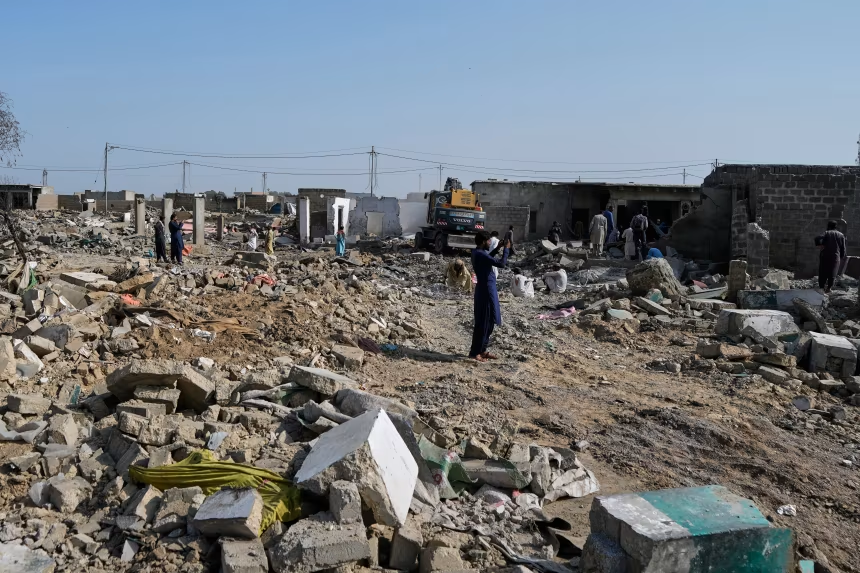
Pakistan and Afghanistan have committed to an immediate ceasefire following over a week of lethal border confrontations, the Qatari Foreign Ministry announced early Sunday. This accord comes after earlier attempts at truce failed to hold. During mediation by Qatar and Turkey, both nations consented to suspend hostilities and pursue a path toward “lasting peace and stability.” The move occurred amid escalating accusations from the Taliban-led Afghan government, which claimed Pakistani forces escalated their airstrikes within Afghanistan. The uptick in violence marked the most intense border conflict between the two neighbors since the Taliban assumed power in Kabul in 2021. Background to the Clash Tensions along the roughly 2,600 km frontier had been mounting, with Pakistan alleging that militant groups in Afghan territory had intensified cross-border attacks. In response, Islamabad conducted air operations targeting sites claimed to be militant bases. Kabul, in turn, accused Pakistan of violating sovereign boundaries and civilian areas. Previously, both nations agreed to a 48-hour ceasefire to de-escalate the situation. That short-term truce was extended to allow for ongoing dialogue in Doha, signaling a shift toward sustained diplomacy. Key Points in the Agreement Challenges Ahead While the ceasefire announcement brings a cautious optimism, lingering obstacles remain: If this ceasefire holds and evolves into a durable peace, it could reshape dynamics in South Asia, reducing instability along a historically volatile border.

Millions Mobilize in “No Kings” Protests Across the U.S.: What Participants Say

When retired public servant Peggy Cole turned 70, she didn’t plan a quiet celebration instead, she and a friend drove nearly ten hours from Flint, Michigan, to take part in a massive protest in Washington, D.C. on Saturday. She says she felt this momentous birthday deserved a bold act — one that reflects her fears for the country’s future. Cole described the current moment as deeply unsettling: “It feels as if (Trump) is gradually dismantling our government, our democracy piece by piece,” she said. “If we just sit and do nothing, we’ll lose it.” This sentiment echoed across the protest grounds, where millions gathered in cities nationwide under the banner of No Kings. Organizers billed it as a show of unity against authoritarian impulses in the White House, and many participants said they came because they felt democracy itself was under threat. For Cole, jumping into the streets was the way to mark her milestone: by standing up when she believed the stakes could not be higher. Why So Many Showed Up These sprawling demonstrations were more than symbolic. Beyond personal stories like Cole’s, protesters pointed to patterns: the growing consolidation of power in executive hands, claims of overreach in policing and immigration, and a general sense that institutional checks are being eroded. Many insisted that silence now would be complicity. Months earlier, No Kings protests made national headlines when tens of thousands marched on June 14, drawing parallels to massive protest waves in U.S. history. This October wave — coordinated across all 50 states — aimed to deepen that narrative and sustain momentum. In many cities, the rallies looked more like colorful street festivals than tense confrontations: marching bands, giant banners of the U.S. Constitution’s “We the People,” inflatable costumes, and creative protest art abounded. Despite the critical messages, most of the events remained peaceful. Across major hubs like New York, Chicago, and Washington, D.C., law enforcement reported minimal disruptions. Voices from the Frontlines For people like Cole, the decision to join was deeply personal. She viewed the protest as marking her belief that inaction would allow power to accumulate unchecked. Others echoed similar themes: defense of civil liberties, fears about the increasing militarization of policy enforcement, and skepticism about authority without accountability. Many described their participation as a form of civic duty — a last stand for democratic norms. In media interviews, numerous attendees said they’d never joined a major protest before — but that they felt compelled now. A Moment of National Reckoning The scale of the demonstrations suggests this is not a fleeting moment. Analysts and news outlets pointed out that the October wave of No Kings may become one of the largest coordinated protest efforts in U.S. history. Still, the movement faces challenges. Republican critics called the protests “hate rallies” and warned of destabilizing effects. Others questioned how the energy on the streets might convert to lasting political change. Yet as people like Cole showed, many regard this as neither spectacle nor protest — but a powerful statement: when democracy feels fragile, citizens must show up.

“I didn’t feel safe, I didn’t feel seen”: How Tems Is Paving the Way for African Women in Music

From the bustling streets of Lagos to the glimmering spotlight of the Grammys, Nigerian singer-songwriter Tems has scaled the world stage, steadfast in staying true to herself. “Authenticity is everything to me,” she insists. “That’s the one thing I cannot compromise on because that’s all I have — who I really am.” When Tems stepped onto the stage at New York’s MetLife Stadium for the FIFA Club World Cup halftime performance in July, she knew millions were watching. Though the pressure and nerves were real, she replays that moment with pride: “It was an honor to just be there,” she reflects. Early Fears, Unseen Struggles, and Finding Voice In interviews, Tems has candidly discussed a time when she felt overshadowed and undervalued in the music industry. As she shared with The Nation, “I didn’t feel safe, I didn’t feel seen, and I didn’t feel supported for a very long time.” These emotions didn’t just vanish once success came. Rather, they became guiding forces in her resolve. The challenges she endured—being underestimated as a producer, feeling invisible amid male-dominated spaces—helped shape her conviction that she must create space not just for herself, but for those who come behind her. Staying True While Stepping into the Light Even amid international acclaim, Tems refuses to dilute the essence of who she is. She’s repeatedly stated that she won’t let stardom alter her inner compass. In a conversation with GRAMMY.com, she described her debut album Born in the Wild as a narrative about survival, embracing inner complexity, and accepting every part of oneself. This balancing act—of growth without self-erasure—is rare in a landscape where labels, collaborators, and the public often demand conformity. Breaking Barriers for Other Women in Music Tems isn’t merely content to succeed as an individual: she’s actively building bridges for other African women in the music industry. She launched the Leading Vibe Initiative (LVI)—a mentorship and development program targeting women between 18 and 35 who aspire to work in music (as artists, producers, managers, or executives). The initiative offers workshops, networking support, legal insights, and funding — all with the goal of making the invisible visible. In her words, “there are so many talented women who can be producers, managers, audio engineers — but they’re not even visible.” To date, LVI has made waves not just in Nigeria, but is expanding to Kenya and other African hubs. Observers see this as a turning moment in the push for equity in music across the continent. The Stage, the Awards, the Legacy Tems’s trajectory is dazzling. After releasing her debut EP For Broken Ears in 2020, she became internationally known via her feature on Wizkid’s hit “Essence” (which charted globally). In 2023, her collaboration with Drake and Future (“Wait for U”) earned her a Grammy win, making her the first African woman to win in that category. In 2025, she added a second Grammy (for Love Me JeJe) to her shelf—cementing her position as one of Africa’s most decorated artists. Through it all, she continues to operate with purpose. She sees her platform not just as a means for personal success, but as a lever to shift power, visibility, and opportunity across the African music ecosystem.

Paul Onuachu Scores Seventh Goal as Trabzonspor Edge Çaykur Rizespor 2-1 Away

Paul Onuachu once again proved his worth as a lethal finisher, helping Trabzonspor secure a vital 2 – 1 away win over Çaykur Rizespor in their Turkish Süper Lig clash on Saturday. Early on, Trabzonspor seized the initiative when Felipe Augusto opened the scoring just two minutes into the contest. From there, Onuachu doubled the lead in the 19th minute with a powerful header, rising above his marker to convert a precise delivery and put the visitors firmly in control. Despite Rizespor’s efforts to pull one back, the home side managed a goal—but Trabzonspor’s resolve and defensive organisation kept them ahead to collect all three points. This latest strike takes Onuachu’s tally for the season to seven goals, underscoring his growing influence in the Turkish top flight. He now heads into national team discussions with momentum after this standout performance. Details & Significance What This Means Going Forward For Trabzonspor, the victory strengthens their league position and adds impetus to their campaign for higher honours. Onuachu will continue to carry the weight of goal-scoring expectation—his consistency could tilt major games in their favour. Meanwhile, for Rizespor, this result is a setback that underlines the need to address defensive lapses, particularly in the opening minutes when the opponent is sharp and hungry.

Arsenal Go Three Points Clear at the Top After Narrow Win Over Fulham

Arsenal strengthened their position at the top of the Premier League table with a crucial 1-0 victory over Fulham on Saturday evening, moving three points clear of their closest rivals. The intense clash at Craven Cottage saw the Gunners display solid control throughout the match, despite facing tough resistance from Marco Silva’s side. Heading into the game, Mikel Arteta’s men were just one point ahead of Liverpool, who have been in relentless pursuit of the title. The North London club had the perfect opportunity to extend their lead in the standings after Manchester City defeated Everton 2-0 earlier in the day to momentarily claim the top spot. Despite dominating possession and dictating the tempo for large stretches of the first half, Arsenal struggled to find the breakthrough before halftime. Fulham’s defensive setup remained disciplined, frustrating the visitors and limiting their clear-cut chances. However, the Gunners’ persistence paid off after the restart. Their patient build-up play and attacking combinations eventually led to the decisive goal that sealed the victory. The result was vital, not only for maintaining momentum but also for sending a clear message to their title rivals. This hard-fought win underscores Arsenal’s growing maturity and consistency under Arteta’s leadership. The North London side has shown remarkable composure in recent weeks, balancing defensive solidity with fluid attacking play—a combination that has kept them ahead in one of the most competitive Premier League title races in recent years. With this win, Arsenal now sit three points clear at the top as the league heads into the international break. Fans will be hoping the team continues this form when domestic action resumes, as every point could prove decisive in their quest for the title.

Kano State Government Closes Popular Shisha Lounge Over Law Violation

The Kano State Government has officially shut down a popular shisha lounge, Arfat, located along Abdullahi Bayero Road in the state capital. According to reports, the closure of the shisha lounge in Kano was carried out through a joint operation involving the Kano State Tourism Board, the National Drug Law Enforcement Agency (NDLEA), and the Kano State Police Command. Authorities stated that the move was part of the ongoing campaign to enforce public morality laws and combat the growing use of illicit substances within entertainment centers across the state. The NDLEA operatives and police officers were seen on site ensuring compliance, sealing off the lounge’s premises. This action aligns with the state’s long-standing ban on shisha smoking, which officials say contributes to substance abuse among youths. A representative from the Kano State Tourism Board emphasized that all hospitality and recreational centers operating within the state must strictly adhere to the established public order and morality regulations. The agency also warned that similar operations will continue in the coming days to ensure full compliance. Residents in the area commended the government’s decisive action, saying it would help discourage drug abuse and other forms of social misconduct among young people. However, some youths argued that instead of shutting such lounges completely, the government should consider implementing controlled recreational guidelines that allow operations under proper regulation and supervision. The Kano State Government reaffirmed its stance that any facility promoting the sale or consumption of banned substances, including shisha, will face immediate closure and legal prosecution. This latest crackdown demonstrates the administration’s commitment to maintaining law and order, while also safeguarding the moral and social standards that define the state’s identity. For now, the Arfat Lounge remains sealed, with ongoing investigations expected to determine whether further penalties will be applied against its management.

How AI Is Quietly Changing Side Hustles in Nigeria. The Hidden Winners of 2025

A few years ago, if you told someone in Nigeria that a machine could write blog posts, design logos, or market your business online while you sleep, they would have laughed. Today, artificial intelligence (AI) has changed everything. But not loudly.Not with fireworks.AI is quietly reshaping side hustles — turning ordinary Nigerians into digital entrepreneurs and rewriting what it means to make money online. The Silent Revolution: AI as the New Workforce The truth is, AI isn’t coming — it’s already here. Across Lagos, Abuja, and even small towns like Warri or Enugu, young people are using AI tools to automate work, earn more money, and save time.But the most interesting part?Many of them don’t even realize how advanced these tools have become. According to a 2025 report by TechCabal, more than 58% of young Nigerian freelancers have used AI tools at least once to support their side income. This quiet adoption is building a new class of AI-assisted entrepreneurs. Side Hustles That AI Is Transforming in 2025 AI isn’t replacing hustles — it’s upgrading them. Let’s break down some examples that are exploding right now: 1. Content Creation & Copywriting AI tools like ChatGPT, Jasper, and Copy.ai help Nigerian bloggers, affiliate marketers, and social media managers create high-quality content in minutes.But here’s the twist — the real winners are not those who copy AI’s words.They are those who humanize AI output with personal stories, humor, and local insight. Tip: Use AI as your assistant, not your voice. Your originality builds trust — Google’s E-E-A-T algorithm rewards that. 2. AI-Powered Graphic Design Before now, hiring a designer was expensive. But with Canva AI, Adobe Firefly, and Leonardo AI, anyone can design business cards, flyers, and logos.This has given rise to a wave of “AI designers” — people who create professional visuals for clients on WhatsApp or Fiverr without formal training. 3. Video Creation & Short-Form Storytelling AI video tools like Runway ML, Sora, and Pika Labs now allow users to generate cinematic clips from text prompts.Imagine creating product ads, motivational videos, or music trailers without touching a camera.These tools are the secret weapons behind the next generation of Nigerian content creators. Example: Many entertainment brands are using Runway to create short promo clips that would have cost thousands to film. 4. Freelancing Automation On platforms like Upwork and Fiverr, Nigerians are now using AI to: Instead of spending hours on routine work, freelancers now complete tasks faster — giving them time to find more clients. According to Upwork’s 2025 Future of Work Report, freelancers using AI complete projects 42% faster than those who don’t. 5. E-Commerce & Dropshipping AI has also entered Nigerian e-commerce. Entrepreneurs use tools like Shopify Magic, Durable.co, and ChatGPT Plugins to generate product descriptions, automate customer replies, and manage pricing. For example, a Lagos-based seller running a Shopify store can now generate 10 SEO-ready product descriptions in 10 minutes — something that used to take a day. The Hidden Winners of the AI Shift AI hasn’t just created new jobs — it’s changing who wins. The real winners are those who: These people build mini-brands, not just side hustles.They are becoming AI-assisted entrepreneurs, the next wave of Nigerian digital wealth builders. Example: A student in Port Harcourt now uses ChatGPT and Canva AI to run a content agency on Instagram — earning in dollars without leaving home. The Future of Side Hustles in an AI-Driven Nigeria AI won’t take your hustle — it will take the person who refuses to learn.By 2026, Nigeria’s digital economy is expected to surpass $40 billion, according to the National Information Technology Development Agency (NITDA).That growth will be driven by technology, content, and creativity — all powered by AI. So, if you’re reading this and wondering whether to embrace AI, the answer is simple:? Start now.? Learn how it fits into your niche.? Combine it with your human creativity. Final Thoughts — The Hustle Is Evolving AI isn’t magic; it’s leverage.It doesn’t make you successful by itself — it multiplies your effort, creativity, and speed. The next big success stories in Nigeria won’t come from those who work the hardest…They’ll come from those who work the smartest — with AI.

Inside My SEO Reset Journey: What I Learned After Deleting My Website from Google Search Console

When I first started my blogging journey, I never imagined that Google could ignore my entire website even after posting regularly, optimizing everything, and following all the SEO “rules.”But month after month, nothing changed.No ranking. No visibility. Just silence. So, I made a bold move:I deleted my website property from Google Search Console — and started again from scratch. This is the story of what I learned, what worked, and how this single act gave my blog a second life in Google Search. ? Step 1: Understanding What Really Happens When You Delete Your Website from Search Console Many people think deleting a property from Search Console removes your site from Google completely. That’s not true.? What it actually does is clear your Search Console data and disconnect Google’s crawling and indexing logs related to that verification. Once you remove the property and re-add it, Google treats it as a brand-new relationship.This reset can be powerful if your old configuration had: ? Reference: According to Google’s official Search Console documentation, removing a property doesn’t delete your site from Google — it only removes your access to performance data. When you re-add it, Google begins recrawling from a cleaner slate, which is exactly what I wanted. ⚙️ Step 2: Submitting a Fresh Sitemap. The Heartbeat of a Reset After deleting and re-verifying my site, I went straight to Sitemaps → Add a New Sitemap.I used my updated sitemap URL, generated from my WordPress SEO plugin (Rank Math). A sitemap acts as your site’s directory — telling Google what to crawl, in what order, and how often to revisit pages.If your sitemap contains old or broken URLs, it confuses Google and delays indexing. ✅ My pro tip:Always check your sitemap for: ? For more on creating a valid sitemap, Google provides a structured guide. ? Step 3: Manually Request Indexing for Key Pages After submitting the new sitemap, I didn’t just wait.I used the URL Inspection Tool to manually request indexing for: This signals Google that these pages deserve priority crawl scheduling. I noticed that within a few days, Google began revisiting my site and started showing “Discovered – currently not indexed” pages moving into “Indexed.”That was a breakthrough moment. ? Step 4: Checking Robots.txt and Meta Robots Tags Another lesson I learned: sometimes your site is fine — but your robots.txt or meta robots tags are quietly blocking Google from seeing your content. I typed mysite.com/robots.txt and found no “Disallow: /” lines (thankfully).Then I inspected my page source to ensure there were no <meta name=”robots” content=”noindex”> tags hiding inside templates. If either of those are wrong, Google literally ignores your pages.Make sure your SEO plugin (like Rank Math) isn’t accidentally adding them during page updates. ? Reference: Google Search Central’s robots.txt rules. ⚡ Step 5: Posting Fresh Content That Feeds Google’s Trust System After resetting, I made sure my next few blog posts weren’t just optimized — they were alive.Google’s current ranking model favors E-E-A-T: Experience, Expertise, Authoritativeness, and Trust. So, I wrote human stories, added internal links, used reputable outbound references, and posted consistently.Within 10–15 days, Google indexed most of my new posts. ✅ What I did differently: ? Step 6: Lessons That Changed My SEO Mindset Forever Here’s what I realized:Deleting your website from Search Console isn’t a failure.It’s a strategic reboot — a reset button that forces Google to see you differently. The real secret is what you do after the reset: When Google sees that pattern, your indexing speed and ranking will climb again — gradually, but permanently. ? Conclusion: A Fresh Start That Works Resetting your website in Google Search Console is like giving your blog a new heartbeat.It won’t fix everything overnight, but it clears the confusion, removes technical noise, and lets your true content value shine again. If your site has been stuck for months with “Indexed but not appearing,” maybe it’s time to start fresh — just like I did. Because sometimes, the best SEO strategy… is to begin again. ✅ Author: Emmanuel James? Contact: [email protected]? Website: www.lmsint.com.ng? Edition: 2025 JOIN OUR WHATSAPP Here….. WHATSAPP GROUP, WHATSAPP CHANNEL JOIN OUR TELEGRAM CHANNEL Here….. TELEGRAM

Rhapsody of Realities October 18th 2025, YOUR WORDS ARE ALIVE

Pastor Chris Oyakhilome DSc DSc DD It is the spirit that quickeneth; the flesh profiteth nothing: the words that I speak unto you, they are spirit, and they are life (John 6:63). The words you speak are not empty; they don’t just go away; they live on. Don’t think the last thing you said ended when you said it. Every word that comes out of your mouth is alive in the spirit-realm. The only way to repel or counter already spoken words is by speaking words that are opposite and more powerful. Words are things; they have energy and tangibility. This should make you put a premium on words. Never say what you don’t mean or don’t want to happen. Never speak negatively because the principle is simple but spiritual: you shall have what you say. The Lord Jesus said so: “For verily I say unto you, That whosoever shall say unto this mountain, Be thou removed, and be thou cast into the sea; and shall not doubt in his heart, but shall believe that those things which he saith shall come to pass; he shall have whatsoever he saith” (Mark 11:23). It’s for the same reason He tells us not to speak idle, inoperative words: “But I say unto you, That every idle word that men shall speak, they shall give account thereof in the day of judgment. For by thy words thou shalt be justified, and by thy words thou shalt be condemned” (Matthew 12:36-37). Idle words are useless words, words you speak that don’t mean anything. He says you’ll be held accountable for speaking such words. Remember, you’re made in the image and likeness of God, and what did the Master say about Himself? He said, “…the words that I speak unto you, they are spirit, and they are life” (John 6:63). He put a premium on words. The difference between the words of the Lord Jesus and the words of any other person is that He spoke life. He gave us an example to follow. Proverbs 18:21 says, “Death and life are in the power of the tongue….” Speak only life and everything in your life and environment will live. Speak life to your business, your finances, your body, your children, and to everything around you. Remember, your words never die; they’re living and active; they determine the course or direction of your life. Whether you’re going to be a success or a failure is all in your mouth. PRAYERDear Father, thank you for teaching me the power of words. My words are full of life, power and faith. I speak only what I desire to see. I speak life to my body, progress to my work, growth to my finances, and peace to my environment. Thank you for making my tongue a tree of life, in Jesus’ Name. Amen. FURTHER STUDY‭‭1 Peter 3:10For he that will love life, and see good days, let him refrain his tongue from evil, and his lips that they speak no guile: ‭‭Matthew 12:36-37 NIVBut I tell you that everyone will have to give account on the day of judgment for every empty word they have spoken. 37 For by your words you will be acquitted, and by your words you will be condemned.” ‭‭Job 22:28 KJVThou shalt also decree a thing, and it shall be established unto thee: and the light shall shine upon thy ways. DAILY SCRIPTURE READING1-Year Bible Reading Plan2 Thessalonians 3:1-18 & Jeremiah 3-4 2-Year Bible Reading PlanJohn 6:30-40 & 2 Kings 4 DAILY AFFIRMATIONS: All things are working together for my good. I am blessed with all spiritual blessings in heavenly places in Christ Jesus, and I take full possession of my inheritance in Him. The peace of God garrisons my heart and mind in Christ. My heart is stayed on the Lord, who is my rock, fortress, protection, and salvation. I am accomplishing great and notable things by the power of the Holy Spirit. I enjoy my days in success, progress, peace, joy, health, and unending prosperity. I rise higher and higher, irrespective of challenges or circumstances around the world. I reject everything that hurts or binds, for I have been delivered from all oppression and defeat. Christ is my life. He’s in every fibre of my being, every bone of my body, and every cell of my blood. I reign and rule over circumstances in His Name, shielded from all evil and harm. I am seated together with Christ in heavenly places, far above all principality, power, and every name that is named. I am a carrier of divinity. The fullness of the Godhead dwells in me bodily. I live life in its fullness, full of glory, beauty, and excellence. I am well-positioned for greatness, empowered to live in perpetual health, godliness, and dominion on earth. My life is for the glory of God. The wisdom of God is at work in me. I know what to do, when to do it, and how to do it. The Holy Spirit guides my thoughts, decisions, and actions. My life is fruitful, productive, and full of divine insight. I am complete in Christ, perfected for excellence, and full of His might. God’s goodness and mercy surround me like a shield. My life is radiant with His beauty and grace. I walk daily in divine health, peace, and prosperity. The Word of God is alive in me, producing strength, vitality, and victory. I am a living testimony of His goodness — a light to my world and a reflection of His glory in Jesus’ name. Amen. Speak in tongues.