
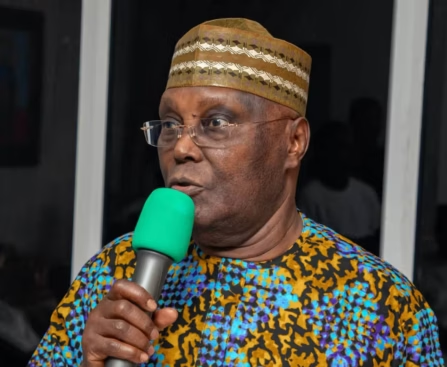
Former Vice President and African Democratic Congress (ADC) presidential candidate, Atiku Abubakar, has rejected claims by President Bola Tinubu’s Senior Adviser on Digital/New Media, O’tega Ogra, that his proposed production subsidy for locally refined petroleum is a repeat of an earlier subsidy arrangement operated during the Olusegun Obasanjo administration. The disagreement has opened a fresh […]


A fresh legal battle over President Bola Ahmed Tinubu’s eligibility for the 2027 presidential election has shifted toward a preliminary question: whether Atiku Abubakar and the African Democratic Congress (ADC) have provided enough evidence and have the legal standing to pursue the case. Former Attorney-General of the Federation and Minister of Justice, Akin Olujinmi, SAN, […]
Kindly Share:


Former Edo State lawmaker Ehiozuwa Agbonayinma has explained why he is pressing the Economic and Financial Crimes Commission (EFCC) to revisit long-standing financial crime allegations involving former Vice President Atiku Abubakar. Agbonayinma, who represented Egor/Ikpoba-Okha Federal Constituency in the House of Representatives, said his demand was not based on a new allegation against Atiku but […]
Kindly Share:


ABUJA — President Bola Ahmed Tinubu’s assertion that Northern Nigeria stands to be the biggest beneficiary of his administration’s economic reforms has triggered a sharp disagreement among major Northern interest groups, exposing a wider debate over whether Nigeria’s improving macroeconomic indicators are translating into meaningful gains for ordinary citizens. While the presidency and the All […]
Kindly Share:


Former Vice-President and African Democratic Congress (ADC) presidential candidate for the 2027 election, Atiku Abubakar, has pledged to ensure that statutory allocations meant for Nigeria’s 774 local government areas are paid directly into council accounts if he wins the presidency. Atiku said his proposed administration would make local government financial autonomy a key component of […]
Kindly Share:


ABUJA — Nigeria’s opposition parties are intensifying efforts to prevent another split-vote outcome in the 2027 presidential election, with six political parties backing a structured coalition process that includes a proposed single four-year transition government. The proposal emerged at an opposition summit in Abuja where political leaders, presidential candidates and senior party officials began laying […]
Kindly Share:


Former Kogi West Senator and African Democratic Congress (ADC) chieftain Dino Melaye has criticised President Bola Ahmed Tinubu’s decision to embark on a three-week vacation in Europe, questioning the length and timing of the President’s absence from Nigeria. Melaye’s criticism came shortly after the Presidency announced that Tinubu had departed Abuja for Europe as part […]
Kindly Share:


ABUJA — Nigeria’s opposition parties are returning to the coalition table with a problem that has repeatedly frustrated attempts to challenge the ruling All Progressives Congress (APC): agreeing not only on the need for a stronger opposition, but on who should ultimately lead it. As opposition leaders prepare for the G-100’s summit in Abuja on […]
Kindly Share:


The political contest ahead of Nigeria’s 2027 general election may have entered a new phase, not because of a campaign rally or manifesto launch, but because of a prediction about what could happen four years after the next presidential election. Senator Abdul’Aziz Yari’s declaration that the All Progressives Congress (APC) could remain in power beyond […]
Kindly Share:


African Action Congress (AAC) presidential candidate Omoyele Sowore has criticised African Democratic Congress (ADC) presidential candidate Atiku Abubakar over his renewed promise to restore petrol subsidy if elected president in 2027. Sowore, in a post on his verified X account on Friday, accused Atiku and other established political figures of changing their positions on fuel […]
Kindly Share:


ABUJA — The debate over petrol subsidy has returned to the centre of Nigeria’s 2027 political contest, with the Presidency challenging former Vice-President and African Democratic Congress (ADC) presidential candidate, Atiku Abubakar, to provide a clear financial and operational framework for his proposed “targeted subsidy.” The latest confrontation followed a series of statements from Atiku […]
Kindly Share:


ABUJA — Nigeria’s long-running fuel subsidy controversy has returned to the centre of the country’s political debate, with President Bola Ahmed Tinubu rejecting any move back toward subsidy and former Vice President Atiku Abubakar proposing a new system that would direct government support toward domestic refining. The disagreement is more than a political exchange ahead […]
Kindly Share:


Former Kogi West Senator Dino Melaye has issued a pointed warning to President Bola Ahmed Tinubu, arguing that political endorsements alone cannot determine the outcome of Nigeria’s 2027 presidential race. In a message shared on his X (formerly Twitter) account on Wednesday, the African Democratic Congress (ADC) chieftain referenced the late former military Head of […]
