Concerns were raised on Monday as Senator Natasha Akpoti-Uduaghan, who represents Kogi Central, questioned the Federal Government’s plan to mobilise funds for private sector participation as outlined in the 2026–2028 Medium-Term Expenditure Framework (MTEF) and Fiscal Strategy Paper. The senator expressed reservations over what she described as unclear and insufficiently detailed policy directions regarding private-sector financing within the fiscal framework. According to her, the strategy presented by the government appeared vague, especially in explaining how funds would be sourced, managed, or directed to stimulate private-sector growth. Her concerns were made known during an interactive engagement organised by the Senate Committee on Finance, held at the National Assembly. The session was convened to allow lawmakers to review and interrogate the government’s proposed fiscal roadmap ahead of its consideration. During the meeting, the Minister of Finance and Coordinating Minister of the Economy, Wale Edun, formally presented the Federal Government’s fiscal outlook, highlighting key assumptions and expectations underpinning the MTEF document. The framework serves as a guiding instrument for national budgeting and economic planning over a medium-term period. Senator Akpoti-Uduaghan’s intervention focused specifically on the government’s intention to “mop up funds” from the economy to support private-sector activity. She sought clearer explanations on the mechanisms involved, stressing the importance of transparency and precision in fiscal policies that directly affect economic participation and investment confidence. The exchange formed part of the Senate’s broader oversight responsibility to ensure that fiscal strategies align with national economic realities and are communicated in a manner that allows for informed legislative scrutiny.
President Bola Ahmed Tinubu has restated his administration’s firm dedication to strengthening the Nigerian Army, with a strong focus on personnel welfare, professional excellence, and overall operational efficiency. This assurance was delivered on Monday during the official opening ceremony of the Chief of Army Staff (COAS) Annual Conference 2025, which is being held in Lagos. The President was represented at the event by the Vice President, Senator Kashim Shettima, who conveyed the administration’s message on his behalf. According to the statement delivered at the conference, the Tinubu-led government remains committed to ensuring that the Nigerian Army is well-equipped and adequately supported to carry out its constitutional responsibilities. Emphasis was placed on improving the well-being of officers and soldiers while sustaining high standards of discipline and professionalism within the force. The annual conference serves as a strategic platform where senior military leaders assess current security realities, review operational strategies, and deliberate on ways to enhance the effectiveness of the Nigerian Army. The President’s reaffirmation underscores the importance his administration places on the armed forces in maintaining national stability and security. By highlighting welfare, professionalism, and operational capacity, the government reiterated its resolve to support the Army in adapting to evolving security challenges across the country. The conference opening in Lagos marks another step toward reinforcing collaboration between the nation’s leadership and the military hierarchy.
Vice President Kashim Shettima has arrived in Lagos State to participate in the Chief of Army Staff (COAS) Annual Conference 2025, a major gathering within Nigeria’s military leadership calendar. Upon his arrival on Monday, the Vice President was formally received by Lagos State Governor, Babajide Sanwo-Olu, alongside other senior government officials present in the state. The reception highlighted the importance of the event and the high-level participation it continues to attract. Governor Sanwo-Olu later proceeded to the conference venue, where he was, in turn, welcomed by the service chiefs, reflecting the collaborative relationship between civil authorities and the armed forces. Also in attendance is the Minister of Defence, General Christopher Musa (retd.), who joined other top-ranking military leaders at the conference. During the event, General Musa was observed exchanging warm greetings with his former colleagues, underscoring the familiar ties among senior military figures. The annual conference serves as a strategic platform for reviewing military operations, strengthening leadership coordination, and discussing national security priorities. The presence of key political and defence leaders further emphasizes the significance of the gathering within Nigeria’s defence and governance framework.
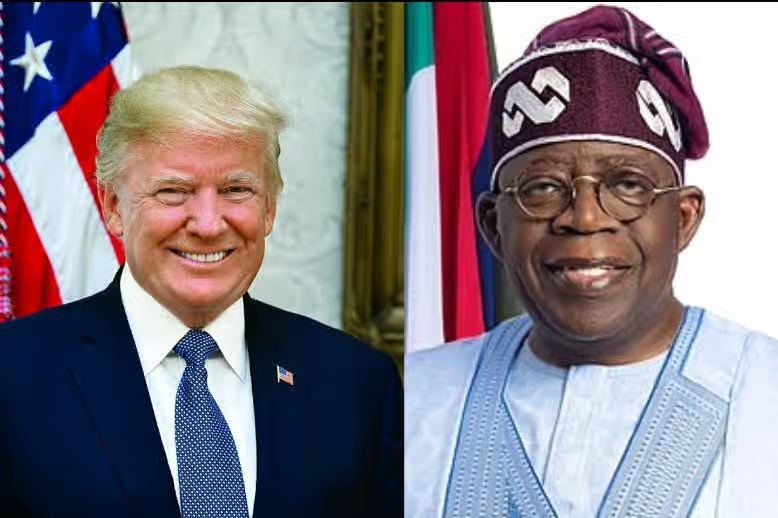
A senior United States lawmaker has disclosed that both the US and Nigerian governments are close to concluding a major security partnership aimed at addressing the persistent insecurity challenges facing Nigeria, particularly terrorism and religious violence. According to United States Congressman Riley Moore, discussions between Washington and Abuja have progressed significantly, with both sides nearing the completion of a strategic security framework designed to confront extremist threats within Nigeria. The framework is expected to strengthen cooperation between the two countries in tackling violent groups that have destabilised several regions. Moore made this known through a post shared on his official X (formerly Twitter) account, where he explained that the proposed agreement would primarily concentrate on counter-terrorism efforts in Nigeria’s North-East and Middle Belt regions. These areas have experienced prolonged attacks linked to insurgency, banditry, and sectarian violence. The US lawmaker further stated that the framework seeks to address what he described as a continued pattern of violence against Christian communities, referring to it as an alleged genocide. According to Moore, the initiative is expected to enhance intelligence sharing, security coordination, and broader policy engagement between both nations to reduce attacks on civilians and religious groups. Meanwhile, the Nigerian Federal Government has reacted to comments previously attributed to former US President Donald Trump, who had reportedly labelled Nigeria a “Country of Particular Concern” in relation to religious freedom and persecution. Nigerian authorities insisted that such remarks do not accurately represent the realities on the ground. Government officials maintained that while security challenges remain, Nigeria is actively working to address terrorism, religious violence, and communal clashes through military operations, diplomatic engagements, and policy reforms. They emphasised that the situation is complex and should not be oversimplified through sweeping labels. As both nations move closer to finalising the strategic framework, observers believe the agreement could mark a turning point in US-Nigeria security relations, especially in the global fight against terrorism and the protection of vulnerable communities across affected regions.
The Governor of Niger State, Mohammed Umaru Bago, has formally submitted the 2026 budget proposal totaling ₦1.031 trillion to the Niger State House of Assembly. The presentation of the financial plan was officially confirmed through a statement released by the Chief Press Secretary to the Governor, Bologi Ibrahim, who provided clarity on the size and structure of the proposed budget. According to the statement, the proposed 2026 budget clearly outlines how funds are expected to be distributed between essential government operations and long-term development initiatives across the state. Out of the total ₦1.031 trillion budget size, over ₦270 billion has been set aside for recurrent expenditure. This portion of the budget is intended to cover the routine running costs of government, including administrative expenses and other recurring obligations required to maintain public service delivery. In addition, more than ₦761 billion has been allocated to capital expenditure, signaling a strong focus on infrastructure and development-oriented projects. Capital allocations typically support long-term investments that contribute to economic growth and structural improvement within the state. The breakdown of the budget reflects a clear distinction between operational spending and development funding, showing how the state government plans to balance day-to-day governance with capital projects aimed at future growth. The submission of the 2026 budget to the House of Assembly marks an important step in the legislative process, as the proposal will undergo review, consideration, and approval before implementation.
Zamfara State Governor, Dauda Lawal, has expressed deep sorrow following a tragic explosion that claimed the lives of five individuals, including the Vice Chairman of Bukkuyum Local Government Area. The incident occurred on Wednesday along the Gurusu–Gwashi road in Bukkuyum Local Government Area of the state. According to the governor, the explosion represents a painful and needless loss of innocent lives at a time when communities are already grappling with persistent security challenges. Governor Lawal conveyed his grief in a statement shared on his official Facebook page, where he sympathised with the families of the victims and residents of the affected communities. The governor explained that preliminary information indicated the explosion was caused by an improvised explosive device allegedly planted by armed bandits operating within the area. He noted that such acts of violence continue to threaten lives, disrupt daily activities, and instil fear among residents who rely on the road for movement and economic activities. Governor Lawal described the incident as senseless, stressing that no justification exists for attacks that target civilians and public officials. He emphasised that the loss of the Bukkuyum Local Government Vice Chairman is not only a personal tragedy for the family but also a significant setback for grassroots governance and community development in the area. While lamenting the incident, the governor reaffirmed his administration’s commitment to improving security across Zamfara State. He stated that efforts remain ongoing to collaborate with security agencies to curb the activities of armed groups and prevent further loss of lives. He also called for unity, resilience, and cooperation among residents as the state continues to confront security-related threats. Governor Lawal concluded by offering prayers for the souls of the deceased and comfort for their families, urging citizens to remain hopeful despite the painful development. The explosion along the Gurusu–Gwashi road stands as another reminder of the urgent need to restore peace and safety in communities affected by banditry in Zamfara State.
Niger State Governor, Mohammed Umaru Bago, has officially presented a ₦1.3 trillion appropriation bill to the Niger State House of Assembly for the 2026 fiscal year. The proposed financial plan is formally described as the “Budget of Consolidation.” According to the budget breakdown, a substantial portion of the proposed funds is directed toward development-focused initiatives, with a clear emphasis on long-term infrastructure and capital investments across the state. Out of the total ₦1.3 trillion budget estimate, ₦270 billion has been allocated for recurrent expenditure, which covers the routine operational costs of governance. This allocation represents 26.19 percent of the entire budget proposal. On the other hand, capital expenditure takes the largest share of the budget. The sum of ₦761 billion has been earmarked for capital projects, accounting for 73.81 percent of the total estimated spending. This indicates a strong commitment toward physical development, infrastructure expansion, and project execution within the state. The presentation of the appropriation bill to the lawmakers marks the beginning of the legislative review process, during which the House of Assembly will examine, deliberate, and consider the proposal before approval. The 2026 budget submission reinforces the state government’s fiscal planning framework under Governor Bago’s administration, with spending priorities clearly structured between recurrent obligations and capital development.
A recent update from a member of the United States House of Representatives, Riley Moore, has confirmed that he is preparing a comprehensive report for former U.S. President Donald Trump. In this report, Moore intends to outline a strategic plan that will involve direct cooperation with the Nigerian government to address and ultimately halt what he describes as the ongoing Christian genocide occurring in Nigeria. Moore announced this development on X on Thursday shortly after concluding his visit to Nigeria. His message emphasized his commitment to presenting Trump with detailed findings and recommendations that could help strengthen efforts to end the violent attacks affecting Christian communities across the country. During his stay in Nigeria, the U.S. lawmaker held meetings with notable government officials. Among those he met was Nigeria’s National Security Adviser, Nuhu Ribadu, who plays a central role in coordinating national security efforts and addressing internal conflict situations. These engagements were part of Moore’s effort to gather firsthand information before submitting his final report. His visit reflects growing international concern over recurring attacks in certain regions of Nigeria. While Moore did not release the full content of the report publicly, his statement suggests that the document will highlight key areas of partnership between the United States and Nigeria, focusing on security cooperation and protective measures for affected communities. Moore’s forthcoming submission to Trump signifies a renewed push for global involvement, especially from American policymakers, in addressing religious violence in Nigeria. His trip and forthcoming report underline the urgency many believe is needed in confronting the crisis and ensuring that vulnerable populations receive the necessary protection and support.
Rising political tension is once again gripping Rivers State as lawmakers aligned with former governor and current Minister of the Federal Capital Territory, Nyesom Wike, begin a fresh confrontation with Governor Siminalayi Fubara.This renewed conflict comes barely three months after both leaders publicly embraced a peace deal intended to end months of political rivalry. Recent updates gathered by LMSINT MEDIA indicate that members of the Rivers State House of Assembly, led by Speaker Martins Amaewhule—who remains strongly loyal to the FCT Minister—are preparing for another direct challenge against Governor Fubara. Their renewed actions suggest that the fragile calm achieved earlier may be breaking down once again. The disagreement between the two power blocs originally erupted in late 2023, only a few months after Governor Fubara assumed office. That earlier clash, driven by a fierce struggle over who controls the state’s political structure, escalated into one of the most intense political crises in the state’s recent history. As both camps brace for another round of confrontation, Rivers residents are watching closely, worried that the state may once again be thrown into turmoil. Despite previous peace efforts, the underlying tensions appear unresolved, raising questions about whether the political actors can find lasting stability or if Rivers State will continue to experience deep internal friction.
Nasarawa State Governor, Abdullahi Sule, has stated that people who insist that leaders are indifferent or not taking adequate action to combat insecurity are acting mischievously and unfairly. The governor shared this position during an interview on Sunday Politics, a Channels Television programme closely followed by LMSINT MEDIA. Governor Sule made the comment while addressing questions surrounding the recent meeting held in Kaduna, where Northern governors and traditional rulers convened to discuss urgent security challenges affecting the region. During the interview, he emphasized that the current wave of insecurity—although troubling—must be viewed with proper context. According to him, the situation has evolved compared to the era when Boko Haram violently dominated parts of the North East. He explained: “This phase will also pass. If you examine the trend critically, you will notice that the worst of it was primarily rooted in the North East, where Boko Haram carried out the majority of their destructive activities.” The governor highlighted that while security threats persist in different regions, huge progress has been recorded through collaborative efforts between security agencies, state governments, and community leaders. He stressed that dismissing these efforts or making sweeping claims that leaders are unconcerned is misleading and unconstructive. Governor Sule reiterated the commitment of Northern governors and traditional rulers to intensify strategies that better secure communities, reduce violent attacks, and restore peace. He added that ongoing conversations with national security stakeholders show that leadership at various levels is actively working to stabilize affected areas.
President Bola Ahmed Tinubu has praised the courage and swift intervention of Nigeria’s military forces after they responded immediately to an emergency request from the Government of Benin Republic to protect its 35-year-old democratic system from an attempted coup. The commendation was revealed in an official statement released on Sunday in Abuja by his Special Adviser on Information and Strategy, Bayo Onanuga. According to the statement, the President acknowledged the professionalism and rapid response displayed by the Nigerian Armed Forces during the early-morning operation. Tinubu explained that the military acted based on two formal requests made by the Benin Republic authorities. Following the first request, he directed the Nigerian Air Force to deploy fighter aircraft into Benin Republic to take control of the airspace and neutralize coup plotters who had taken over the National Television station and regrouped within a military facility. The President emphasized that Nigeria, as a nation committed to regional stability, could not ignore any threat to democracy within the West African neighbourhood. He expressed satisfaction that the coordinated operation helped prevent the overthrow of a democratically elected government, demonstrating Nigeria’s leadership role within the region. Tinubu applauded the bravery and professionalism of the Nigerian soldiers who carried out the assignment with precision and discipline. He noted that their actions reaffirmed the country’s commitment to safeguarding democratic institutions across West Africa. The President also highlighted the importance of protecting constitutional rule, stressing that democracy in the region must not be undermined by any group trying to seize power through force. He further maintained that the success of the operation proved that Nigeria and its neighbours remain united in defending peace, stability, and democratic governance.
In a historic moment at the 2026 FIFA World Cup draw event in Washington D.C., the President of the United States, Donald Trump, received the inaugural FIFA Peace Prize—a newly introduced honour designed to celebrate individuals whose actions have contributed to reducing global tension and strengthening the unity of international football. The announcement, made publicly by FIFA President Gianni Infantino, highlighted Trump’s perceived efforts in preventing global conflicts and influencing diplomatic stability during his administration. According to Infantino, the award symbolizes FIFA’s intention to acknowledge leaders whose decisions align with the values of peace, cooperation, and the expansion of football across borders. Presented with an impressive trophy and a custom-designed commemorative medal, Trump’s recognition instantly triggered intense public discussion. Many sports analysts questioned whether the global football body was stepping too deeply into political matters, while others viewed the gesture as a strategic move to reinforce FIFA’s relationship with the host nation ahead of the 2026 World Cup. Moments after receiving the honour, Trump expressed profound appreciation, describing the award as “one of the great honours of my life.” He insisted that his administration had played a significant role in easing multiple international crises during his tenure, suggesting that the prize validated those efforts on a global scale. The ceremony, widely followed by football fans worldwide, underscored FIFA’s evolving role not only in sports governance but also as an influential voice in promoting unity and cross-cultural harmony. As preparations for the 2026 World Cup intensify, this development adds greater attention to the event and the geopolitical conversations surrounding global sports. For related political and global updates, you may explore additional stories on LMSINT Media, including articles covering international diplomacy, sports developments, and leadership commentary.