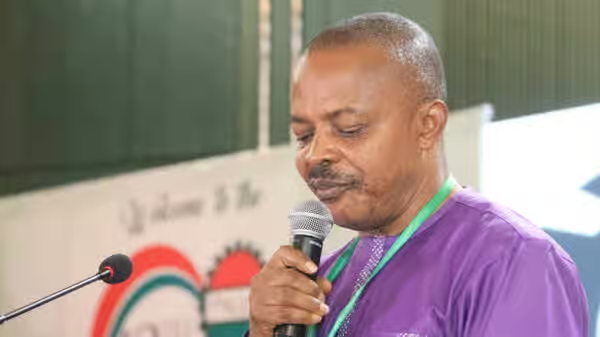
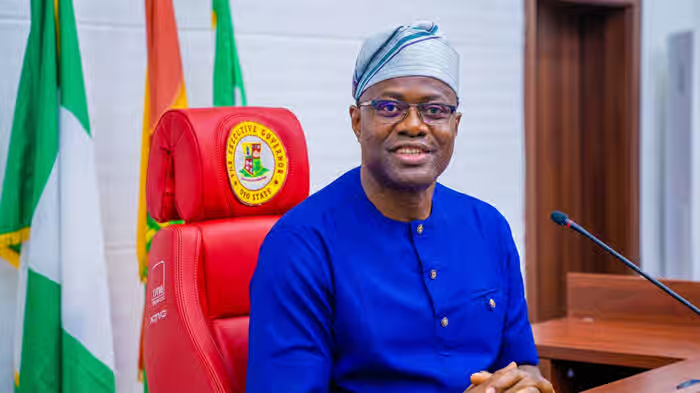
Former Nigerian President Muhammadu Buhari has explained the reason he chose not to back the presidential ambition of his former Vice President, Professor Yemi Osinbajo, during the buildup to the 2023 general elections. According to revelations contained in a recently published biography, Buhari withheld his support because he did not have a personal relationship or close familiarity with Osinbajo throughout their years in government. The disclosure is documented in From Soldier to Statesman: The Legacy of Muhammadu Buhari, a biography written by Dr. Charles Omole. In the book, Buhari is quoted as stating that he never truly knew Osinbajo on a personal level, despite serving together for two terms in office. Buhari reportedly explained that his first real connection to Osinbajo came through Nigeria’s current President, Bola Ahmed Tinubu. Osinbajo was introduced to him by Tinubu before the formation of the All Progressives Congress (APC) government in 2015. This distance, according to the former president’s account, played a major role in his decision not to publicly endorse Osinbajo when the former Vice President declared his intention to contest for the highest office in the country. The revelation has sparked renewed public debate about political loyalty, succession planning, and internal party dynamics within the APC. Many Nigerians had expected Buhari to rally behind his deputy, considering their long years of joint leadership. However, the former president’s explanation suggests that political proximity does not always translate into personal trust or endorsement. Osinbajo eventually lost the APC presidential primary, while Bola Tinubu emerged as the party’s flag bearer and later won the presidential election. This account adds a new layer to Nigeria’s political history, shedding light on behind-the-scenes relationships that influenced major decisions during a critical transition period.
President Bola Ahmed Tinubu held a closed-door meeting on Tuesday night with the leadership of the Nigeria Labour Congress (NLC) in an effort to prevent a planned nationwide protest. The engagement took place at the State House in Abuja and was aimed at addressing the concerns raised by organised labour ahead of the protest scheduled to begin today. The President of the Nigeria Labour Congress, Joe Ajaero, led other labour leaders to the meeting, representing workers across the country. The discussions were part of last-minute efforts by the federal government to calm tensions and find common ground with labour unions. The planned protest had raised concerns nationwide, especially regarding its potential impact on economic activities and public order. By meeting directly with labour representatives, the presidency signaled its willingness to engage in dialogue rather than confrontation. Although details of the meeting were not immediately made public, the talks were widely viewed as a strategic move to persuade labour leaders to reconsider the planned action. The outcome of the meeting was expected to influence whether the protest would proceed as scheduled. Joe Ajaero, speaking on behalf of the labour movement, emphasized the importance of protecting workers’ interests while maintaining open communication with the federal government. The presence of top labour officials underscored the seriousness of the issues under discussion. The meeting marked another critical moment in the ongoing relationship between the Tinubu administration and organised labour, as both sides navigate economic reforms and their effects on Nigerian workers. As Nigerians awaited further updates, attention remained focused on whether the dialogue would lead to a suspension of the protest or pave the way for continued negotiations.
The Zamfara State Government has officially approved the appointment of a new Vice-Chancellor for Zamfara State University, Talata Mafara (ZAMSUT). The approval was granted by the state governor, Dauda Lawal, as part of ongoing efforts to strengthen leadership and academic administration within the institution. Professor Ibrahim Abdullahi Tsafe has been selected to assume the role of Vice-Chancellor of the university. His appointment is scheduled to run for a single tenure of five years, in line with the university’s statutory regulations governing top academic leadership positions. According to the announcement, the decision to appoint Professor Tsafe did not come arbitrarily. It followed a structured and transparent process initiated by the Governing Council of Zamfara State University, which evaluated candidates and submitted formal recommendations for consideration. The Secretary to the Zamfara State Government, Abubakar Mohammad Nakwada, made this known while confirming the governor’s approval. He explained that the appointment was finalized after careful review of the Governing Council’s recommendations, reflecting adherence to due process and institutional guidelines. The appointment is expected to contribute positively to the university’s academic growth, administrative stability, and overall development. With a full five-year term ahead, the new Vice-Chancellor is positioned to implement policies and strategies aimed at improving academic standards, research output, and institutional governance at ZAMSUT. Zamfara State University, located in Talata Mafara, remains a key institution in the state’s educational framework, and leadership decisions such as this are considered vital to sustaining its long-term vision and objectives.
Renowned human rights lawyer and Senior Advocate of Nigeria, Mr. Femi Falana, has urged Nigerians to take a more active role in exposing both private individuals and public office holders who violate the provisions of the Anti-Torture Act of 2017. Falana emphasized that the law clearly outlines consequences for acts of torture and abuse, stressing that accountability must not be selective. According to him, citizens have a responsibility to speak up whenever violations occur, regardless of the status or influence of those involved. In a formal letter addressed to the Attorney-General of the Federation and Minister of Justice, Prince Lateef Fagbemi, SAN, Falana demanded urgent legal action against security personnel accused of grave misconduct. He specifically called for the immediate re-arrest and prosecution of 10 soldiers allegedly involved in the killing of three police officers in Taraba State. The senior lawyer maintained that failure to act decisively on such cases undermines public confidence in the justice system and weakens the rule of law. He noted that the seriousness of the allegations requires transparent investigation and prosecution in line with existing laws. Beyond the issue involving the soldiers, Falana also drew attention to a much broader concern relating to national security. He called on the Attorney-General to revisit and revive the prosecution of approximately 400 individuals accused of financing terrorism, whose cases were reportedly abandoned during the previous administration. According to Falana, allowing such cases to remain unresolved poses a significant threat to national stability. He argued that terrorism financing is a critical issue that must be addressed with urgency, as it directly fuels insecurity across the country. He further stressed that justice should not be delayed or denied due to political transitions or administrative changes. In his view, continuity in the prosecution of serious criminal cases is essential to demonstrate the government’s commitment to fighting impunity and upholding the law. Falana concluded by reaffirming that the enforcement of the Anti-Torture Act and the prosecution of terrorism-related cases are not optional duties but constitutional obligations. He insisted that decisive action in these matters would strengthen democratic institutions and restore public trust in Nigeria’s justice system.
A number of influential figures linked to Nigeria’s weakened opposition bloc have released a joint statement expressing serious concerns about the current political direction of the country. According to them, the administration led by President Bola Ahmed Tinubu is allegedly steering Nigeria toward a political system dominated by a single ruling party. These opposition voices argue that the federal government is accused of fostering an environment where political plurality is under threat. Central to their claim is the role of the Economic and Financial Crimes Commission (EFCC), which they allege has been repurposed as a political instrument rather than functioning as an independent anti-corruption agency. The critics assert that the EFCC is being used to apply pressure on opposition politicians, particularly sitting and former governors. They believe that several of these political figures are allegedly compelled to abandon their political platforms and align with the ruling All Progressives Congress (APC) in order to avoid legal scrutiny. According to the statement, politicians who resist such realignment are said to face heightened risks of investigation or prosecution for alleged financial misconduct. The opposition leaders contend that this pattern creates fear within the political space and undermines democratic competition. They further claim that this perception of selective enforcement by the EFCC is not limited to politicians alone but is widely shared among ordinary Nigerians. In their view, the belief that the anti-graft agency operates with political bias has gained traction across the country, raising questions about institutional independence and democratic accountability. The statement concludes by warning that if unchecked, such developments could weaken Nigeria’s democratic foundations and erode public confidence in governance, law enforcement, and the rule of law.
President Bola Ahmed Tinubu has expressed profound sorrow following the death of former Chief Justice of Nigeria, Justice Ibrahim Tanko Muhammad. The President described the news as heartbreaking and a great loss to the Nigerian judiciary and the nation as a whole. Justice Tanko Muhammad passed away at the age of 71 on Tuesday while in the Kingdom of Saudi Arabia. A native of Bauchi State, he served Nigeria with distinction and dedication throughout his long legal career. Justice Muhammad held the office of Chief Justice of Nigeria between 2019 and 2022, a period during which he played a significant role in the administration of justice at the highest level. His tenure was marked by years of service shaped by experience, discipline, and commitment to the rule of law. President Tinubu acknowledged the late jurist’s contributions to the Nigerian legal system, noting that his impact would be remembered by the judiciary, legal practitioners, and the country at large. The President joined the family, colleagues, and well-wishers in mourning the former Chief Justice, praying for the peaceful repose of his soul. The passing of Justice Ibrahim Tanko Muhammad represents a moment of reflection for Nigeria’s justice system, as the nation remembers a man who rose through the ranks to occupy one of the most respected positions in the country’s judiciary.
Uhttps://lmsint.com.ng/S President Donald Trump has initiated a major legal battle against the British Broadcasting Corporation (BBC), demanding at least $10 billion in damages over what he claims was a misleading edit of his January 6, 2021 speech in a BBC documentary. The lawsuit, filed in federal court in Miami, targets the BBC on allegations that its editing fundamentally altered the meaning of his remarks ahead of the U.S. Capitol riot. Trump’s legal complaint argues that the documentary’s producers spliced together clips from different parts of his speech, creating the false impression that he directly urged supporters to “fight like hell” and march on the Capitol — an accusation his legal team insists he never made in that context. The lawsuit includes two counts: one for defamation and another alleging violation of the Florida Deceptive and Unfair Trade Practices Act. Trump’s attorneys are seeking a minimum of $5 billion for each count, totaling $10 billion in potential damages against the BBC. Allegations of Misrepresentation and Defamation According to court documents, Trump alleges the BBC’s Panorama documentary deliberately distorted his speech to harm his reputation and influence public perception during the 2024 U.S. election cycle. The BBC is accused of splicing together separate parts of the January 6 remarks to create a misleading narrative that implied Presidential endorsement of violent action — a depiction Trump’s legal team labels false, defamatory, deceptive, and malicious. While the documentary was broadcast outside the United States, Trump’s lawyers contend that the BBC’s content was accessible to American audiences through online platforms such as BritBox, exposing U.S. viewers to what they argue was a manipulated portrayal. BBC’s Response and Controversy The BBC has acknowledged that the editing created a mistaken impression of Trump’s comments but disputes that the material meets the legal standard for defamation. The broadcaster’s chairman, Samir Shah, has described the edit as an “error of judgment”, while emphasizing that the network maintains its commitment to impartial journalism and denies any deliberate attempt to mislead viewers. The incident has triggered significant internal fallout at the BBC, including the resignation of two senior executives: the Director‑General and the Head of News. Critics have debated whether the BBC’s editorial oversight and response to the controversy were adequate. Legal and Practical Challenges Ahead Legal experts have noted that Trump’s case may face substantial hurdles, including questions around jurisdiction, free‑speech protections in U.S. law, and whether the BBC’s actions rise to the required standard of “actual malice” for defamation claims involving public figures. New York Times v. Sullivan and similar precedents make proving such allegations especially difficult in U.S. court However, Trump’s team maintains that the impact on his reputation and potential election outcomes gives weight to the suit. The BBC declined immediate comment on the lawsuit but has indicated that it intends to contest the allegations.
The United States Embassy in Abuja has issued a strong warning to Nigerian visa applicants, stressing that any form of visa fraud carries long-lasting and irreversible consequences under United States immigration law. According to the embassy, individuals who intentionally provide false information, misrepresent facts, or submit forged or altered documents during the visa application process risk facing a permanent ban from entering the United States. Such violations, the embassy clarified, are taken seriously and are not treated as minor offences. The warning was made public on Monday through an official post shared on the embassy’s verified X (formerly Twitter) account. In the advisory, the mission clearly stated that dishonesty during visa processing can permanently disqualify an applicant from ever traveling to the United States. The embassy emphasised that once a visa ban is imposed due to fraud, it remains in effect indefinitely. This means affected individuals lose the opportunity to study, work, visit, or conduct legitimate business in the United States at any point in the future. This public advisory was issued at the same time as a diplomatic engagement between the United States and Nigeria. The US Ambassador to Nigeria, Richard Mills, held discussions with Nigeria’s Minister of Foreign Affairs, Yusuf Tuggar. During the meeting, both officials reportedly explored key areas of bilateral cooperation between the two nations, reinforcing ongoing diplomatic and international relations. Although the embassy’s warning was not directly linked to the meeting, the timing highlighted the importance of lawful conduct and mutual respect for immigration regulations as part of broader US-Nigeria relations. The United States mission reiterated that visa applicants are expected to be truthful at every stage of the application process and advised prospective travelers to ensure that all documents submitted are accurate, complete, and authentic. The embassy further encouraged applicants to seek information only from official sources to avoid falling into practices that could jeopardize their eligibility permanently.
President Bola Ahmed Tinubu has reiterated his resolve to preserve and advance the core leadership principles associated with the late former President, Muhammadu Buhari. According to the President, the most meaningful way to honour Buhari’s memory is not through words alone, but through sustained governance that delivers measurable outcomes anchored on discipline, integrity, national security, and social justice. The President made this pledge on Monday while addressing attendees at the State House in Abuja. The occasion was the official presentation of From Soldier to Statesman: The Legacy of Muhammadu Buhari, a publication authored by Dr. Charles Omole. The book reflects on Buhari’s transition from military service to democratic leadership and the enduring values he represented throughout his public life. In his remarks, President Tinubu described the late leader’s impact as a benchmark that must not be compromised. He emphasized that his administration is deliberately committed to maintaining those ideals as guiding standards for governance. According to him, Buhari’s leadership approach placed a strong emphasis on discipline in public service, personal integrity among leaders, a security-focused national strategy, and policies aimed at promoting fairness and justice within society. The President further stated that sustaining these principles goes beyond ceremonial recognition. He explained that his government intends to reflect Buhari’s ethos through concrete actions and results that positively affect the lives of Nigerians. By doing so, the administration aims to demonstrate continuity in leadership philosophy while adapting to contemporary governance challenges. President Tinubu’s comments underscored the importance of institutional memory in Nigeria’s political evolution. He noted that Buhari’s legacy provides a framework that can help guide policy direction, strengthen governance structures, and reinforce public trust. The launch of the book, he said, serves as both a historical reflection and a reminder of the responsibility placed on current leaders to uphold values that promote national stability and accountability.
ABUJA — Former Attorney-General of the Federation and immediate past Minister of Justice, Abubakar Malami, has openly accused the Economic and Financial Crimes Commission (EFCC) of engaging in what he described as a targeted witch-hunt against him. Malami has formally demanded that the Chairman of the EFCC, Mr. Olanipekun Olukoyede, step aside from any involvement connected to investigations or potential prosecution linked to his name. According to the former justice minister, the continued participation of the EFCC leadership in the matter raises serious concerns about neutrality, fairness, and adherence to due process. He maintained that the anti-graft agency, under its current leadership, lacks the moral and legal standing to handle issues involving him objectively. Malami argued that the principle of justice requires not only fairness in action but also fairness in perception, stressing that any investigation conducted under questionable impartiality undermines public confidence in the rule of law. The former Attorney-General emphasized that recusal is necessary to prevent conflicts of interest and to ensure that any legal process aligns strictly with constitutional standards. He insisted that without such a step, any outcome arising from the EFCC’s actions could be seen as procedurally flawed and legally questionable. Malami’s position reflects a broader debate surrounding institutional accountability and the independence of anti-corruption agencies in Nigeria. His demand adds to ongoing national conversations about transparency, ethical governance, and the need for public institutions to operate without prejudice or personal interest.
Former United States President Donald Trump stated on Monday that discussions aimed at ending the ongoing conflict between Russia and Ukraine had reached their most promising stage so far. According to him, negotiations surrounding a possible agreement were progressing faster than before, suggesting that a resolution to the prolonged war could be approaching. His comments emerged at a time when European leaders were actively exploring security arrangements to support any future settlement. Among the ideas presented was the formation of a multinational peace enforcement force. This proposed group would be responsible for maintaining stability and ensuring compliance if a peace agreement is eventually finalized. These developments unfolded alongside high-level diplomatic talks held in Berlin. The meeting brought together influential international figures, including Ukraine’s President, Volodymyr Zelensky. The discussions focused on reinforcing diplomatic momentum and identifying practical measures that could contribute to ending the conflict that has deeply affected regional and global stability. Despite the renewed optimism expressed by Trump and the proposals introduced by European nations, there had been no official response from Russia regarding the suggested peace framework at the time of reporting. The absence of a reaction left uncertainty about how Moscow might respond to the evolving diplomatic efforts. Still, the combination of growing international engagement, renewed confidence from key political figures, and strategic proposals from European leaders underscored an intensified push toward de-escalation. Observers note that these coordinated discussions signal one of the most concerted attempts yet to move the conflict toward a negotiated conclusion.
Concerns were raised on Monday as Senator Natasha Akpoti-Uduaghan, who represents Kogi Central, questioned the Federal Government’s plan to mobilise funds for private sector participation as outlined in the 2026–2028 Medium-Term Expenditure Framework (MTEF) and Fiscal Strategy Paper. The senator expressed reservations over what she described as unclear and insufficiently detailed policy directions regarding private-sector financing within the fiscal framework. According to her, the strategy presented by the government appeared vague, especially in explaining how funds would be sourced, managed, or directed to stimulate private-sector growth. Her concerns were made known during an interactive engagement organised by the Senate Committee on Finance, held at the National Assembly. The session was convened to allow lawmakers to review and interrogate the government’s proposed fiscal roadmap ahead of its consideration. During the meeting, the Minister of Finance and Coordinating Minister of the Economy, Wale Edun, formally presented the Federal Government’s fiscal outlook, highlighting key assumptions and expectations underpinning the MTEF document. The framework serves as a guiding instrument for national budgeting and economic planning over a medium-term period. Senator Akpoti-Uduaghan’s intervention focused specifically on the government’s intention to “mop up funds” from the economy to support private-sector activity. She sought clearer explanations on the mechanisms involved, stressing the importance of transparency and precision in fiscal policies that directly affect economic participation and investment confidence. The exchange formed part of the Senate’s broader oversight responsibility to ensure that fiscal strategies align with national economic realities and are communicated in a manner that allows for informed legislative scrutiny.
President Bola Ahmed Tinubu has restated his administration’s firm dedication to strengthening the Nigerian Army, with a strong focus on personnel welfare, professional excellence, and overall operational efficiency. This assurance was delivered on Monday during the official opening ceremony of the Chief of Army Staff (COAS) Annual Conference 2025, which is being held in Lagos. The President was represented at the event by the Vice President, Senator Kashim Shettima, who conveyed the administration’s message on his behalf. According to the statement delivered at the conference, the Tinubu-led government remains committed to ensuring that the Nigerian Army is well-equipped and adequately supported to carry out its constitutional responsibilities. Emphasis was placed on improving the well-being of officers and soldiers while sustaining high standards of discipline and professionalism within the force. The annual conference serves as a strategic platform where senior military leaders assess current security realities, review operational strategies, and deliberate on ways to enhance the effectiveness of the Nigerian Army. The President’s reaffirmation underscores the importance his administration places on the armed forces in maintaining national stability and security. By highlighting welfare, professionalism, and operational capacity, the government reiterated its resolve to support the Army in adapting to evolving security challenges across the country. The conference opening in Lagos marks another step toward reinforcing collaboration between the nation’s leadership and the military hierarchy.