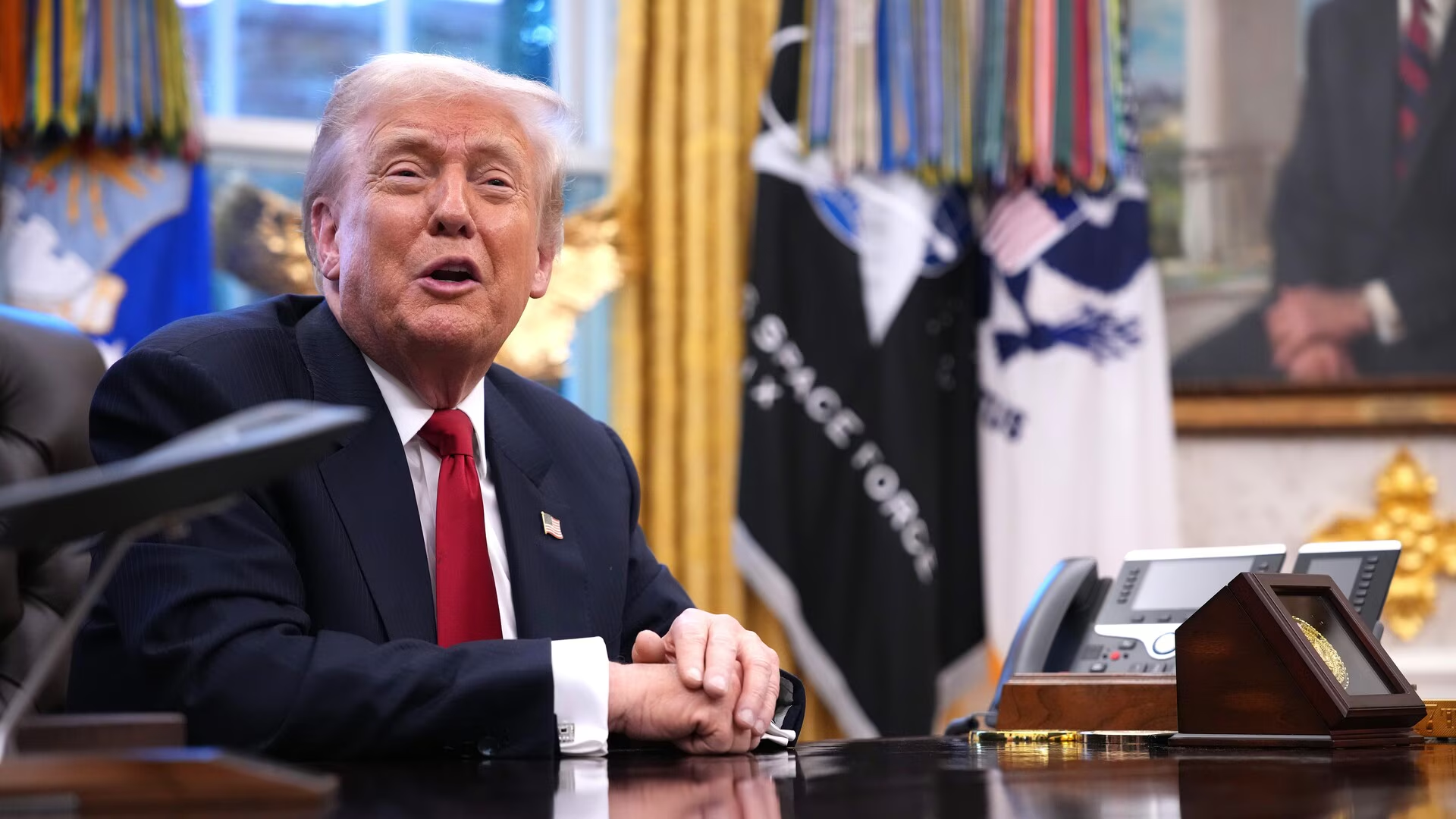
Trump’s Greenland Takeover Remarks Spark NATO Defense Debate – Germany Responds

Germany has stated that discussions around Greenland’s security could be raised within the North Atlantic Treaty Organization (NATO) if circumstances demand it, following renewed remarks from former United States President Donald Trump suggesting an interest in taking control of the Arctic territory. Speaking on Monday, German Foreign Minister Johann Wadephul emphasized that Greenland is legally part of Denmark, underlining that its sovereignty is not in question. He noted that since Denmark is a full NATO member, Greenland automatically falls under the alliance’s collective defense framework. Wadephul’s remarks came after Trump reignited controversy by repeating his long-standing desire to acquire Greenland. The comments unsettled several NATO allies, particularly as they followed recent developments in Venezuela, where Trump had acted on prior threats involving the political leadership of President Nicolás Maduro. Trump initially floated the idea of acquiring Greenland in 2019 during his first term as president. The issue resurfaced on Sunday when he reiterated his position in an interview with The Atlantic, arguing that the territory is vital to U.S. defense interests. According to Trump, Greenland’s strategic location makes it essential for national and international security considerations. While addressing journalists in Lithuania, Wadephul also commented on the situation in Venezuela. He raised concerns over external involvement in the country’s leadership transition and maintained that Venezuela’s future should be determined by its citizens through transparent and democratic elections. His remarks followed Trump’s claim that the United States would assume control over Venezuela’s governance. Returning to the Greenland issue, the German foreign minister reaffirmed that the island remains Danish territory. He explained that because Denmark is protected under NATO’s collective defense obligations, Greenland is similarly covered. “If Denmark is part of NATO, then Greenland is, by extension, included within NATO’s defensive responsibility,” Wadephul stated, adding that any discussion about additional protection would take place within established alliance structures. Contact Information ? Email: [email protected] Stay Updated Stay informed and ahead of the curve.Follow LMSINT MEDIA on WhatsApp to receive real-time updates, breaking news, and exclusive content. Never miss an important headline—join today.

BREAKING: Tinubu Submits Fresh Nominees for NMDPRA and NUPRC Governing Boards

President Bola Ahmed Tinubu has officially transmitted a list of nominees to the Nigerian Senate for confirmation into the governing boards of two critical petroleum sector regulators — the Nigerian Midstream and Downstream Petroleum Regulatory Authority (NMDPRA) and the Nigerian Upstream Petroleum Regulatory Commission (NUPRC). The development was made public on Tuesday by the President’s Special Adviser on Information and Strategy, Bayo Onanuga, who confirmed that formal letters seeking legislative approval had been dispatched to the upper chamber. According to the submission, 21 individuals have been carefully selected to occupy strategic board positions across both agencies, reflecting a mix of returning officials and newly appointed professionals with extensive experience in energy governance, regulation, finance, and administration. NUPRC Board Appointments In the first correspondence to the Senate, President Tinubu nominated Senator Magnus Abe as Chairman of the NUPRC board. Abe, who represented Rivers South-East Senatorial District for two terms, previously served on the board of the Nigerian National Petroleum Corporation (NNPC). He currently heads the National Agency for the Great Green Wall, bringing both legislative and administrative experience to the role. Also listed as non-executive commissioners for the NUPRC are: The President further proposed several executive commissioners to oversee specialized portfolios within the commission. These include: Additionally, Ms. Olayemi Adeboyejo was nominated to serve as Secretary and Legal Adviser to the board. It was noted that some nominees, including Lamido and Adeboyejo, were initially appointed under the administration of former President Muhammadu Buhari, while Alka received his appointment in 2023 under President Tinubu. The remaining nominees represent fresh selections by the current administration. NMDPRA Board Nominations In a separate letter, President Tinubu presented Mr. Adegbite Ebiowei Adeniji as Chairman of the NMDPRA board. Adeniji is a seasoned legal practitioner with over three decades of experience in energy law and natural resource management. His professional background includes service as Special Technical Adviser to the Minister of State for Petroleum Resources on upstream and gas matters. He also contributed to the World Bank Oil and Gas Policy advisory team, offering technical guidance to the Nigerian government. Other nominees for non-executive board positions at NMDPRA include: For executive board roles, the President nominated: Additional board members include: Senate Confirmation and Presidential Charge President Tinubu urged the Senate to expedite the confirmation process, emphasizing the importance of stable leadership within the regulatory agencies. This request follows the recent appointment of Oritsemeyiwa Eyesan as Chief Executive Officer of the NUPRC and Engineer Saidu Aliyu Mohammed as CEO of the NMDPRA. The President further charged all nominated board members to uphold professionalism, transparency, and efficiency in the execution of their regulatory mandates, with the goal of strengthening oversight and performance within Nigeria’s oil and gas industry. Contact Information  Email: [email protected] Stay Updated Stay informed and ahead of the curve.Follow LMSINT MEDIA on WhatsApp to receive real-time updates, breaking news, and exclusive content. Never miss an important headline—join today. Join LMSINT MEDIA Channel

Danish PM Warns Trump to End Greenland Takeover Threats Amid Rising Tensions

Denmark’s head of government has firmly warned former United States president Donald Trump to halt what she described as repeated hostile statements regarding Greenland. Prime Minister Mette Frederiksen dismissed any suggestion that the United States should assume control of Greenland, stressing that such claims are unjustified and unacceptable. According to her, discussions about American ownership of the Arctic territory are entirely misplaced. She further emphasized that the United States does not possess the legal authority to absorb any of the three constituent countries that make up the Kingdom of Denmark. Her comments followed a controversial social media post made by Katie Miller, the spouse of Trump adviser Stephen Miller. In the post, an image of Greenland appeared stylized in the red, white, and blue colors associated with the American flag, accompanied by the word “SOON,” which sparked political tension between Copenhagen and Washington. Donald Trump has repeatedly suggested that Greenland could become part of the United States, pointing to the island’s strategic positioning in the Arctic and its access to valuable natural resources. After Frederiksen’s public response, Trump reinforced his position rather than retracting it. In an official statement released through Denmark’s government platform, Frederiksen stated that she was speaking to Washington in very clear terms. She explained that Denmark, along with Greenland, is a member of the North Atlantic Treaty Organization, meaning the territory already benefits from collective defense protections. She also noted that an existing bilateral defense arrangement already allows the United States military access to Greenland. In addition, Denmark has increased funding and military focus in the Arctic region to strengthen security cooperation. Frederiksen urged the United States to abandon what she called threats against a long-standing partner, as well as against a population that has explicitly expressed it is not open to being sold or transferred. She reiterated that Greenland’s people have made their position clear. Shortly afterward, while speaking aboard Air Force One, Trump repeated his stance, claiming Greenland was essential to American national security. He argued that Denmark lacked the capacity to manage the island’s defense requirements. Earlier, Denmark’s ambassador to the United States responded directly to the social media post shared by Katie Miller. The ambassador reminded the public that Denmark and the US are allied nations and stated that Denmark expects its borders and sovereignty to be treated with respect. This diplomatic exchange occurred against the backdrop of recent American military action in Venezuela. The United States conducted a large-scale operation that resulted in the capture of President Nicolás Maduro and his wife, who were transferred to New York. Trump later announced that the US would oversee Venezuela’s governance and allow American oil firms to operate within the country. Trump has previously declined to rule out military force as a means of securing Greenland. He has repeatedly argued that Greenland’s geographic importance and mineral resources are critical for American technological and defense interests. Tensions increased further after the Trump administration appointed a special envoy focused on Greenland, a decision that was met with strong resistance from Danish officials. Greenland, home to approximately 57,000 residents, has maintained a high level of self-rule since 1979. While Copenhagen still manages defense and international relations, local governance is largely autonomous. Although many citizens in Greenland support eventual independence from Denmark, surveys consistently indicate strong opposition to joining the United States. Contact Information ? Email: [email protected] Stay Updated Stay informed and ahead of the curve.Follow LMSINT MEDIA on WhatsApp to receive real-time updates, breaking news, and exclusive content. Never miss an important headline—join today.

Trump Issues Stark Warning to Venezuela’s Incoming Leader as Maduro Faces US Court Appearance

Former United States President Donald Trump has issued a strong warning to Venezuela’s incoming leader, Delcy Rodríguez, cautioning that she could face consequences “even more severe than Nicolás Maduro” if she fails to act in line with Washington’s expectations. Trump made the statement during an interview with The Atlantic, as Venezuela’s ousted president, Nicolás Maduro, was preparing to appear before a New York court on Monday. Maduro is facing multiple charges from US authorities, including allegations related to drug trafficking and weapons offenses—claims he has consistently rejected. The US government accuses Maduro of operating what it describes as a “narco-terrorist” system. Despite these accusations, Maduro has denied any involvement in criminal networks and insists that the charges are politically motivated. Rodríguez Signals Willingness to Engage the United States Delcy Rodríguez, who previously served as Maduro’s vice president, adopted a notably moderate tone during her first cabinet meeting on Sunday. She publicly expressed openness to cooperation with the United States, emphasizing diplomacy and adherence to international law. “We extend an invitation to the United States government to work with us on a cooperative agenda focused on shared development, within the boundaries of international law,” Rodríguez stated. Supported by Venezuela’s Supreme Court and the nation’s military leadership, Rodríguez is scheduled to be officially sworn in as president on Monday morning in Caracas at 08:00 local time (12:00 GMT). US Officials Deny War Declaration Despite Military Action US Secretary of State Marco Rubio dismissed claims that the United States is at war with Venezuela, following military operations in Caracas on Saturday that resulted in the arrest of Maduro and his wife, Cilia Flores. The pair were subsequently transported to the United States. Some Democratic lawmakers criticized the action, labeling it an “act of war.” However, Rubio maintained that the operation targeted criminal networks rather than the Venezuelan state itself. “We are not at war with Venezuela,” Rubio said during an appearance on NBC’s Meet the Press. “We are at war with international drug trafficking organizations.” Trump Threatens Consequences and Supports Regime Change In his interview with The Atlantic, Trump reiterated his warning to Rodríguez, saying that failure to “do what’s right” would result in serious repercussions. He argued that political change in Venezuela—regardless of how it is defined—would be an improvement over the current situation. “Call it regime change or whatever you want,” Trump remarked. “Anything is better than what exists now. It can’t get worse.” Trump also posted an image on social media showing Maduro aboard the USS Iwo Jima after his arrest, depicting him wearing a blindfold and headphones. The former president further claimed that the United States would temporarily oversee Venezuela until a “safe, proper, and judicious transition” could take place. He added that US oil companies would be brought in to repair infrastructure and revive oil production for economic benefit. Regional Tensions and International Fallout Despite Trump’s statements, Maduro’s political allies remain influential within Venezuela. Cuba, a longstanding ally of the Venezuelan government, reported that 32 Cuban combatants were killed during the US operation. The Cuban government declared two days of national mourning in response. Rubio also warned that the United States retains “multiple levers of leverage” should Venezuela fail to comply with US expectations. Among those measures is the continued restriction—described as a “quarantine”—on Venezuelan oil exports. “We’re going to assess everything based on their actions,” Rubio said. “Our interests will be protected.” Trump Expands Criticism to Colombia Trump did not limit his remarks to Venezuela alone. Speaking aboard Air Force One, he issued harsh comments about neighboring Colombia and its president, Gustavo Petro. He suggested that military action against Colombia was not off the table, stating that such a move “sounds good,” and accused Petro of overseeing cocaine production destined for the United States. Trump described the Colombian leader as “a sick man” and claimed Colombia was being run by a deeply flawed administration. Maduro’s Arrest and Legal Proceedings Maduro, who has led Venezuela since 2013 as head of the United Socialist Party, has long faced accusations of suppressing opposition voices and limiting political freedoms—often through force. Both domestic opponents and international governments have questioned the legitimacy of his victory in Venezuela’s 2024 election. According to US officials, Maduro and his wife were apprehended at their residence during a coordinated special forces operation conducted in the early hours of Saturday. The mission also involved air strikes on military installations. The couple now faces formal charges related to drug trafficking and weapons violations and is expected to appear before a New York court. Maduro has dismissed the accusations, asserting that the US is exploiting its so-called “war on drugs” as a justification to remove him from power and gain access to Venezuela’s oil resources. Disputed Casualties and Congressional Oversight While US authorities claim no American personnel were injured during the operation, Venezuela’s Defense Minister, Vladimir Padrino, alleged that numerous members of Maduro’s security detail, along with soldiers and civilians, were killed. Rubio defended the lack of congressional notification, stating that the mission did not qualify as an invasion and therefore did not require prior approval. He described it as a law-enforcement action carried out on the ground by FBI agents. “You can’t inform Congress in advance about an operation like this—it would leak,” Rubio said during an interview with ABC. When asked whether the United States recognizes Delcy Rodríguez as Venezuela’s legitimate president, Rubio responded that legitimacy was not the issue, emphasizing that Washington does not recognize the Venezuelan regime as valid. Contact Information ? Email: [email protected] Stay Updated Stay informed and ahead of the curve.Follow LMSINT MEDIA on WhatsApp to receive real-time updates, breaking news, and exclusive content. Never miss an important headline—join today.

Lilu Killings: Youths Call on Soludo to Declare State of Emergency

A fresh and urgent Save Our Soul (SOS) appeal has once again been directed to the Governor of Anambra State, Professor Chukwuma Charles Soludo, following the worsening security situation in Lilu Community, located within Ihiala Local Government Area of the state. Concerned youths of the community, operating under the banner of the Concerned Youths Organisation of Lilu, revealed that insecurity in the area has escalated to alarming levels. According to them, incidents of kidnapping, indiscriminate killings of residents, and rampant destruction of properties through arson have become frequent and almost routine, thereby forcing them to speak out publicly. During an interaction with journalists who visited the community on an on-the-spot assessment, the group’s spokesperson, identified simply as Emeka, explained that the appeal was unavoidable due to the scale of devastation and fear gripping the community. He stated that the youth body is determined to exhaust every legitimate avenue to draw both state and federal government attention to the persistent crisis confronting their people. Standing alongside fellow youths and community members at the ruins of St. Andrew’s Anglican Church, which showed clear evidence of violent attacks allegedly carried out by hoodlums, Emeka described the destruction as a painful reminder of the unchecked insecurity plaguing Lilu. The group passionately urged Governor Soludo to immediately declare a state of emergency on insecurity in the community. According to Emeka, such an emergency declaration remains the most effective step capable of enabling security agencies to flush out criminal elements and restore peace and normalcy in the affected areas. He maintained that without decisive intervention, the situation may continue to deteriorate. Beyond security concerns, the youths also appealed to the state government to decentralise the “One Youth, Two Skills” empowerment programme. They argued that bringing the programme closer to grassroots communities like Lilu would allow more young people to participate. Emeka explained that a significant number of youths within and around Lilu are idle, unemployed, uneducated, and unskilled, making them vulnerable and excluded from empowerment opportunities. He noted that many potential beneficiaries feel shy, discouraged, or uncomfortable travelling the long distance from Lilu to Awka merely to inquire about or register for the programme, regardless of its potential benefits. Expressing deep frustration, the youth leader warned that the community might be left with no option but to escalate the matter beyond the state government. He stated that petitions could be sent to the National Assembly, the United Nations, the European Union, President Donald Trump, Ohanaeze Ndigbo, and the Anambra State Association of Town Unions (ASATU), stressing that it has become increasingly apparent to them that the Anambra State Government appears to show little urgency or commitment toward resolving their plight. The Concerned Youths Organisation further lamented that nearly 70 percent of Lilu Community has allegedly fallen under the control of armed men. They specifically mentioned Umuezeala, Eziorsu, Umuodochi, Uhualabor, and Enugwu-Ezenduru villages, among others, as areas severely affected. The group expressed the belief that a well-coordinated and sustained security operation lasting a few hours would be sufficient to dislodge, overpower, and eliminate the hoodlums occupying their community, if the political will is present. Contact Information ? Email: [email protected] Stay Updated Stay informed and ahead of the curve.Follow LMSINT MEDIA on WhatsApp to receive real-time updates, breaking news, and exclusive content. Never miss an important headline—join today.

Tinubu, Kagame Hold Strategic Meeting as Nigeria Expands Diplomatic Reach

President Bola Ahmed Tinubu recently held a private lunch discussion with Rwandan President Paul Kagame in Paris, France, further underlining Nigeria’s steady push to deepen diplomatic relationships across Africa and other influential global centres. The quiet but significant engagement took place on the sidelines of President Tinubu’s international engagements in the French capital. While no official agenda was released, the meeting reflects Nigeria’s growing emphasis on discreet, high-level diplomacy as a tool for advancing foreign policy goals. The interaction was made public by the President’s Special Assistant on Social Media, Dele Olusegun, who shared the update through his verified X (formerly Twitter) account, @DOlusegun. The absence of detailed briefings surrounding the meeting has been interpreted by observers as a deliberate diplomatic approach, often employed to allow frank exchanges without public pressure. Paris Emerges as a Key Diplomatic Hub for Nigeria Since assuming office in 2023, President Tinubu has increasingly used Paris as a strategic location for bilateral engagements. The city has hosted several of his high-level meetings, including past discussions with French President Emmanuel Macron. These meetings have frequently occurred alongside global summits or official working visits, positioning France as a recurring platform for Nigeria’s international outreach. Diplomatic sources suggest that such engagements allow Nigeria to maintain visibility within global decision-making circles while fostering partnerships that align with its long-term economic and security interests. Nigeria–Rwanda Relations and African Cooperation Nigeria and Rwanda share cordial bilateral relations grounded in mutual commitments within the African Union (AU). Both countries have consistently supported initiatives focused on economic integration, particularly through the African Continental Free Trade Area (AfCFTA), as well as regional peace, security collaboration, and institutional reforms across the continent. Earlier in February 2025, Presidents Tinubu and Kagame also met in Abu Dhabi, United Arab Emirates. That earlier engagement, combined with the Paris meeting, points to a sustained dialogue between two of Africa’s most influential leaders from West and East Africa respectively. Foreign policy analysts view these side-line discussions as essential avenues for aligning national interests, sharing perspectives on continental challenges, and strengthening Nigeria’s leadership influence within Africa’s regional blocs. Falana Raises Concerns Over Nigeria’s Security Capacity In a related national discourse, prominent human rights lawyer and Senior Advocate of Nigeria, Femi Falana, expressed strong concerns regarding the country’s ongoing security challenges. He argued that Nigeria’s armed forces possess the capacity to overcome terrorism and banditry if they are adequately motivated and properly equipped. Falana, who spoke with journalists in his hometown of Ilawe Ekiti, lamented that insurgents and criminal groups, as seen in various online videos, sometimes appear better armed than Nigeria’s security personnel. He attributed this situation to years of neglect and mismanagement of key security institutions. According to him, funds earmarked for military hardware and ammunition were allegedly diverted by some individuals, weakening the nation’s defence capabilities. Falana urged the Federal Government to establish effective mechanisms to recover such funds and redirect them toward strengthening the armed forces. He stressed that with proper funding, motivation, and accountability, Nigeria’s military could decisively address terrorism and banditry without relying on foreign intervention. Warnings Over Global Power Politics and Sovereignty Meanwhile, former Nigerian Ambassador to the Philippines, Dr Yemi Farounbi, weighed in on recent global developments, particularly actions taken by former United States President Donald Trump concerning Venezuela. Farounbi described the situation as a clear example of how power dynamics often overshadow international law in global affairs. He warned that such actions undermine national sovereignty and could destabilise international diplomacy. Analysts have echoed these concerns, suggesting that unilateral interventions by powerful nations risk weakening multilateral institutions such as the United Nations (UN). They argue that bypassing established global frameworks could expose smaller nations to increased pressure and insecurity. Speaking in Ibadan, Farounbi cautioned that the precedent set in Venezuela could embolden other global powers. He warned that countries like Russia might feel justified in exerting stronger influence over former Soviet states, while dominant nations in Africa and the Middle East could exploit smaller neighbours, potentially escalating regional instability. Contact Information ? Email: [email protected] Stay Updated Stay informed and ahead of the curve.Follow LMSINT MEDIA on WhatsApp to receive real-time updates, breaking news, and exclusive content. Never miss an important headline—join today.

Kwankwaso Says He Will Only Defect If Offered Presidential or VP Ticket Ahead of 2027 Elections

Former Kano State Governor and national leader of the Kwankwasiyya political movement, Senator Rabiu Musa Kwankwaso, has declared that he will only consider leaving his current political platform if he is offered either the presidential or vice-presidential ticket ahead of the 2027 general elections. Kwankwaso made this known on Saturday while speaking to loyal supporters of the New Nigeria Peoples Party (NNPP) at his private residence in Kano State. According to him, any potential defection must align with his long-standing political relevance and the expectations of his widespread support base across Nigeria. The former governor emphasized that his political structure, which has been built and sustained for over four decades, would not support a move to another party unless it guarantees him one of the country’s two highest political offices in the next general election cycle. He explained that his followers nationwide believe strongly in his leadership and would reject any political arrangement that sidelines him from a presidential or vice-presidential position. Kwankwaso further disclosed that the All Progressives Congress (APC) had approached him with an invitation to join the ruling party. However, he stated that he turned down the offer because it lacked clarity and failed to present any meaningful political value. According to him, discussions with the APC did not produce convincing answers regarding what role he would play if he joined the party. He questioned whether the offer was limited to political appointments and asked how such positions would align with his political standing, as well as the principles of the NNPP leadership. He noted that no definite response was given to these questions, which ultimately led him to reject the proposal. Reaffirming his political direction, Kwankwaso stated that the NNPP remains fully committed to the Kwankwasiyya ideology, a movement centered on improving the welfare of ordinary citizens. He highlighted the party’s focus on poverty alleviation, youth empowerment through education and employment, economic growth, access to quality healthcare, and agricultural development. He stressed that the NNPP is preparing seriously for the 2027 general elections, describing the upcoming contest as a collective national effort that demands cooperation and unity, especially within Kano State. Kwankwaso emphasized that political unity in Kano is essential for electoral success, noting that internal division could weaken the party’s chances in the next election. He also reacted to reports suggesting a possible defection by Kano State Governor, Abba Kabir Yusuf, describing such a move as a betrayal of trust. Despite expressing disappointment, he urged his supporters to remain calm, focused, and prayerful as political events continue to unfold. Kwankwaso lamented that after the collective struggle to reclaim Kano State from the influence of former governor Abdullahi Ganduje and the APC, the alleged move could undo those efforts without resistance. Contact Information ? Email: [email protected] Stay Updated Stay informed and ahead of the curve.Follow LMSINT MEDIA on WhatsApp to receive real-time updates, breaking news, and exclusive content. Never miss an important headline—join today.

PDP Crisis Deepens as Umar Sani Says Party Leaders Want Wike to Exit

Former Presidential Media Adviser, Umar Sani, has alleged that the Minister of the Federal Capital Territory, Nyesom Wike, is intentionally fueling instability within the Peoples Democratic Party (PDP). According to Sani, influential leaders within the opposition party no longer feel comfortable with Wike’s continued membership, insisting that his actions have become harmful to the party’s unity and future. Speaking during an interview on ARISE News on Saturday, Sani provided insight into the widening disagreement between Wike and several PDP governors, the internal leadership struggle, and the potential consequences for the party ahead of the 2027 general elections. Sani explained that the ongoing conflict inside the PDP is not rooted in personal hostility but rather in resistance to what party stakeholders perceive as Wike’s excessive influence and disruptive conduct. Directly addressing the former Rivers State governor, Sani stated that if Wike believes the PDP cannot function without him, then he should consider leaving the party altogether. “From our standpoint, we want him to go. Let him move to the APC and see how we manage. We cannot continue accommodating someone who is destructive,” Sani declared. Despite his strong position, Sani maintained that reconciliation is still possible if Wike admits wrongdoing and seeks forgiveness. “If he acknowledges his errors and returns saying, ‘Please accept me,’ we will. This is simply the story of the prodigal son,” he added. Sani further clarified that Wike’s confrontations with PDP governors are not personal feuds but symptoms of deeper structural issues within the party. He suggested that PDP leaders suspect the presence of an internal saboteur working to weaken the party from within. “You cannot constantly drag people into crisis. You are fighting this person today, another tomorrow,” he said. “All these developments are not because they hate him or he hates them. It is the PDP’s internal challenge.” According to Sani, tensions escalated significantly when it became clear that Wike would not have any representation in the party’s National Working Committee (NWC). He noted that this would be the first time the PDP would constitute an NWC without a single nominee linked to Wike. Sani explained that Wike believed he deserved representation, but party leaders disagreed. “They felt you cannot eat your cake and still keep it. You cannot actively work for the APC and still expect to impose candidates within the PDP,” he explained. On the legal actions initiated by Wike against the party’s internal processes, Sani dismissed the claims entirely, describing them as unfounded. “Everything he took to court is just a collection of falsehoods,” Sani stated. He emphasized that the PDP followed its constitutional guidelines during its convention, contrary to Wike’s allegations. “For a convention to hold, two-thirds of the states must be present, and that requirement was met. Claims that 16 states lacked congresses are simply untrue.” Reacting to Oyo State Governor Seyi Makinde’s assertion that Wike promised to weaken the PDP in favor of President Bola Tinubu ahead of 2027, Sani said he believed Makinde’s account. “Governor Makinde is not known for dishonesty. I do not think he would fabricate such a serious allegation. I am convinced Wike made that statement,” he said. Sani also addressed accusations made by Bauchi State Governor Bala Mohammed, who alleged that Wike orchestrated harassment against him through anti-corruption agencies. Sani pointed to Wike’s political weight in Abuja while criticizing the Economic and Financial Crimes Commission (EFCC) for what he described as selective enforcement. “The EFCC has become a textbook example of selective prosecution. How can Nigerians trust such an institution?” he questioned. Despite the internal turmoil, Sani expressed confidence that the PDP would ultimately resolve its challenges through the judicial system. He referenced past Supreme Court rulings which clearly state that the Independent National Electoral Commission (INEC) has no authority to interfere in the internal affairs of political parties. “We are waiting for the higher courts to reaffirm those judgments. Once that happens, the issue is settled,” he said. Looking ahead to the 2027 elections, Sani dismissed claims that the PDP is politically finished. He insisted the party would regain strength once its legal matters are concluded. “Once the PDP overcomes this phase, the momentum will return. The political traffic will shift, and all roads will lead back to the PDP,” he said. On Peter Obi’s decision to move to the African Democratic Congress (ADC), Sani stated that the former Labour Party presidential candidate still has the option of returning to the PDP. “If he is denied a ticket elsewhere, the PDP remains his only viable alternative, and we are ready to offer him the platform,” he noted. Sani concluded by stressing that the PDP remains Nigeria’s most formidable political platform, citing its nationwide structure, extensive reach, and loyal support base as unmatched by any other opposition party. Contact Information ? Email: [email protected] Stay Updated Stay informed and ahead of the curve.Follow LMSINT MEDIA on WhatsApp to receive real-time updates, breaking news, and exclusive content. Never miss an important headline—join today.

Makinde Gives Official Approval to Prince Ashiru Oyebisi Olalere as New Onilua of Ilua

Oyo State Governor, Engineer Seyi Makinde, has formally granted approval for the appointment of Prince Ashiru Oyebisi Olalere as the new Onilua of Ilua, a highly revered traditional position located in Kajola Local Government Area of Oyo State. This development officially brings the long-awaited succession process for the historic Ilua royal stool to a close, marking a new chapter in the traditional governance of the community. The Ilua throne holds deep cultural importance, symbolizing heritage, leadership continuity, and community identity within Kajola Local Government. The governor’s decision was communicated through an official correspondence issued by the Oyo State Ministry of Local Government and Chieftaincy Matters, headquartered in Ibadan. The letter serves as formal confirmation that due process was followed in line with state regulations governing traditional rulership appointments. According to the document, the approval letter was dated December 31, 2025, and referenced as CB.141/26A Vol. III/99. It was duly signed by the Director of Chieftaincy Matters, A.M. Olajire, thereby validating the authenticity and legality of the appointment. The ministry’s communication stated clearly that Governor Makinde had “graciously approved” the selection of Prince Ashiru Oyebisi Olalere as the Onilua of Ilua. The approval takes retrospective effect from October 20, 2023, in accordance with established statutory guidelines. Furthermore, the state government confirmed that the appointment will be published in the Oyo State Government Official Gazette, fulfilling all legal and administrative requirements that regulate traditional institutions within the state. Gazette publication remains a critical step in formalizing royal appointments and ensuring public recognition. The emergence of the new Onilua has been met with widespread acceptance and goodwill among residents of Ilua and key stakeholders across Kajola Local Government Area. Community members have expressed optimism that the ascension will reinforce unity, preserve cultural values, and enhance cooperation between traditional leadership and government authorities. In its congratulatory message, the Oyo State Government expressed strong confidence that the reign of Prince Ashiru Oyebisi Olalere would promote peaceful coexistence, social harmony, and steady socio-economic advancement within Ilua and neighboring settlements. The official letter concluded with goodwill wishes, expressing hope that the monarch’s tenure would reflect the legacy of his ancestors while contributing positively to grassroots development.

New Dimension of Alaafin–Ooni Rivalry: Okanlomo of Yorubaland (Seyi Tinubu) Versus Okanlomo Oodua

The long-standing rivalry surrounding cultural authority and traditional influence between the Ooni of Ife, Oba Adeyeye Ogunwusi, and the Alaafin of Oyo, Oba Abimbola Owoade, has taken on a fresh dimension following the recent conferment of a prestigious title on Seyi Tinubu, son of Nigeria’s President, Bola Ahmed Tinubu. The Alaafin of Oyo formally installed Seyi Tinubu as Okanlomo of Yorubaland, a development that has further intensified discussions about supremacy, jurisdiction, and leadership within the Yoruba traditional structure. This action has been widely interpreted as significant, given the historical sensitivities surrounding titles that symbolically represent the entire Yoruba nation. The installation ceremony, held about two weeks prior, attracted a high-profile audience. Distinguished personalities present included Senate President Godswill Akpabio, former Ogun State governor Otunba Gbenga Daniel, Deputy Speaker of the House of Representatives Benjamin Kalu, members of the Federal Executive Council, and several traditional rulers from different parts of Nigeria and the Benin Republic. The gathering underscored the political and cultural weight attached to the title. Notably, this event occurred barely a month after the Ooni of Ife, during an elaborate traditional ceremony, installed Chief Jubril Dotun Sanusi, a prominent Ibadan-based businessman, as Okanlomo Oodua. The proximity of both installations has continued to fuel debate, with many observers interpreting the developments as a subtle contest for influence. Traditionally, the Okanlomo title holder is expected to serve as a cultural ambassador of the Yoruba people, offer counsel to the monarch, promote unity among Yoruba communities, and contribute to the advancement of education, social welfare, and collective development. Earlier in August, the Alaafin had openly challenged the Ooni’s decision to bestow the Okanlomo title on Sanusi. Through a statement released by his Director of Media and Publicity, Bode Durojaiye, Oba Owoade described the action as a violation of established authority and an encroachment on his position as the paramount ruler of Yorubaland. The Alaafin’s camp insisted that titles bearing jurisdiction over the entire Yoruba land fall exclusively under the authority of the Alaafin, citing a Supreme Court ruling in support of this claim. The Ooni was reportedly given a 48-hour ultimatum to withdraw the title or face consequences. Part of the statement emphasized that conferring such a title outside the Alaafin’s authority disregarded the apex court’s decision and undermined the revered institution of the Oyo throne. However, following what appeared to be a resolution of the disagreement, Oba Owoade proceeded to install Seyi Tinubu as Okanlomo of Yorubaland. Many have interpreted this move as a symbolic reassertion of authority and a strategic response to earlier events. Admirers of the President’s son welcomed the decision, while analysts continued to dissect its broader implications. On October 25, a peace meeting involving leading Yoruba monarchs was convened by renowned businessman and philanthropist Kessington Adebutu as part of activities marking his birthday celebration. The meeting was aimed at resolving the tensions arising from the competing Okanlomo titles. At the gathering, the Ooni of Ife and the Alaafin of Oyo appeared to reach a common understanding. The outcome was the announcement of the formation of the Joint Council of Yoruba Unity (JCUY), a body established to encourage peace, protect cultural heritage, and promote economic and social development across Yorubaland. In a communiqué signed by the royal fathers, witnessed by Adebutu, and issued by Kola Oyefeso, Secretary of the Communiqué Drafting Committee, both monarchs reaffirmed their commitment to unity, respect, and cooperation. The communiqué described the moment as historic, stressing a shared determination to foster harmony among Yoruba people and uphold the values of brotherhood handed down by their ancestors. Despite this reconciliation, the decision to install Seyi Tinubu reportedly surprised many observers. The move has reignited public discourse about an age-long rivalry between the two royal stools—one that predates the current occupants and has shaped Yoruba traditional politics for decades. Some commentators described the Alaafin’s decision as tactically astute, suggesting it could signal a shift toward shared authority in the conferment of titles that carry pan-Yoruba significance. On social media platform X (formerly Twitter), reactions varied widely. An X user, Abraham Kowo, argued that sustainable peace would only be achieved if titles referencing Yorubaland or Oduduwa were jointly conferred by both monarchs. Conversely, another commentator, Steven, questioned the historical basis of such an arrangement, asking when the Ooni ever conferred titles representing the entire Yoruba land. Another user, Ade, criticized Seyi Tinubu’s acceptance of the title, pointing out that a similar title had already been conferred by the Ooni. He suggested the development was another episode in the recurring rivalry between both traditional leaders. Meanwhile, Akewugberu Damilola opined that both monarchs were asserting dominance within their respective domains, noting that the Ooni appeared to be ahead in influence. Providing historical context, renowned Ifa priest and traditional authority, Araba Ifayemi Elebuibon, explained in a recent interview that the rivalry between the Alaafin and the Ooni dates back to the colonial era. According to him, political interference over the years further deepened the divide. Elebuibon recalled the intense rivalry between the late Oba Okunade Sijuwade and the late Oba Lamidi Adeyemi, noting that it nearly rendered the Yoruba Council of Obas ineffective in the former Oyo State. He added that disagreements over who held consenting authority in the appointment of certain monarchs—before the creation of Osun State—also contributed to the tension. Politically, he noted, the lack of unity between both royal figures weakened the Yoruba nation’s collective influence. Elebuibon urged restraint and cooperation, warning that ongoing supremacy struggles do not serve the global interests of the Yoruba people. He emphasized that unity and development should take precedence over rivalry, stressing that continued conflicts only bring embarrassment to Yoruba communities both at home and in the diaspora. Contact Information ? Email: [email protected] Stay Updated Stay informed and ahead of the curve.Follow LMSINT MEDIA on WhatsApp to receive real-time updates, breaking news, and exclusive content. Never miss an important headline—join today.

Kamala Harris Criticises Trump’s Venezuela Military Intervention

Former United States Vice President Kamala Harris has openly criticised the Trump administration following its reported military operation in Venezuela, describing the intervention and capture of President Nicolás Maduro as a dangerous and irresponsible escalation of U.S. foreign policy. In a public statement shared on X early Sunday, Harris warned that the overnight strikes and extraction of Venezuela’s leader signal a return to an era of regime-change actions that have historically produced instability rather than security. She characterised the move as being driven by political ambition and resource interests rather than genuine national safety concerns. According to Harris, the harsh reputation of the Maduro government does not justify bypassing established legal frameworks or ignoring international sovereignty. She stressed that no executive authority should be granted unrestricted power to act outside domestic law or global legal standards, regardless of how oppressive a foreign government may be. She further argued that the administration’s approach mirrors past foreign policy missteps that were initially promoted as displays of strength but ultimately resulted in prolonged conflict and disorder. Harris stated that such operations often lead to long-term consequences that disproportionately affect American families and service members. The former Vice President directly challenged the White House’s explanation for the mission, which officials have framed as a focused operation against a narco-terrorist structure. Harris dismissed this justification, asserting that the public has grown weary of misleading narratives used to rationalise military action. Instead, she claimed the intervention has little to do with combating drug trafficking or defending democratic values. Harris alleged that the real motivations behind the operation are linked to oil interests and President Trump’s desire to assert dominance in the region. She also pointed out what she described as contradictions within the administration’s broader Venezuela policy. Harris questioned how the government could claim to uphold democratic principles while marginalising Venezuela’s recognised democratic opposition and reportedly engaging with individuals formerly aligned with Maduro. Raising concerns about consistency and accountability, Harris highlighted domestic contradictions as well, noting that the administration has shown leniency toward convicted drug offenders at home while claiming to combat narcotics abroad. She questioned how such actions align with the stated commitment to the rule of law. In her closing remarks, Harris emphasised the financial and human toll of the operation. She warned that U.S. troops are being placed in harm’s way and that billions of dollars are being spent without a clearly defined exit strategy or explicit legal approval from Congress. Harris called for a redirection of national priorities, urging leaders to focus on reducing the financial burden on working families, reinforcing international partnerships, and avoiding destabilising military actions that deliver no clear benefit to American citizens. By likening the intervention to “a movie we’ve seen before,” Harris tapped into widespread public exhaustion with prolonged foreign conflicts. Her remarks underscore what she sees as a fundamental contradiction: sidelining Venezuela’s legitimate opposition while simultaneously claiming to act in defence of democracy. Contact Information ? Email: [email protected] Stay Updated Stay informed and ahead of the curve.Follow LMSINT MEDIA on WhatsApp to receive real-time updates, breaking news, and exclusive content. Never miss an important headline—join today.

Kano State Government Denies Any Role in Alleged Nasarawa Palace Event

The Kano State government has officially clarified that it has no involvement in any planned activities reportedly linked to the Nasarawa Palace Emir, Alhaji Aminu Ado Bayero. The statement was released by Malam Sanusi Bature Dawakin Tofa, the Director-General of Media and Publicity to the Kano State Governor, via his verified Facebook page. This clarification came in response to circulating reports suggesting that a gathering associated with the Nasarawa Palace was being organised in collaboration with the Kano State Government and its affiliates. These claims sparked concern among loyalists of the Emir of Kano at Kofar Kudu, Malam Muhammadu Sanusi II, who have closely followed the ongoing emirate dispute. In addressing the situation, Malam Sanusi Bature firmly dismissed the circulating narratives, labeling them as unfounded and false information. He stressed that the state government has no connection with any Nasarawa Palace event and urged citizens to disregard such misleading reports. The longstanding Kano Emirate dispute, which involves Khalifa Muhammadu Sanusi II and Alhaji Aminu Ado Bayero, has significantly divided the region. Following the electoral victory of Kano Governor Abba Kabir Yusuf under the New Nigeria Peoples Party (NNPP), Sanusi II was reinstated as the Emir of Kano, with the state government officially recognizing his position. Meanwhile, Alhaji Aminu Ado Bayero has garnered support from certain quarters within the Federal Government, further intensifying the division. Recent political developments, including reports of Governor Abba Kabir Yusuf potentially decamping to the All Progressives Congress (APC), suggest that the emirate dispute could evolve in a new direction in the near future. Political analysts argue that this may lead to shifts in alliances that could influence the traditional leadership dynamics in Kano State. The Kano State Government’s official clarification reinforces its commitment to maintaining transparency and public trust amid ongoing political tensions. Residents and stakeholders are encouraged to rely on verified government statements and official channels for accurate information.