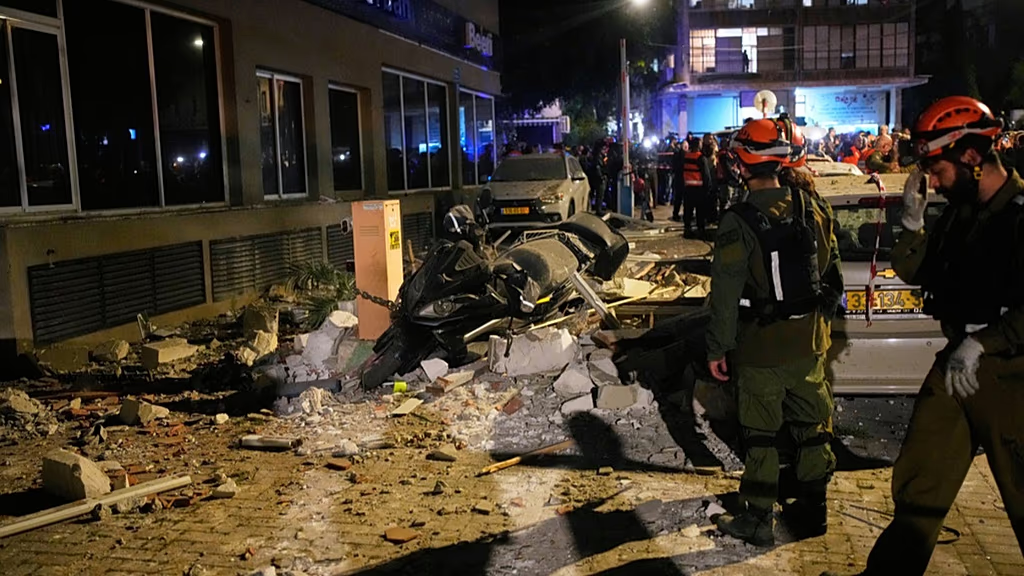
Two individuals who survived the deadly assault on St. Francis Catholic Church in Owo, Ondo State, have given emotional testimonies before a Federal High Court in Abuja, describing the chaos and trauma that followed the 2022 attack which claimed about 40 lives. The witnesses appeared in court during the ongoing trial of five suspects accused of planning and executing the violent incident. The attack occurred while worshippers were attending a church service, turning a peaceful gathering into a scene of fear and devastation. According to the testimonies, the attackers stormed the church and opened fire, while several explosive devices were also detonated within the premises. The assailants are alleged to be linked to the Al-Shabab extremist group. One of the survivors, whose identity was concealed for security reasons and identified only as “SSC,” gave her account from behind a protective screen. She told the court that she suffered a serious injury to her left leg as a result of one of the explosives used during the attack. The witness explained that the sudden sound of gunfire caused widespread panic inside the church, leaving her disoriented and unsure of how to escape. She recalled that the situation worsened after an elderly woman seated near her was fatally struck, prompting a member of the church choir to pull her toward the altar area in an attempt to find safety. While at the altar, she said she was assisted by another worshipper, identified as Chinedu Ojukwu, who helped her lie flat on the floor as the attack continued. Moments later, the attackers reportedly moved toward the altar and questioned the worshippers about their actions. The witness narrated that one of the assailants noticed her movement and issued a threat. Shortly after, an explosive device was placed close to her. Although she attempted to move away after being warned, she was unaware that part of her body was still within the blast range when the device detonated, resulting in a severe leg injury. During the proceedings, the court requested confirmation of her claims. The witness stepped forward and physically displayed her injured leg to substantiate her testimony. The second survivor also shared a separate account supporting the sequence of events, reinforcing the prosecution’s case against the accused persons. The trial continues as the court examines evidence and testimonies linked to one of the most tragic attacks on a place of worship in Nigeria’s recent history.
The Nigeria Police Force has confirmed that the Inspector-General of Police (IGP) has issued a directive for the immediate release of students who were genuinely involved in the recent protest in Edo State. This disclosure was made by the Force Public Relations Officer, Benjamin Hundeyin, during a televised interview on Politics Today, a current affairs programme aired on Channels Television on Tuesday. According to Hundeyin, the directive followed concerns raised over the arrest of individuals during the protest, particularly students who were exercising their rights peacefully. Hundeyin explained that while there has historically been a level of mistrust between the public and law enforcement agencies, efforts are ongoing to rebuild confidence and improve engagement. He noted that the situation has improved compared to previous years due to continuous advocacy and public-oriented policing initiatives carried out by the Nigeria Police Force. He stated that the Inspector-General of Police specifically instructed the Commissioner of Police in Edo State to ensure that only those who are confirmed to be genuine students arrested during the protest are released without delay. This move, according to Hundeyin, reflects the commitment of the police leadership to fairness, accountability, and public trust. The police spokesperson further explained that protests can sometimes escalate beyond the capacity of nearby police units. In such instances, standard operational procedures require officers to request reinforcement. Using the situation in Ekpoma as an example, Hundeyin said the nearest police formations may have initially struggled to control the protest, prompting the need for additional support. As a result, reinforcement teams were deployed, and senior officers, including the Commissioner of Police, moved from Benin City to Ekpoma to assess and manage the situation firsthand. He added that the Area Commander, several Divisional Police Officers (DPOs), and other officers were present on ground to restore order and ensure safety. Hundeyin emphasized that this approach aligns with global policing standards, where reinforcement is introduced when situations threaten to spiral out of control. He maintained that such measures are taken to prevent further escalation and protect both civilians and security personnel. Despite the challenges, the Nigeria Police Force reiterated its willingness to strengthen collaboration with citizens. Hundeyin concluded by calling on members of the public to work more closely with the police, stressing that mutual cooperation remains essential for maintaining peace and ensuring public safety.
The United States has reinforced its security cooperation with Nigeria by supplying military support equipment to Nigerian security agencies to aid ongoing security operations across the country. The delivery was officially confirmed by the United States Africa Command (AFRICOM) through a statement shared on its verified X (formerly Twitter) account on Tuesday. According to the command, the military items were handed over in Abuja as part of efforts to strengthen Nigeria’s operational capacity in combating security threats. AFRICOM stated that U.S. forces delivered essential military supplies to Nigerian partners, emphasizing that the move reflects the strong and ongoing security partnership between both nations. The command highlighted that the assistance is aimed at supporting Nigeria’s current counter-terrorism and internal security operations. This development comes at a time when Nigeria is experiencing a significant rise in security challenges, particularly in various regions of the country. In recent months, cases of abduction, armed attacks, and banditry have escalated, leading to the kidnapping of hundreds of civilians and increasing pressure on security agencies to restore stability. In addition to the equipment delivery, U.S. military involvement in Nigeria’s security efforts was further demonstrated during the Christmas period. On Christmas Day, U.S. forces reportedly carried out airstrikes targeting terrorist hideouts in parts of North-West Nigeria, signaling intensified international collaboration against extremist groups. The continued cooperation between Nigeria and the United States underscores a shared commitment to addressing terrorism, organized crime, and other security threats. Analysts believe that such partnerships could enhance intelligence sharing, operational effectiveness, and regional stability if sustained over time.
Scenes of heartbreak and uncertainty unfolded at the Kahrizak Forensic Medical Center, located south of Tehran, as grieving Iranians gathered around rows of bodies wrapped in black bags. Families cried out in despair, struggling to identify loved ones amid overwhelming confusion. Inside makeshift morgue spaces and outside on bare ground, bodies lay in numbers that far exceeded the facility’s capacity. Despite a nationwide internet shutdown, videos managed to circulate beyond Iran’s digital blackout. These clips, recorded earlier in the week and shared widely over the weekend, reveal distressing images of dozens of bodies stored in warehouse-like rooms and scattered across open courtyards. Families moved from one body to another, desperately searching for missing relatives believed to be victims of Iran’s latest wave of protest-related violence. The unrest erupted following worsening economic conditions, triggering widespread demonstrations across the country. These protests now represent one of the most serious challenges to Iran’s leadership in recent years. According to visual evidence reviewed by the US-based Human Rights Activists News Agency (HRANA), an estimated 250 bodies are believed to be held at the Kahrizak facility alone. Footage from the scene shows body bags lined along walkways and spread across unpaved areas near parked vehicles. Some bodies were placed just outside the forensic building due to lack of space. The activist organization Mamlekate reported that the sheer number of deceased individuals forced authorities to use the courtyard as an extension of the morgue. Another recording, captured inside a nearby warehouse, shows a room converted into a temporary morgue. Bodies wrapped in black coverings were arranged on floors and metal tables, forming long rows that underscored the scale of the fatalities linked to the unrest. Iranian state media acknowledged the existence of the scenes but presented a different explanation. Officials claimed that most of the deceased were not protesters but ordinary citizens who were unintentionally caught in violent disturbances. State outlets attributed the deaths to actions carried out by what they described as “rioters.” Competing Narratives and Government Messaging State-affiliated outlets, including Tasnim News Agency and Student News Agency, released their own footage from the vicinity of the forensic center. In these videos, reporters interviewed mourning families who stated that their relatives were not involved in demonstrations and had no intention of protesting. One grieving man, seated beside a body bag, told a state reporter that his loved one was struck in the head by an object thrown from a building. He emphasized that the deceased supported the government. The reporter later addressed the camera, suggesting that some individuals among the dead may have attempted to confront security forces or seize military facilities. However, the overall message emphasized that most victims were everyday citizens from non-political families. Observers say this narrative reflects a broader attempt by authorities to discourage further protests by shifting responsibility for the violence away from state forces. Human rights organizations strongly dispute this portrayal. Given Iran’s long history of suppressing dissent through force, advocacy groups argue that available evidence contradicts official claims. Michael Page, deputy director of Human Rights Watch’s Middle East and North Africa division, stated that Iranian authorities bear responsibility for the deaths and injuries of civilians during the demonstrations. Use of Force and Human Rights Concerns Iranian leaders have repeatedly warned citizens against joining what they label as foreign-backed agitators and violent elements. President Masoud Pezeshkian has publicly differentiated between peaceful demonstrators and those he described as disruptors of public order. The country’s attorney general has pledged severe legal consequences for the latter, including capital punishment. Despite these statements, rights groups argue that Iranian authorities have historically failed to distinguish between peaceful protesters and violent actors. Large gatherings are often treated as existential threats, leading to aggressive responses from security forces. The Interior Minister, Eskandar Momeni, claimed on state television that security personnel exercise restraint to avoid civilian harm. Yet eyewitness accounts and independent testimonies suggest otherwise. Protest participants and observers reported seeing security forces using military-grade weapons against crowds. In Tehran, witnesses described multiple fatalities after armed forces intervened during demonstrations. An Iranian social worker also recounted seeing a young girl incapacitated after being struck with a Taser. According to HRANA, more than 500 protesters, including children, have been killed since demonstrations began in late December, with over 10,000 arrests recorded. Due to internet restrictions and limited access to information, these figures cannot be independently verified. Iranian state media, meanwhile, claims that over 100 members of security forces have also lost their lives. As Iran enters its sixth day of restricted internet access, fragmented videos from places like Kahrizak provide rare insight into the true human toll of the unrest. These images suggest a crisis far deeper than official statements acknowledge, leaving families with grief, unanswered questions, and little hope for accountability.
Bandits have reportedly killed two people and abducted several others during a violent attack on Unguwar Nagunda, a community located in Kankara Local Government Area of Katsina State. The incident occurred on Sunday night when armed assailants stormed the village at the exact moment a wedding convoy was entering the community from Mabai, another settlement within the same local government area. The arrival of the convoy reportedly coincided with the bandits’ invasion, leading to chaos, panic, and loss of lives. According to information shared on Monday via X by a security analyst identified as Bakatsine, the attackers opened heavy gunfire upon reaching the area. Residents were thrown into fear as people attempted to flee for safety while others were caught in the crossfire. Bakatsine disclosed that at least two individuals lost their lives during the attack, while several others sustained gunshot injuries. Among those injured was the bride, who was reportedly part of the wedding convoy targeted by the bandits. In addition to the fatalities and injuries, an unspecified number of wedding guests were abducted by the attackers. The exact figure of those taken away remains unknown, as families and community members are still making efforts to identify and account for their missing relatives. In his statement, Bakatsine explained that residents described the situation as terrifying, with sustained gunshots echoing through the community as the bandits carried out the attack. “Last night, bandits attacked Unguwar Nagunda in Kankara LGA, Katsina State, just as a wedding convoy was arriving from Mabai, another community in the same local government. Residents report heavy gunfire and widespread panic as the bandits struck. At least two people were killed, several others injured, including the bride, and an unknown number of wedding guests were abducted. As of this morning, families are still trying to confirm how many people were taken,” he wrote. As of the time this report was filed, the Katsina State Police Command had not released any official statement regarding the attack or the condition of the abducted victims. Security agencies were also yet to confirm whether rescue operations had commenced. The incident adds to the growing concerns over insecurity in parts of Katsina State, where rural communities have continued to face repeated attacks by armed groups.
Sudan’s transitional leadership has officially returned to the capital city, Khartoum, almost three years after violent conflict forced the government to relocate. Speaking to journalists on Sunday, Prime Minister Kamil Idris confirmed that the administration, which he described as a “government of hope,” has resumed operations from the war-scarred capital. The announcement marks a significant political and symbolic turning point for the country, following prolonged fighting that left Khartoum devastated and largely uninhabitable for millions of residents. Military Retakes Capital After RSF Occupation The Sudanese army lost control of Khartoum in 2023 when clashes erupted between national armed forces and the Rapid Support Forces (RSF), a powerful paramilitary group. The RSF quickly seized strategic locations across the city, forcing the government and military leadership to withdraw. In a major military breakthrough last March, government troops succeeded in reclaiming Khartoum, paving the way for the return of civilian leadership. The recapture ended a long period of RSF dominance marked by instability, widespread destruction, and humanitarian suffering. Civilian Suffering and Mass Displacement At the height of the conflict, approximately five million people fled Khartoum, according to United Nations estimates. Those who remained behind endured severe hardship under RSF control. Residents reported widespread looting, forced occupation of private homes, and violence against civilians. Entire neighborhoods were stripped of essential infrastructure, leaving much of the city unrecognizable. Large portions of Khartoum remain in ruins, with damaged roads, destroyed hospitals, and collapsed public utilities. In October, UN official Ugochi Daniels warned that essential services in the capital were “barely functioning,” highlighting the scale of recovery still required. Government Pledges Restoration of Basic Services Prime Minister Idris stated that restoring essential services would be a top priority for the returning government. He outlined immediate plans to stabilize electricity supply, water access, healthcare systems, and educational institutions across the city. The administration aims to rebuild public confidence and encourage displaced residents to return, although security and infrastructure challenges remain significant obstacles. A Declaration of Peace Amid Ongoing Crisis During the announcement, Idris declared that 2026 would be a “year of peace” for Sudan, a statement aimed at signaling a new political direction after years of bloodshed. Since the conflict began, at least 150,000 people have been killed, and the United Nations has labeled the situation the world’s worst humanitarian crisis. More than 12 million people have been forced to flee their homes, both internally and across borders. Roots of the Conflict The war originated from a power struggle between Sudan’s army chief, General Abdel Fattah al-Burhan, and his former deputy, General Mohamed Hamdan Dagalo, who leads the RSF. Their fallout triggered a violent contest for national control, plunging the country into chaos. Both the Sudanese military and the RSF have faced accusations of serious human rights violations throughout the conflict. Despite repeated diplomatic efforts, international peace initiatives have failed to produce lasting results. Foreign Involvement and Global Scrutiny The conflict has been further complicated by external involvement. Several foreign governments have been accused of supplying weapons and political backing to rival factions. In recent months, the United Arab Emirates (UAE) has faced increased scrutiny over allegations that it supports the RSF. UAE officials have strongly denied these claims.
Iran has issued a strong warning that it will respond forcefully if the United States launches any form of military action, as reports from activists indicate that hundreds of protesters have been killed amid a widening government crackdown. Sources inside Tehran describe the situation as extremely dire, with heavy security presence and widespread use of live ammunition against demonstrators. One resident told reporters that conditions on the streets resemble an active battlefield, with bodies being removed in trucks and blood visible across major roads. Independent verification remains difficult, but visual evidence emerging from medical facilities near Tehran suggests a rapidly rising death toll. Footage reviewed by journalists showed rows of body bags inside a morgue located in Kahrizak, south of the capital. Human rights monitoring groups based outside Iran have reported that nearly 500 protesters have lost their lives nationwide, alongside dozens of security personnel. In addition to the fatalities, thousands of citizens have reportedly been arrested over the past two weeks as protests continue to spread across multiple provinces. Activist networks estimate that more than 10,000 people are currently being held in detention facilities. U.S. Response and Military Considerations Tensions escalated further after the United States warned it could take action in response to the killing of civilians. However, U.S. President Donald Trump stated on Sunday that Iranian officials had reached out seeking negotiations. Despite this, he indicated that Washington might act before any formal talks take place, adding that several aggressive options are under review. Although no specific plan has been announced publicly, U.S. officials have confirmed that military strategies, including potential strikes, have been presented to the president. Other measures reportedly under consideration include expanded economic sanctions, cyber operations targeting Iran’s military infrastructure, and increased support for opposition voices online. Iran’s parliamentary leadership reacted swiftly, cautioning that any American attack would place U.S. military assets and allies in the region, including Israel, at risk. Iranian officials stated that such locations would be considered legitimate targets in the event of escalation. Protests Shift from Economic Anger to Political Demands The demonstrations initially began as public outrage over worsening economic conditions and soaring inflation. Over time, however, the movement has evolved into a broader challenge against Iran’s clerical leadership, with protesters openly demanding the removal of Supreme Leader Ayatollah Ali Khamenei. Government officials have taken a hardline stance. Iran’s attorney general declared that participants in the protests would be treated as enemies of God, a charge that carries the death penalty under Iranian law. Meanwhile, the supreme leader dismissed demonstrators as destructive elements allegedly acting to satisfy foreign interests. State authorities announced a three-day period of mourning, honoring individuals they described as martyrs killed during what they framed as a national struggle against the United States and Israel. Hospitals Overwhelmed as Violence Intensifies Medical workers across multiple cities have described overwhelming scenes. In the northern city of Rasht, dozens of bodies reportedly arrived at a single hospital within hours. Health professionals in Tehran said many victims died almost immediately after reaching emergency wards, having sustained gunshot wounds to the head or chest. International journalists remain barred from reporting directly inside Iran, and a near-total internet shutdown imposed by authorities has made verification extremely challenging. Despite these obstacles, some footage has surfaced, showing lines of wrapped bodies in forensic centers and grieving families searching for missing relatives. Clashes Captured on Video Across Major Cities Verified videos from cities including Mashhad, Tehran, and Ilam reveal intense confrontations between protesters and security forces. Demonstrators were seen using makeshift barricades and fires for cover, while armed officers advanced in formation. Gunfire can be clearly heard in several clips, alongside chants calling for an end to clerical rule. In Tehran neighborhoods such as Gisha, Punak, and Heravi, crowds filled the streets late into the night, banging pots and chanting slogans against the government. Similar unrest was recorded in western and southern regions, including Kermanshah and Bushehr. Government Blames Foreign Influence Iran’s President Masoud Pezeshkian accused the United States and Israel of orchestrating the unrest, claiming that external actors had trained individuals to destabilize the country and attack public spaces. However, independent video analysis conducted by international media organizations has confirmed that security forces have fired directly into crowds in several locations. Internet access within Iran has been reduced to a restricted domestic network, with even internal connectivity severely limited. Technology experts say the blackout is more extensive than restrictions imposed during the 2022 protests. While satellite internet services like Starlink may offer limited access, analysts warn that such connections could be traced. Exiled Royal Figure Addresses Protesters Reza Pahlavi, the U.S.-based son of Iran’s last monarch, released a message praising the courage of demonstrators and urging them to continue protesting safely. He claimed that government forces were increasingly unwilling to suppress civilians, though these statements could not be independently confirmed. Support for Iranian protesters has also surfaced abroad. In London, videos circulated online showing individuals removing Iran’s flag from its embassy balcony. Iranian authorities later summoned the UK ambassador in response. A Crisis Echoing Past Uprisings The current unrest represents the most widespread protests since 2022, when nationwide demonstrations erupted following the death of Mahsa Amini in morality police custody. That uprising resulted in hundreds of deaths and tens of thousands of arrests, according to human rights organizations. As tensions continue to rise, fears are growing that the situation could spiral into a broader regional conflict if diplomatic efforts fail.
Iran has issued a strong warning that it will respond forcefully to any military action by the United States, while continuing to accuse external forces of orchestrating the ongoing nationwide demonstrations against the government. This development follows a report released by the US-based Human Rights Activists News Agency (HRANA), which stated that at least 466 people have lost their lives, while 2,638 individuals have been taken into custody amid an intensifying security crackdown on protesters who continue to defy government orders. Former US President Donald Trump had repeatedly cautioned that Washington could step in should Iranian authorities continue killing demonstrators. According to reports that surfaced yesterday, the United States was actively reviewing possible military responses. The New York Times, citing several US officials, revealed that President Trump had been presented with multiple options, including targeted strikes on non-military locations in Tehran. Another proposal reportedly involved large-scale air attacks on several Iranian military facilities, as disclosed by the Wall Street Journal, which referenced a senior US official familiar with the discussions. Iran Threatens Retaliation, Points Finger at Foreign Influence In response to the US warnings, Mohammad Baqer Qalibaf, the Speaker of Iran’s parliament, declared that any American strike would be met with retaliation. He warned that such action would turn Israel and US military installations across the region into legitimate targets. Qalibaf made these remarks during a parliamentary session marked by lawmakers chanting “Death to America!”, underscoring the regime’s defiant stance. Iranian leaders have consistently blamed Washington for fueling unrest. Supreme Leader Ayatollah Ali Khamenei previously accused protesters of damaging their own neighborhoods to satisfy the leader of another nation. Meanwhile, Iran’s President Masoud Pezeshkia echoed similar sentiments, asserting that foreign-linked groups were behind the protests. However, he also adopted a more conciliatory tone by expressing willingness to hear public grievances. Speaking for the first time about the protests during a televised interview on Iran’s economic challenges, Pezeshkia alleged that “terrorists” connected to outside powers were responsible for killings, mosque burnings, and attacks on public infrastructure. He claimed Iran’s adversaries were attempting to instigate chaos and instability by directing violent unrest. At the same time, he stated that the government remained open to dialogue and was committed to addressing economic hardships facing citizens. Pezeshkia urged Iranians to distance themselves from what he described as “rioters and terrorists,” accusing such elements of attempting to undermine the entire society. Security Forces Intensify Crackdown as Death Toll Rises Iran’s police chief, Ahmad-Reza Radan, confirmed on state television that confrontations with protesters had escalated significantly. He announced that security forces had carried out arrests overnight, targeting what he referred to as key organizers of the demonstrations. Radan claimed that many of the deaths were caused by trained individuals acting under direction, rather than by security personnel, though he did not provide detailed evidence. According to HRANA’s latest update, the death toll surged from 116 reported on January 10 to 466 fatalities. The organization stated that 162 of those killed were protesters, while 41 were members of Iran’s security forces. HRANA also noted that previous findings showed many victims were shot using live bullets or pellet weapons, often at close range. Medical staff at several hospitals reportedly struggled to cope with the influx of casualties. According to the BBC, hospital workers described being overwhelmed by injured and deceased individuals. BBC Persian verified that 70 bodies were taken to a hospital in Rasht city on Friday night, while a healthcare worker reported approximately 38 deaths at a hospital in Tehran. Iran’s attorney general earlier warned that individuals arrested for protesting — or even assisting demonstrators — could face charges of being “an enemy of God,” a crime that carries the death penalty under Iranian law. US Ambassador Says Regime Change Could End Regional Militancy The situation has also drawn comments from Mike Huckabee, the US ambassador to Israel, who suggested that the collapse of Iran’s current leadership could have far-reaching regional consequences. Huckabee stated that ending what he described as “46 years of hateful and incompetent rule” could allow Iran’s historical culture of education, art, and strength to re-emerge. He further argued that a change in government could potentially bring an end to groups such as Hamas, Hezbollah, and the Houthis, which Iran has long been accused of supporting.
Nigeria is currently undergoing a difficult phase marked by multiple security threats, but the country will ultimately prevail. This assurance was given by the Minister of Defence, General Christopher Musa (retd.), who described the situation as a national trial that requires collective resilience and faith. The Defence Minister spoke during a thanksgiving interdenominational church service in Abuja, organized as part of activities to commemorate the 2026 Armed Forces Celebration and Remembrance Day at the National Christian Centre. According to him, Nigeria is confronted with serious security concerns including terrorism, banditry, kidnapping, and other criminal activities across different regions. Despite these challenges, he emphasized that the nation is not without hope, stressing that the Armed Forces, the Nigeria Police, and other security agencies remain steadfast and committed to protecting the country. He noted that personnel across the security sector have demonstrated exceptional courage, sacrifice, and determination in the face of danger, assuring Nigerians that these efforts will not be in vain. The minister explained that the gathering was not only a time of worship but also an opportunity for reflection and remembrance. He stated that Nigerians across the 36 states had gathered in churches as people of faith and purpose, trusting in divine promises and national restoration. He paid glowing tribute to fallen military personnel who lost their lives while defending the nation, describing their sacrifices as unforgettable and permanently engraved in Nigeria’s history. He also commended serving officers and their families, particularly spouses who continue to shoulder responsibilities at home while their loved ones serve on the frontlines. The Defence Minister reassured military families that their welfare remains a top priority for the government, adding that they would not be forgotten. He further disclosed that President Bola Ahmed Tinubu remains committed to strengthening the Armed Forces and other security agencies by ensuring they are adequately equipped, properly motivated, and well cared for. According to him, the President’s actions clearly demonstrate the value he places on service, sacrifice, and national security. The minister offered prayers for divine wisdom and strength for the President as he continues to lead the country through challenging times, while also expressing deep appreciation to security personnel for their unwavering dedication to keeping Nigeria safe. Cleric Warns Against Coups, Urges Military to Defend Democracy Also speaking at the event, Most Rev. Uche Dan Okafor, who delivered the sermon, made a strong appeal to members of the Armed Forces to remain loyal to democratic governance and resist any temptation to interfere in Nigeria’s democracy. Addressing the Chief of Defence Staff, General Olufemi Oluyede, and other service chiefs, the cleric urged them to stand firmly in defence of constitutional order, especially as Nigeria approaches the 2027 general elections. He acknowledged that insecurity across the country has been discouraging for many citizens but encouraged the military not to lose heart. He reminded them that their duty goes beyond national service, describing their efforts against terrorism, banditry, kidnapping, and criminality as service to God, who condemns such vices. According to him, Nigeria is entering a new phase where the tide will turn against insecurity. He expressed strong optimism that terrorists, bandits, kidnappers, and their sponsors would soon be exposed and defeated. He urged the Armed Forces to remain politically neutral as elections draw closer and cautioned against the growing trend of military coups across parts of West Africa. He specifically warned against following the path taken by countries such as Mali, Burkina Faso, Niger, and Guinea, where democratically elected governments were recently overthrown. The cleric emphasized that Nigeria must not be drawn into similar instability and encouraged the military to uphold professionalism and national unity. Senate President Reaffirms Legislative Support for Security Meanwhile, Senate President Godswill Akpabio reaffirmed the commitment of the National Assembly to working closely with the Executive arm of government to restore Nigeria’s peace and security. Represented by the Deputy Chief Whip, Senator Peter Nwebonyi, Akpabio stated that the sacrifices of both fallen and living members of the Armed Forces have strengthened the nation’s resolve to build a safer, stronger, and more united Nigeria. He described the blood of fallen heroes and heroines as the foundation of national unity, peace, and progress, noting that their sacrifices continue to shape the country’s future. The Senate President highlighted Nigeria’s diversity, describing the country as one of the most linguistically diverse nations globally, united under one flag despite religious and cultural differences. He emphasized that the Nigerian Constitution guarantees freedom of religion, worship, and conscience, describing these freedoms as essential pillars of democracy that must be safeguarded at all times. He concluded by stating that history would judge leaders not merely by their words but by their actions, urging all stakeholders to make decisions today that would secure a better future for generations to come.
Tragic new details have emerged regarding the final moments of Abuja-based lawyer, Nwamaka Chigbo, who was abducted and subsequently killed following a N3 million ransom demand, according to her family. The family revealed that Chigbo was on the phone with her sister, Anthonia, moments before her abduction. Alarmingly, the call reportedly remained active even after the lawyer was taken, allowing her sister to hear her cries of distress before the line suddenly went dead. “When Anthonia reverted, Nwamaka’s phone was still live. Her distress cries were audible in the background before the line abruptly went dead and unreachable,” the family stated. Despite repeated attempts to reach Chigbo or her abductors, initial efforts were unsuccessful. When communication was eventually established, a male voice answered, issuing threats and demanding a ransom. “A male voice cursed in both English and Hausa, warning, ‘Send three million naira, or we will kill her,’” the family statement read. The family promptly reported the incident to the police, who assured them of ongoing tracking efforts and suggested that the kidnappers might release Chigbo after collecting the ransom. However, the kidnappers did not make further contact. Subsequent calls to the lawyer’s phone revealed horrifying details. “They heard Nwamaka screaming in pain, pleading, ‘I am dying, save me. Please send the money; I am dying,’ before the phone went dead again,” the family added. Efforts to secure her release continued, but the situation ended tragically. On Tuesday, January 6, the family was informed that a woman in critical condition had been admitted to a specialist hospital in Abuja. Chigbo’s sister, Maureen Chigbo, traveled from Lagos to Abuja to confirm the situation. “On arrival, she found her sister’s lifeless body in the mortuary, showing signs of brutal torture—bruises, swollen eyes, and a cracked skull,” the family said. Chigbo was a respected legal professional, serving as the former treasurer of the Nigerian Bar Association (NBA), Abuja branch, and as a member of international bodies such as the International Federation of Women Lawyers and the Global Association of Female Lawyers. Her untimely death has sparked widespread concern among legal practitioners. Afam Okeke, former NBA Abuja chairman, called for enhanced coordination among security agencies to address kidnappings and similar crimes within the Federal Capital Territory. “I urge the police to utilize all necessary resources to bring the perpetrators of this heinous act to justice, preventing any future occurrence,” Okeke said. The police have confirmed that investigations are ongoing. FCT Commissioner of Police, Miller Dantawaye, assured the NBA delegation that the command is conducting extensive and discreet inquiries to identify, apprehend, and prosecute the perpetrators. “The Command has commenced detailed investigations surrounding this incident, with a firm commitment to ensuring justice for the victim and her family,” the police said in a statement. The tragic death of Nwamaka Chigbo highlights the urgent need for strengthened security measures and improved responses to kidnapping in Nigeria’s capital, emphasizing the vulnerability of professionals and citizens alike. For more updates on crime news in Nigeria and legal developments, check our latest news section
Benue State is currently facing a severe crisis as suspected armed herdsmen have reportedly launched violent attacks on farmers in Adogo, Ugbaam Council Ward of Ukum Local Government Area. The raids have resulted in the destruction of crops valued at millions of Naira, leaving residents terrified and forcing many to abandon their homes. The sudden attacks have sent shockwaves across the farming communities, disrupting agricultural activities and creating widespread panic. Reports indicate that farmers, fearing for their lives, have fled their communities, leaving farmlands unattended and vulnerable to further destruction. Renewed Attacks Disrupt Farming Activities A notable community leader, Chief Aule Gba, confirmed the attacks and described the devastating impact on local farmers. He explained that the renewed aggression has severely disrupted farming routines and jeopardized the livelihoods of numerous families in the area. “Most farmers have fled and relocated for fear of being attacked and killed by these militia herdsmen,” Chief Gba said. According to the community leader, the armed herdsmen were observed destroying farmlands, including cassava plantations, primarily to feed their livestock. This situation has highlighted the vulnerability of rural communities in Benue and the urgent need for effective intervention by security agencies. Vulnerability of Communities Exposed Chief Gba stressed that the attacks underscore a significant gap in government and security responses, noting that the illegal migration of herders into certain regions of the state has not been adequately addressed. This lack of enforcement leaves communities constantly exposed to violent raids. “The illegal migration of these suspected armed herdsmen into certain parts of the state has not been adequately addressed. This leaves communities exposed and at constant risk of attacks,” he warned. Call for Strategic Security Measures The community leader further urged the Benue State Security Council to reevaluate current strategies and collaborate with the Federal Ministry of Defense for high-caliber security assistance. He suggested that the plan should include air tactical support to target herders’ hideouts in dense forests and remote areas with poor road networks and limited communication systems. Chief Gba emphasized that proactive measures were essential to prevent further destruction and loss of livelihoods, warning that without urgent action, future attacks may intensify, putting more communities at risk. “If urgent steps are not taken, the state should expect more of such attacks,” he added. This alarming situation has reignited debates around rural security, sustainable agriculture, and the protection of farmers in Nigeria, highlighting the urgent need for government intervention to safeguard lives and property.
The Department of State Services (DSS) has officially addressed public reports alleging that one of its operatives was involved in the abduction and sexual abuse of a minor in Jigawa State. The reaction follows a ruling by a Magistrate Court sitting in Hadejia, Jigawa State, which ordered the arrest and investigation of a DSS staff member accused of abducting a 16-year-old girl, unlawfully detaining her, and coercing her into changing her religious faith. Background of the Allegations The legal action originated from a formal petition submitted to the court by a legal practitioner, Gamji Lawchain, who represented the father of the victim, identified as Walida Ibrahim. According to the petition, the DSS operative allegedly abducted the teenage girl more than two years ago. It was further claimed that she was held in unlawful custody, sexually exploited over an extended period, and compelled to abandon her religion and adopt another faith without the knowledge or consent of her parents. The petition also stated that Walida reportedly gave birth while still under the legal age, raising serious concerns about child protection violations and abuse of authority. Calls for Accountability and Justice The petitioners strongly criticized what they described as a gross misuse of official power. They demanded the immediate suspension, arrest, and prosecution of the accused operative. In addition, they called for an independent investigation into the DSS facility located at Karmajji, where part of the alleged abuse was said to have occurred. The legal representatives emphasized the emotional and psychological toll the incident had on Walida’s family. They revealed that the prolonged trauma and distress reportedly contributed to the death of the girl’s mother, further intensifying calls for justice and transparency. DSS Confirms Investigation, Clarifies Identity In a public statement issued on January 9, 2026, the DSS confirmed that the allegations are currently under investigation. The statement was signed by Favour Dozie, Deputy Director of Public Relations and Strategic Communications at the DSS National Headquarters. She clarified a key detail in the petition, stating that the individual named Ifeanyi Festus does not exist in the agency’s employment records. However, the DSS confirmed that an active operative identified as Ifeanyi Onyewuenyi has been arrested in connection with the case. According to the DSS, Onyewuenyi is suspected of forcefully converting and marrying the minor, identified as Walida Abdulhadi, and is presently undergoing investigation. DSS Condemns Alleged Conduct The agency emphasized that the alleged actions are a clear violation of its internal regulations and code of conduct. The DSS reassured the public that it does not tolerate misconduct or abuse of office by its personnel. The statement concluded by assuring Nigerians that the investigation would be thorough and that the outcome would be made public once concluded.
The Jigawa State Command of the Nigeria Police Force has urged its newly commissioned cadet officers to demonstrate exemplary conduct and serve as positive ambassadors of the force in all aspects of their duties. This directive was highlighted in an official statement issued to LMSINT MEDIA, signed by the Police Public Relations Officer of the state command, SP Shiisu Lawan Adam. The statement reflects the command’s commitment to maintaining high standards of discipline, professionalism, and community-focused policing. According to the statement, the State Commissioner of Police (CP), Dahiru Muhammad, personally welcomed twenty-nine (29) newly graduated Cadet Officers from the Nigeria Police Academy, Wudil, Kano. These officers have now been posted to the command headquarters located in Dutse, Jigawa State, to begin their active service. During the welcome ceremony, CP Muhammad congratulated the cadets on their successful completion of rigorous training, emphasizing the importance of discipline, integrity, professionalism, and respect for human rights as foundational principles in their new roles. The CP further advised the officers to foster a spirit of teamwork, embrace intelligence-led policing, and actively engage with communities to strengthen trust and cooperation between the police and the public. He assured the cadets of the full support of the Jigawa State Command, encouraging them to be worthy ambassadors of the Nigeria Police Force. He also disclosed that the cadet officers will be strategically deployed to various divisions across the state to reinforce existing manpower and enhance operational efficiency. Highlighting the broader goal of the state command, CP Muhammad reiterated the commitment to ensuring the safety and security of citizens. He urged all officers to provide credible, actionable intelligence to security agencies, which is essential in combating crime and criminal activities across Jigawa State. This initiative aligns with ongoing national efforts to improve policing standards, foster community engagement, and reduce crime rates across Nigeria, ensuring a safer environment for all citizens. The Jigawa State Police Command continues to emphasize professional development, community trust, and operational excellence as core elements in the continuous growth and success of the Nigeria Police Force.