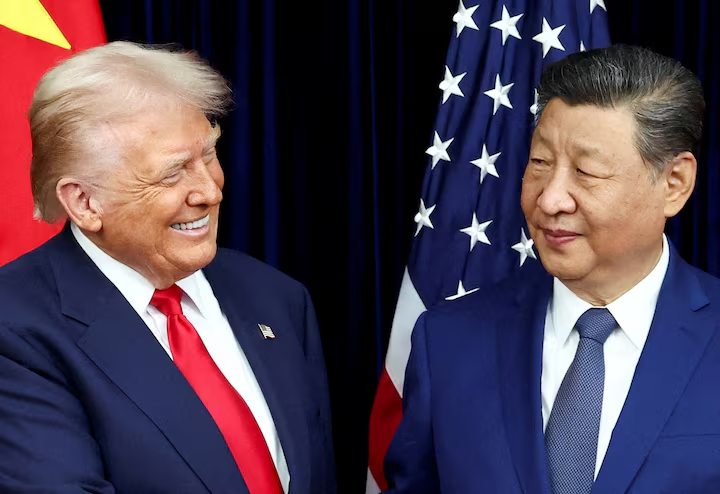
China, as Iran’s largest trading partner, plays a vital role in supporting the Islamic Republic’s economy.
BEIJING, Jan 13 (Reuters) – U.S. President Donald Trump’s recent warning to impose a 25% tariff on nations conducting trade with Iran could strain relations with Beijing, Iran’s most significant economic ally.
With Iran once again in his sights, the proposed tariffs could push U.S. levies on Chinese exports beyond 70%, surpassing the effective 57.5% tariff rate in place before Trump and Chinese President Xi Jinping reached a temporary truce in their trade conflict in October.
It remains uncertain which countries Trump might target for doing business with Iran, and China has not been specifically named. Observers note that Trump has often made public threats that do not immediately translate into policy action.
“China will likely call Trump’s bluff. I am confident that Trump lacks the resolve to impose an additional 25% tariff on China, and if he tries, Beijing will retaliate as it did during the Meng Wenzhou episode,” said Wu Xinbo, dean of the Institute of International Studies at Fudan University.
Some analysts in China questioned why Trump seems determined to revisit one of the most controversial foreign policy issues from his previous term.
“China and Iran are not as closely aligned as the public often assumes,” said a Beijing-based academic advising China’s foreign ministry on Iran policy, speaking anonymously.
Chinese customs data confirms that Beijing has significantly reduced Iranian imports in recent years, with companies wary of U.S. sanctions. In the first 11 months of last year, China purchased only $2.9 billion of Iranian goods, compared with a high of $21 billion in 2018 during Trump’s first administration.
“China is being used as a convenient excuse by the Trump administration to increase pressure on Iran,” said Wang Jin, from the Beijing Club for International Dialogue think tank.
When asked about Trump’s proposed tariffs at a recent press briefing, China’s foreign ministry emphasized that Beijing would “firmly protect its legitimate rights and interests.”
The stakes are high. Iran remains a more substantial trading partner for China than countries like Venezuela, where Trump previously sought to limit Beijing’s influence. Analysts suggest that Trump’s renewed attempt to isolate Iran from international trade could impact Xi Jinping’s flagship Belt and Road Initiative, as Iran is a key logistical hub connecting Chinese goods to the Middle East.
Moreover, the tariff threat injects uncertainty into plans for Trump’s anticipated visit to Beijing in April, which was expected to include a major trade agreement announcement with China.
“Whether Trump’s tariffs can actually be enforced is unclear,” said Xu Tianchen, a Beijing-based analyst at the Economist Intelligence Unit. “Past announcements, such as tariffs on illicit Russian oil, were inconsistently implemented. Trump is also known for targeting weaker nations, so he must tread carefully to prevent these tariffs from escalating into direct confrontation with China.”
Kindly Share:

Discover more from LMSINT STORE
Subscribe to get the latest posts sent to your email.


