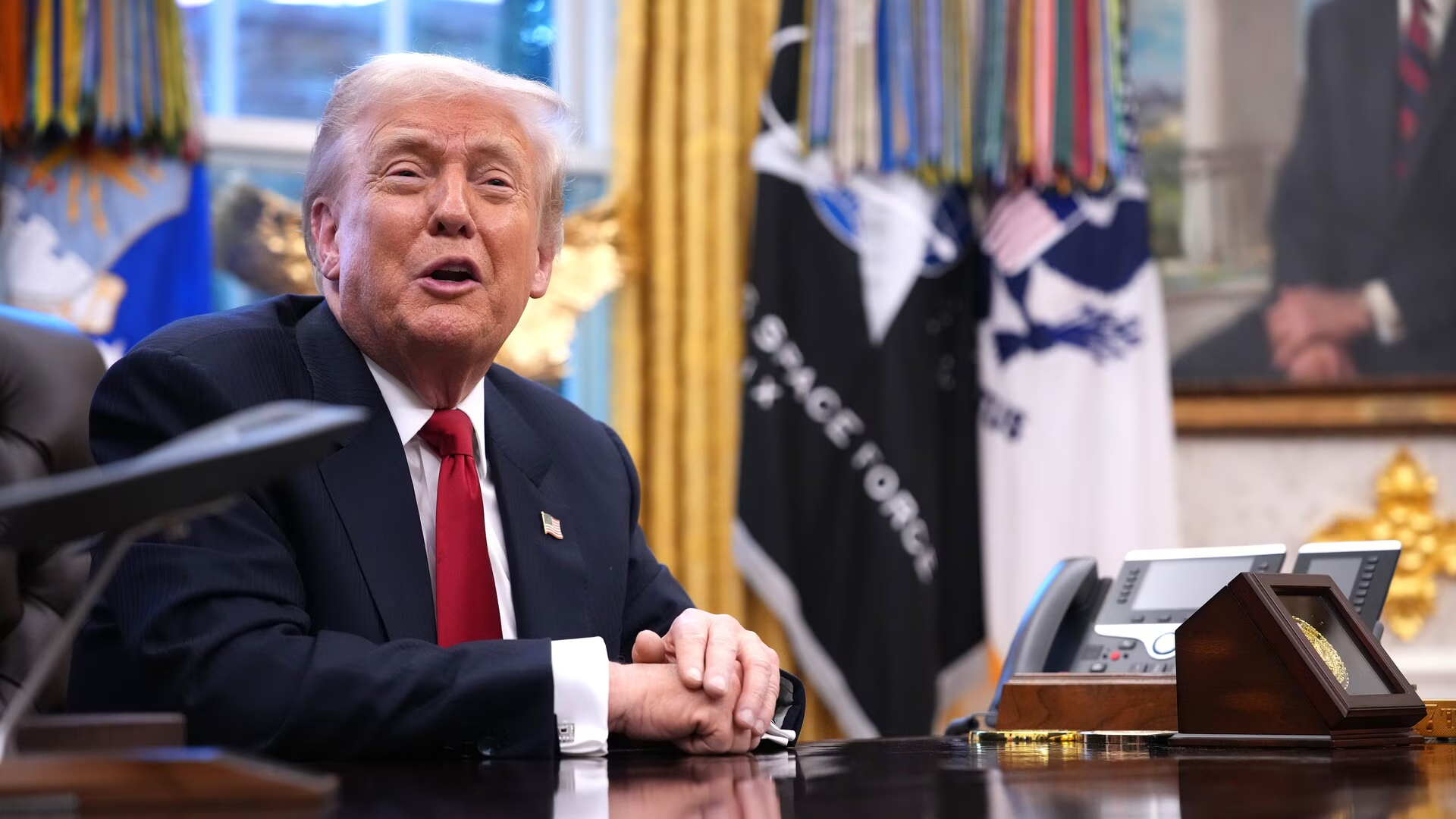
President Donald Trump is set to deliver a high-profile address on Wednesday, aiming to convince Americans that he has a plan to make housing more affordable. However, the location for this speech has drawn attention for its apparent irony: the Swiss mountain town of Davos, where ski chalets can cost a staggering $4.4 million.
During his campaign, Trump promoted himself as a populist focused on lowering the cost of living, once even engaging in a symbolic gesture of serving fries at a McDonald’s drive-thru. Yet, his public schedule in office suggests a shift toward interacting with the affluent, seemingly prioritizing elite gatherings over direct engagement with his working-class base.
“Ultimately, it’s the investors and billionaires at Davos who command his attention, not the families struggling with monthly bills,” remarked Alex Jacquez, chief of policy and advocacy at the liberal think tank Groundwork Collaborative.
Since returning to office, Trump’s agenda has often emphasized foreign policy—addressing crises in Gaza, Ukraine, and Venezuela—over domestic affordability concerns. One of his more controversial initiatives involves pursuing Greenland, a move that has provoked unease among European allies and is likely to dominate discussions at Davos, potentially overshadowing his housing proposals. Reflecting on the upcoming summit, Trump told reporters Monday evening, “Let’s put it this way: It’s going to be a very interesting Davos.”
Political Calculations and Polling Pressures
The White House is now attempting to shift Trump’s focus toward domestic affordability, responding to warning signals from recent polls ahead of midterm elections, where control of Congress is at stake. The latest survey by the Associated Press-NORC Center for Public Affairs Research shows that roughly six in ten U.S. adults believe Trump has negatively impacted the cost of living. Even among Republicans, dissatisfaction is evident: only 16% believe he has significantly improved affordability, a steep decline from 49% in April 2024.
Trump’s strategy relies on leveraging investments from billionaires and foreign governments to generate a domestic jobs boom, despite tariffs that have slowed labor markets and contributed to inflation. His supporters are expected to trust that these business connections will ultimately trickle down benefits to middle-class Americans.
Wealth Concentration and Housing Concerns
Since Trump’s first term in 2017, the wealthiest 0.1% of Americans have seen their fortunes nearly double, rising from $11.98 trillion to $23.46 trillion, according to the Federal Reserve. In contrast, the bottom 50% of households gained $2.94 trillion—roughly a quarter of the increase experienced by the ultra-wealthy.
Housing affordability continues to be a pressing concern for many Americans. Trump has floated several proposals, including lowering interest rates on mortgages through a $200 billion debt purchase and restricting large financial companies from purchasing homes. However, these measures may not resolve the fundamental issue: a persistent shortage of housing supply and home prices that have consistently outpaced wage growth.
Trump frequently highlights investment activity by the affluent as a signal of future economic growth. Policies pursued in his first year—including tax cuts, financial deregulation, and AI initiatives—primarily benefit high-net-worth individuals.
“Most billionaires don’t share the interests of the working class,” said Darrell West, senior fellow at the Brookings Institution. “The ultrawealthy favor tax breaks and deregulation, which can make it harder for government to deliver tangible help to everyday Americans.”
Tax Reforms and Economic Messaging
Trump has attempted to frame his tax reforms, including the so-called “One Big Beautiful Bill,” as beneficial to workers. Yet, analyses from the Congressional Budget Office suggest middle-class families may see modest savings of $800 to $1,200 annually, while the top 10% could benefit from $13,600. The Tax Policy Center further indicates that individuals earning over $1 million could see average savings exceeding $66,500.
Trump’s Elite Circle
Trump routinely engages with billionaires and corporate leaders, both domestically and internationally. During overseas trips to the Middle East and Asia, he showcased investment commitments intended to bolster U.S. manufacturing and job creation. In September, he hosted a dinner with tech magnates such as Bill Gates, Tim Cook, Sergey Brin, and Mark Zuckerberg, praising their intellect and innovation.
The White House contrasts Trump’s approach with the previous administration, emphasizing his purportedly pro-growth policies and “friendly relationships” with industry leaders as mechanisms for creating jobs. White House spokesman Kush Desai noted that these policies aim to channel investments to benefit ordinary Americans.
Trump has also spotlighted significant charitable contributions by billionaires, including a recent $6.25 billion donation by Michael Dell to Trump investment accounts for children, blending discussions of economic inequality with public relations opportunities.
Frequent communications with top executives, including Nvidia founder Jensen Huang, and appointments of wealthy individuals to strategic positions—such as Commerce Secretary Howard Lutnick ($3.3 billion) and Special Envoy Steve Witkoff ($2 billion)—demonstrate Trump’s reliance on elite networks. High-profile figures like Elon Musk ($780 billion) have also played roles in government initiatives under Trump, reflecting both cooperation and publicized disputes.
White House press secretary Karoline Leavitt frames Trump’s billionaire status as an asset: “Voters re-elected him because he is a businessman who understands the economy and knows how to fix it.”
Kindly Share:

Discover more from LMSINT STORE
Subscribe to get the latest posts sent to your email.


