BBNaija Season 10 Update: Mensan Breaks Down in Diary Session, Opens Up About Family Struggles

The emotional depth of Big Brother Naija Season 10 continues to resonate with viewers, as yet another heartfelt moment unfolds. This time, it was Mensan who couldn’t hold back the tears, revealing the personal burdens he carries as a son, brother, and aspiring provider. During Thursday’s highly anticipated diary session, Mensan became visibly emotional, shedding tears as he opened up to Biggie about the immense pressure he faces when it comes to supporting his family. His confession instantly struck a chord with fans and quickly sparked a flurry of reactions across social media platforms. Mensan Shares Emotional Battle with Lack of Father Figure In his heartfelt discussion, the BBNaija housemate spoke openly about the absence of a father figure in his life. Fighting through tears, Mensan shared his deep longing for a paternal presence — someone to guide him, someone he could rely on. “I’ve always wanted a father figure in my life. I’m not just here for myself,” he said emotionally.“I want to get to that point where I’m the one who can truly carry the family the way they expect me to.” This touching revelation highlighted his determination to be the rock his family needs, despite the weight it places on his shoulders. Biggie Responds with Uplifting Words In response to Mensan’s tearful admission, Biggie offered a few words of encouragement aimed at strengthening his resolve. “Wipe your tears because diamonds are unbreakable,” Biggie said, offering comfort and inspiration. These words not only served to soothe Mensan but also resonated with many fans watching the show — reinforcing the emotional depth of this season. Mensan Feels Awkward Around Male Housemates In another vulnerable moment, Mensan mentioned how out of place he sometimes feels when communicating with the male housemates. He described his interaction with them as “just vibes,” implying a lack of genuine connection or perhaps a language barrier. This adds yet another layer to his emotional journey, portraying a housemate grappling with both internal and external pressures. BBNaija Viewers React to Mensan’s Tears on Social Media As expected, Mensan’s emotional display quickly made waves on social media, triggering a wide variety of opinions from fans. While some sympathized with his situation, others questioned the authenticity of his tears — suggesting it might be a strategic move to gain viewer sympathy. Here are a few standout reactions curated by LMSINT MEDIA: Whether strategic or sincere, Mensan’s breakdown has undoubtedly added another emotional layer to BBNaija Season 10 — fueling online debates and stirring public interest. ✅ Rank Math SEO Elements (To Be Placed After Blog Post) Tools ChatGPT can make mistakes. Check important info.

Tinubu Approves One-Year Extension for Customs CG Bashir Adewale Adeniyi

In a recent move aimed at reinforcing institutional stability, President Bola Ahmed Tinubu has approved the extension of tenure for the Comptroller-General of the Nigeria Customs Service (NCS), Bashir Adewale Adeniyi, by an additional one year. Initially, Adeniyi’s term was due to conclude on August 31, 2025, but with the new directive, he will continue in office until August 2026. This decision underscores the administration’s intention to ensure continuity in customs leadership and enhance the performance of the agency during a pivotal time for Nigeria’s economic and security development. The announcement was formally conveyed on Thursday, through a press release issued by Bayo Onanuga, the President’s Special Adviser on Information and Strategy. Strategic Continuity and Reforms The statement highlighted that this extension would offer Mr. Adeniyi the necessary timeframe to solidify the reform programs already initiated under the current administration. These reforms are aligned with Tinubu’s broader policy objectives to reposition the Customs Service as a more effective body in trade facilitation, border protection, and revenue optimization. According to Onanuga, the President has full confidence in Adeniyi’s capabilities, citing his performance and leadership since assuming the top position at Customs. This extension is expected to bolster the capacity of the service to meet evolving challenges in customs administration and cross-border operations. Background and Appointment Bashir Adewale Adeniyi first took up the mantle of Comptroller-General in October 2023, having served briefly in an acting capacity. His confirmation as substantive CG was received with commendation from stakeholders, largely due to his rich professional experience and reform-driven mindset. This extension reflects the administration’s trust in his ability to deliver key policy outcomes, especially in the context of Nigeria’s growing import-export dynamics and regional trade agreements.

Lost Voices: Unwritten Memoirs of Forgotten Revolutionaries

In the annals of global history, countless names have been immortalized in books, documentaries, and monuments. Yet, buried beneath those glowing pages are the silent echoes of forgotten heroes—ordinary individuals who sparked extraordinary change but were never handed the pen to write their story. These are the lost voices—the unsung revolutionaries whose sacrifices shaped nations, yet whose names are largely absent from our collective memory. The Forgotten Foot Soldiers of Change Revolution isn’t always loud. It often begins in whispers—in hushed conversations behind closed doors, in hidden safe houses, or in coded letters passed among the oppressed. These beginnings are seldom glamorous, and the individuals at the heart of them rarely live to see recognition. While leaders like Nelson Mandela, Thomas Sankara, or Patrice Lumumba are widely remembered, there were countless others behind the scenes—women, peasants, teachers, students, and artisans—who risked or gave their lives for justice and freedom. The story of revolution is incomplete without them. Why Their Memoirs Remain Unwritten There are many reasons why the memoirs of these change-makers never reached the public eye: Examples of Erased Heroism Nigeria’s Women in the Anti-Colonial Struggle Names like Funmilayo Ransome-Kuti are occasionally mentioned in Nigerian history, but what about the countless market women who led protests against taxation and colonial laws? Their stories have barely survived through oral traditions. South Africa’s Hidden Resistance Fighters Beyond the iconic image of Mandela lies the unrecorded legacy of township mothers, students, and clergy members who sheltered ANC fighters, printed newsletters, or smuggled information. African-American Grassroots Organizers During the U.S. Civil Rights Movement, figures like Bayard Rustin, an openly gay Black pacifist and strategist behind the 1963 March on Washington, remained behind the curtain due to societal prejudice. His story, among many others, is only now resurfacing. The Emotional Toll of Erasure When we fail to remember, we rob future generations of identity and direction. Every erased story is a missing puzzle piece in our understanding of justice, sacrifice, and resilience. For descendants of these revolutionaries, the loss isn’t just academic—it’s deeply personal. They grow up with shadows instead of legacies. Why We Must Preserve These Histories There’s power in remembering. Documenting the lives of the forgotten: The Role of Digital Storytelling Today Thanks to modern technology, the internet now serves as a powerful archive. Initiatives like The Missing Chapter by the BBC, which explores overlooked Black British history, and platforms like BlackPast.org are helping reframe the narrative. Bloggers, YouTubers, podcasters, and writers now bear a digital responsibility—to become the scribes of those who couldn’t write their own stories. How You Can Contribute to the Cause A Call to Remember The time to remember is now. The memoirs of forgotten revolutionaries deserve a place in our libraries, our classrooms, and our hearts. Let us write what was never written. Let us speak what was once silenced. Let us honor what was almost lost. Their courage lives on—not in ink or stone—but in the fire of every person who refuses to forget.

Nigerian Government Projected to Generate N796 Billion Annually from Proposed 5% Petrol Surcharge by 2026

The Federal Government of Nigeria is projected to generate approximately ₦796 billion each year from a proposed five percent surcharge placed on both locally produced and imported Premium Motor Spirit (PMS)—commonly known as petrol. This revenue stream is expected to kick off following the enforcement of new tax legislation scheduled to begin on January 1, 2026, as part of sweeping fiscal reforms introduced by the current administration. Recall that on June 26, 2025, President Bola Ahmed Tinubu gave assent to four new tax laws, aimed at revamping Nigeria’s tax framework and boosting government revenue without increasing income taxes. One of these legislative instruments is the Nigeria Tax Administration Act, which introduces a 5% surcharge on fossil fuels. The newly signed law clearly stipulates that the surcharge will apply to all chargeable fossil fuel products that are either produced within or supplied into Nigeria. This includes products such as diesel, aviation fuel, kerosene, and compressed natural gas (CNG), among others. However, the policy document makes a significant exemption for renewable energy sources and specific domestic products like household kerosene, cooking gas, and CNG used for domestic purposes, indicating a shift toward incentivizing clean energy adoption. According to the official document, “A surcharge is imposed at five percent on chargeable fossil fuel products provided or produced in Nigeria and shall be collected at the time a chargeable transaction occurs.” A review of the total volume of petrol—both imported and refined domestically—in 2024 provides insight into the scale of potential revenue. According to recent data published by the Nigerian Midstream and Downstream Petroleum Regulatory Authority (NMDPRA), the volume of Premium Motor Spirit consumed by Nigerians in the year totaled 18.75 billion litres. Using an average petrol price of ₦850 per litre during the review period, the total consumer spending on petrol alone amounted to ₦15.93 trillion. Applying a 5% surcharge to this figure equates to ₦796 billion in yearly government earnings from petrol alone, without including diesel or other chargeable fossil fuel categories. When other fossil fuel products are factored in, the overall revenue from the surcharge is likely to surpass the ₦796 billion mark. However, the newly introduced surcharge is already generating significant resistance from stakeholders within the downstream petroleum sector. Petroleum marketers and retailers have voiced strong opposition, warning that the policy could further drive up fuel prices across the country, placing a heavier financial burden on consumers. Responding to the development, Chinedu Ukadike, spokesperson for the Independent Petroleum Marketers Association of Nigeria (IPMAN), emphasized that any additional tax burden will inevitably be transferred to consumers, as marketers are not in a financial position to absorb the cost. “Any additional levy will reflect on the price of petrol across Nigeria. Marketers cannot absorb the additional burden,” Ukadike stated. At the time of this report—Wednesday, July 30, 2025—fuel prices in major cities such as Lagos and Abuja ranged between ₦865 and ₦905 per litre at several filling stations, including MRS, Nigerian National Petroleum Company Limited (NNPC), AP Ardova, Optima, Bova, Ranoil, and AA Rano. The ongoing policy shifts signal the government’s intention to diversify national income streams beyond crude oil exports and address the fiscal challenges caused by fuel subsidy removal, inflation, and exchange rate fluctuations. However, the growing cost of energy and public backlash may test the feasibility of these reforms in the coming year.

Abia State Government Forms Committee to Review Deployment of 5,300 Newly Hired Teachers Across the State

In a recent move to enhance the welfare and effectiveness of newly recruited educators, the Abia State Universal Basic Education Board (ASUBEB) has officially constituted a dedicated committee to review the recent posting of 5,300 teachers employed by the state administration. This review process, according to ASUBEB, has become necessary due to the significant number of the new hires—about 80% of whom are married women. The board emphasized the need to prevent the displacement of these teachers from their families by avoiding distant deployments, which could negatively affect both their productivity and family responsibilities. New Teachers to Resume on September 1, 2025 Speaking during a stakeholders’ gathering in Umuahia, ASUBEB Executive Chairman, Lydia Onuoha, disclosed that the newly employed teachers are scheduled to commence duties on September 1, 2025. She highlighted that the committee would work collaboratively with various education stakeholders to ensure that the posting process is smooth, transparent, and equitable. “We are dealing with a workforce where over 80 percent are married women, and this presents a challenge when considering their deployment away from their homes and children,” she stated. Stakeholders to Guide the Posting Review Process The newly formed committee is expected to partner with local stakeholders, school administrators, and community leaders to ensure that teacher placement is efficient and does not disrupt family structures or the educational framework of communities. Onuoha urged both existing and newly recruited teachers across the state to remain calm and patient as the process unfolds. She also announced the activation of a helpline for concerned teachers to lodge their complaints or seek clarity regarding their posting locations. Governor Otti Approves Incentives and Security Measures In a commendable gesture aimed at improving the work environment for educators, Governor Alex Otti has not only endorsed the review of the postings but has also approved special provisions for teachers deployed to remote or difficult-to-access areas. Additionally, Governor Otti has greenlit the recruitment of security personnel for schools throughout the state. These measures will be implemented in collaboration with Local Government Mayors, ensuring that schools, particularly in vulnerable zones, are adequately protected. No Extortion Involved in the Recruitment Process – ASUBEB Secretary Meanwhile, Mrs. Uzoamaka Amah-Mba, the Board Secretary of ASUBEB and the head of the initial recruitment committee, stressed that the process was fair, credible, and devoid of extortion. She reiterated the board’s commitment to transparency and merit-based recruitment, assuring applicants and the public that no one was financially exploited during the selection process.

Australia Set to Prohibit Under-16s from Accessing YouTube Under New Social Media Regulation

Australia is preparing to implement groundbreaking social media legislation that will prohibit children under 16 years old from accessing YouTube, Communications Minister Anika Wells announced on Wednesday. The aim is to protect young users from the influence of manipulative content recommendation systems, often described as “predatory algorithms.” Wells disclosed that a concerning 40% of Australian children have encountered harmful content on YouTube, a platform known for being among the most frequently visited websites globally. “We want children to discover their identities independently before technology platforms start defining them,” Wells emphasized in her official statement. She further clarified: “There’s a place for digital platforms in modern life, but that place does not include allowing algorithms to target vulnerable children.” In 2023, the Australian government revealed intentions to draft new digital laws that would block minors under 16 from registering on social media platforms including Facebook, TikTok, and Instagram. Initially, YouTube was thought to be excluded due to its significant presence in educational environments. However, that position has now shifted. YouTube to Join Other Restricted Platforms Prime Minister Anthony Albanese confirmed that the upcoming policy will now apply to YouTube, alongside other major platforms. “Young individuals under the age of 16 will no longer be allowed to hold personal accounts on YouTube,” said Albanese during a press briefing. He added that the rule will also affect platforms such as Facebook, Instagram, TikTok, Snapchat, and X (formerly Twitter). “This initiative is about reassuring Australian families that their children’s wellbeing online is being prioritized,” Albanese stated. “It may not be enforced flawlessly, similar to how alcohol laws are sometimes bypassed, but it’s the right path forward.” YouTube Pushes Back Against Classification In response, a YouTube spokesperson criticized the announcement, characterizing it as a drastic policy reversal. “Our stance is unwavering — YouTube is a video distribution platform offering free, high-quality content that’s now increasingly consumed on television screens,” the spokesperson said. They added: “YouTube is fundamentally different from social media.” Despite these objections, Australia’s proposed regulation is among the strictest globally in terms of age-based access to digital platforms. Enforcement Still Unclear Although the law is scheduled to take effect on December 10, it currently lacks detailed guidelines on enforcement mechanisms. This ambiguity has raised concerns that the regulation may end up being symbolic rather than practical. Social media companies found violating the upcoming law could face penalties as high as AUD $49.5 million (approximately USD $32 million). However, industry reactions have been skeptical: International Attention Growing This legislative move is under global scrutiny, as other countries are closely monitoring Australia’s approach to determine whether similar age-restrictive policies could be implemented in their own jurisdictions.

UK Decries Killing of 38 Hostages in Zamfara Despite ₦50 Million Ransom Payment

The United Kingdom Government has denounced the brutal execution of 38 kidnapped villagers in Banga community, Zamfara State, even after a ransom of ₦50 million was paid to their captors. This tragic event has sent shockwaves across both national and international communities. Gill Lever, who is the Acting British High Commissioner to Nigeria, referred to the gruesome event as a “horrific and inexcusable crime”, noting that it inflicts deep psychological and physical trauma on citizens and slows down Nigeria’s collective progress as a nation. “It affects people’s psychological and bodily health, delays development, and we must put an end to it,” Lever said during a security forum. She also expressed heartfelt sympathy to the grieving families and extended support to the broader population of Zamfara, emphasizing that such violent acts cannot continue without urgent and coordinated intervention. These comments were issued during a media session under the State Expansion Programme for the Anti-Kidnap Fusion Cell—a joint initiative between the UK and Nigeria’s National Counter‑Terrorism Centre (NCTC), designed to strengthen anti-kidnapping operations across multiple states. According to LMSINT MEDIA, the killings occurred shortly after gunmen led by a well-known criminal leader identified as Dan Sadiya raided Banga village. During the attack, the gang abducted 56 individuals. Although a substantial ransom of ₦50 million was delivered, only 18 of the abductees were eventually set free. Shockingly, the remaining 38 hostages were executed by the assailants. The Chairman of Kaura-Namoda Local Government Area, Mannir Haidara Kaura, confirmed the heartbreaking incident. He also revealed that those released are currently receiving medical attention in the hospital to treat physical injuries and emotional trauma. This violent development underscores the urgent need for improved national security infrastructure and stronger collaboration between Nigeria and its international allies. It also raises serious questions about the effectiveness of ransom negotiations and the persistent threats from criminal gangs operating freely in Nigeria’s northern regions.

Rhapsody of Realities 30th July, 2025, THE GLORIOUS ASCENSION OF JESUS

Pastor Chris Oyakhilome DSc DSc DD And it came to pass, while he blessed them, he was parted from them, and carried up into heaven (Luke 24:51). The Ascension of Jesus is the biggest event to ever happen in this world. Acts 1:9 gives us a detailed account of how it happened: “And when he had spoken these things, while they beheld, he was taken up; and a cloud received him out of their sight.” His disciples were looking at Him as He ascended. They were watching Him go up into the clouds. Jesus didn’t just suddenly vanish; His disciples were there, watching Him as He levitated. If you were there that day, how would you have described such an experience? You would have been so shocked; you might not have been able to speak for days. That’s exactly what happened to the disciples. What they saw was the proof of something Jesus had told them earlier in John 6. When He was preaching, some of His disciples were offended when He said, “…my flesh is meat indeed, and my blood is drink indeed” (John 6:55). His words were hard for many to accept, and as a result, many of His disciples stopped following Him. Jesus then asked the twelve disciples, “…Doth this offend you? What and if ye shall see the Son of man ascend up where he was before?” (John 6:61-62). And there was no response. But eventually, right before their eyes, it happened. They saw those words come to pass. What they witnessed was too weighty for words. They had already been having difficulty convincing people of His resurrection. They were called liars for declaring Jesus was alive. And now, they had witnessed His ascension. It wasn’t like Elijah who was taken up by a whirlwind with a chariot of fire. This was different. The churches, Christians, and preachers haven’t emphasized the Ascension of Jesus enough. We often read about it and assume everyone understands it. But this was the biggest event that ever occurred on Earth. The resurrection is crucial because our salvation is based on it, but the Ascension is proof of something even more remarkable: His supreme authority, dominion, lordship and eternal reign. Blessed be God. PRAYERDear Father, I thank you for the magnificent ascension of the Lord Jesus Christ, which demonstrated His supreme authority, dominion, lordship and eternal reign. I rejoice that I am seated with Him in heavenly places, far above all principalities and powers. Thank you for the victory and authority I have in His Name. Amen. FURTHER STUDYActs 1:9–11 (KJV)And when he had spoken these things, while they beheld, he was taken up; and a cloud received him out of their sight. And while they looked stedfastly toward heaven as he went up, behold, two men stood by them in white apparel; Which also said, Ye men of Galilee, why stand ye gazing up into heaven? this same Jesus, which is taken up from you into heaven, shall so come in like manner as ye have seen him go into heaven. John 20:17 (KJV)Jesus saith unto her, Touch me not; for I am not yet ascended to my Father: but go to my brethren, and say unto them, I ascend unto my Father, and your Father; and to my God, and your God. John 3:13 (KJV)And no man hath ascended up to heaven, but he that came down from heaven, even the Son of man which is in heaven. DAILY SCRIPTURE READING1-YEAR BIBLE READING PLANRomans 5:1-11;Psalms 49-51 2-YEAR BIBLE READING PLANLuke 12:1-12;Judges 5 DAILY AFFIRMATIONS: I have been called into God’s rest. I take charge of my life and enjoy it to its fullest, for Christ has made me a sharer, partner and participator of the divine nature. Therefore, I take advantage of the immense treasures and blessings of the Christ-life. God’s Word is a light unto my path and a lamp to my feet. None of my steps shall slide; for my path is illuminated with the light of God’s Word. I do not lack direction. Life is at work in me. I’m full of life; my entire being is inundated with divine life and energy. I’ve passed from death unto life. I am the glory of God, a life-giver, and a dispenser of eternal verities! I am seated with Christ in the place of authority; far above all principality, power, might, dominion, and every name that is named, not only in this world but also in that which is to come. I know who I am, the child of the Monarch of the universe. The peace of God garrisons my heart and mind in Christ. My heart is stayed on the Lord who is my rock and fortress, my protection, and salvation. Now and always, I walk in victory, and in the dominion of the Word, reigning by grace through righteousness. My light shines ever so brightly, and I gloriously fulfil my destiny in Christ. I walk in the truth and realities of God’s eternal Word. I’m God-coded because I’ve got the life and nature of God in me. I function with precision, utmost proficiency, excellence, and perfection. I’m a creator, a distributor, and a sharer of eternal blessings; I rule and reign in this life, prevailing gloriously by the power of the Holy Ghost. I am infused with divine abilities to handle transactions that bring huge profits. The systems of the world are working together to favour my increase and progress. I have been infused with divine abilities to handle transactions that bring huge profits. The systems of the world are working together to favour my increase and progress. I hail from above, and my sufficiency is of God; who had made me an able minister of the New Testament. My life only goes in the direction of God’s will and purpose for me; nothing is permitted to happen to me by chance. There are no limitations in my life. I am limitless, in the name

Zamfara Governor Appoints Alhaji Abdulkadir Bello as the 16th Emir of Gusau

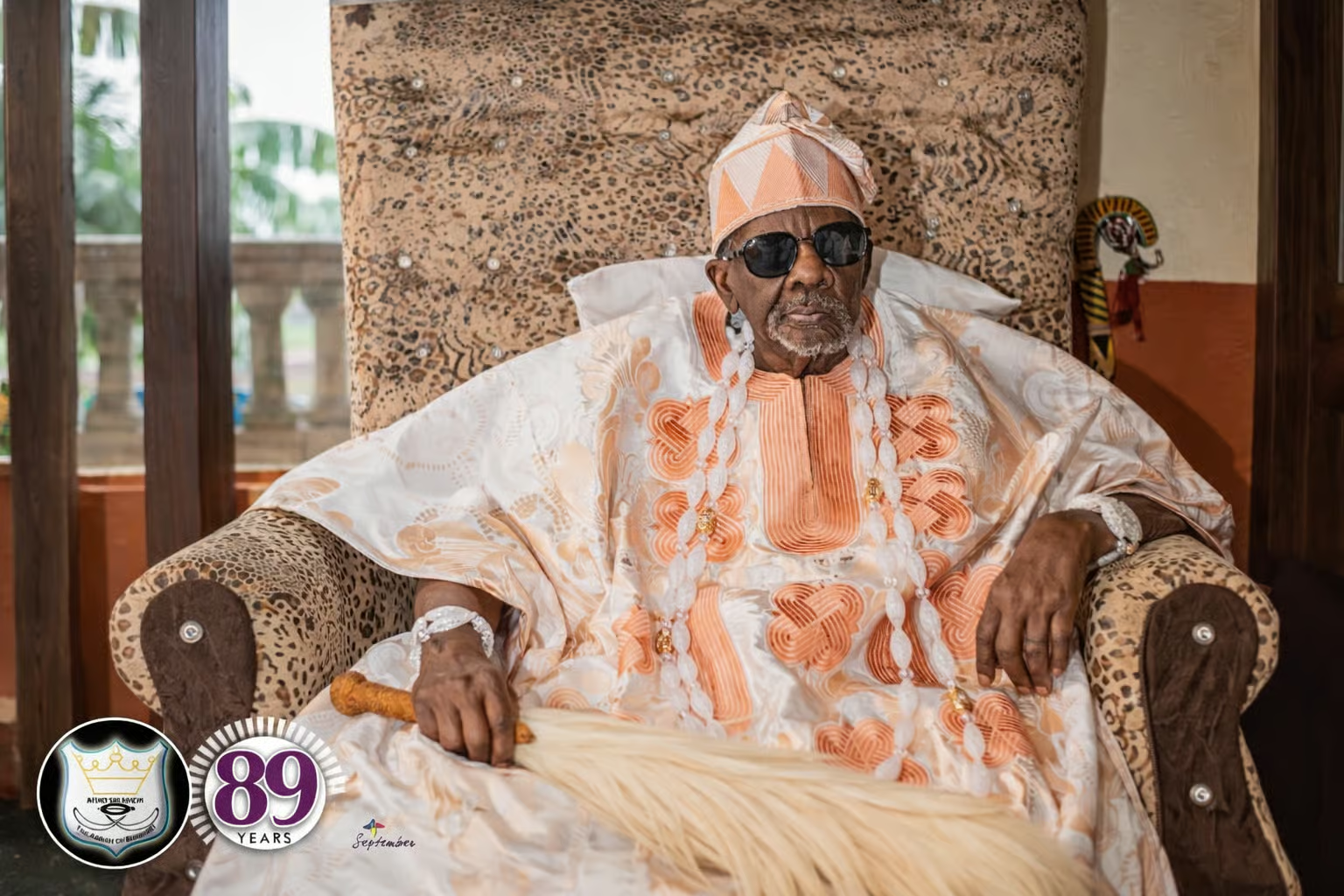
In a significant leadership transition within the traditional institution of Zamfara State, Governor Dauda Lawal has formally approved the appointment of Alhaji Abdulkadir Ibrahim Bello as the new Emir of Gusau. The new royal appointment follows the recent passing of his father, Dr. Ibrahim Bello, the 15th Emir of Gusau, who died on July 25, 2025, after a decade-long reign that witnessed both cultural and socio-political impact within the state. According to an official statement issued on Tuesday by Malam Abubakar Mohammad Nakwada, the Secretary to the Zamfara State Government, the appointment was carried out after the recommendation of the Gusau Emirate Council’s kingmakers, in accordance with Zamfara’s traditional norms and existing legal provisions governing chieftaincy titles. Alhaji Abdulkadir, who prior to his elevation held the prestigious traditional title of Bunun Gusau, ascends the throne as the 16th Emir of the ancient emirate. Notably, he is the eldest son of the late Dr. Ibrahim Bello, making his succession both symbolic and culturally significant. Governor Dauda Lawal, while officially confirming the appointment, charged the newly installed Emir to uphold the virtues of peacebuilding, communal harmony, and sustainable development across the emirate, emphasizing the need for continuity in leadership that strengthens unity among citizens. This royal succession marks a pivotal chapter in the Gusau Emirate’s history, symbolizing a generational shift rooted in tradition, respect, and governance.

Nigerian Farmers Protest Rice and Maize Import Policy Amid Falling Food Prices

Overview: A wave of dissatisfaction is sweeping across Nigeria’s agricultural sector as local farmers voice deep frustration over the federal government’s growing support for food imports—especially rice and maize. This comes after a significant dip in market prices for these staples, largely due to import waivers that have flooded local markets with foreign grains. Farmers Cry Out Over Import Surge Across social media and agricultural forums, many Nigerian farmers have openly criticized President Bola Ahmed Tinubu’s policy, which they say is undermining local grain cultivation. Using platforms like X (formerly Twitter), they argue that the administration’s decision to approve mass food imports—particularly of rice and maize—is threatening the survival of indigenous agriculture. What’s Causing the Price Drop? The decline in rice and maize prices across Nigeria is no accident. The root cause, according to local producers, is the 150-day import duty waiver introduced by the federal government in July 2024. This policy allowed for the duty-free import of essential staples including rice, maize, and other food items, leading to a surge in foreign alternatives and a drastic drop in prices. According to Nigeria Customs Comptroller-General, Bashir Adeniyi, this policy significantly contributed to price reductions in the first quarter of 2025. Market Realities: Local vs. Foreign Prices A market survey conducted by LMSINT MEDIA revealed the following: This pricing gap makes it almost impossible for local farmers to compete, thereby shrinking their profit margins and pushing many to consider abandoning cultivation altogether. Rising Fertilizer Costs Deepen the Crisis The farmers’ woes don’t stop at imports. Many are also grappling with a sharp rise in fertilizer prices, which has increased the cost of production. This means even with reduced earnings from their harvests, they are paying more to produce. Expert Opinion: Prof. Oyedokun Warns of Policy Fallout Speaking with LMSINT MEDIA, Prof. Godwin Oyedokun of Lead City University, Ibadan, stressed that the growing preference for imports over local production has severe long-term consequences. “Favorable import policies result in market oversupply, driving down prices and severely affecting local farmers who cannot compete,” he explained. Oyedokun emphasized that ignoring these concerns could derail the nation’s food security and economic stability. He recommended a multi-step approach: Solutions for Sustainable Local Agriculture ✅ Incentivize Local Farming The government must provide financial support, credit access, and agricultural technology to encourage local grain production. ✅ Implement Import Tariffs Introducing or increasing tariffs on imported rice and maize could help local producers gain a competitive edge. ✅ Quality Assurance Enforcing strict quality standards on imports would increase consumer confidence in Nigerian-grown grains. ✅ Enhance Market Access Farmers should be given better access to structured markets where they can sell at fair prices. ✅ Farmer Training and Education Equip local farmers with modern farming techniques to boost productivity and reduce dependence on imports. What This Means for Nigeria’s Economy While the policy may offer short-term relief in food prices for consumers, its long-term impact on local agriculture could be devastating. A balanced approach is necessary—one that considers both consumer affordability and the sustainability of domestic food production. Inflation Report: Mixed Signals Despite the dip in general inflation, food-related inflation remains a concern. According to recent data from LMSINT MEDIA in June 2025: This contradiction highlights the instability of food pricing and the urgent need for sound agricultural policies. Conclusion: Farmers Need a Voice in Policy-Making Nigerian farmers are not just resisting change—they are fighting for survival. If the government continues to sideline local producers in favor of foreign imports, the nation could face serious agricultural and economic setbacks. Policymakers must engage directly with stakeholders in the farming community to co-create solutions that ensure both affordability for consumers and profitability for local producers.

Thailand and Cambodia Reach Immediate and Unconditional Ceasefire Agreement – Confirms Malaysian PM

In a significant diplomatic breakthrough, Thailand and Cambodia have formally agreed to an “immediate and unconditional ceasefire” in an effort to stop the recent deadly border confrontations, according to Malaysia’s Prime Minister Anwar Ibrahim. During a press briefing held in Putrajaya, Malaysia, Prime Minister Anwar, who currently serves as the ASEAN regional bloc chairman, confirmed that both nations had committed to halting hostilities along their contested frontier. “A ceasefire that is both immediate and unconditional shall commence from midnight, 28th July,” Anwar declared, citing the official joint communique endorsed by Cambodian Prime Minister Hun Manet and Thailand’s interim Prime Minister Phumtham Wechayachai. As a public display of unity and shared commitment, both Southeast Asian leaders joined Anwar at the press conference and shook hands before the media, reinforcing their agreement to de-escalate tensions. Background of the Conflict The recent spike in violence erupted last Thursday, when a landmine blast seriously injured five Thai soldiers stationed near the border, aggravating long-standing tensions between the two countries. Since the incident, each government has blamed the other for instigating the violence. Reports suggest that more than 35 lives have been lost as a result of the clashes, while over 260,000 civilians have been forced to evacuate their homes on both sides of the border. Diplomatic Hope for Peace Both Hun Manet and Phumtham Wechayachai lauded the results of the emergency discussions, voicing optimism that the ceasefire would mark the beginning of sustained dialogue and regional harmony. They underscored their joint commitment to long-term peace and emphasized that the resolution would be a stepping stone for future diplomatic engagement under ASEAN’s peace-building framework.

25-Day Power Outage in Lagos, Ogun to Cost Nigerian Businesses Billions

Widespread Blackout Threatens Economic Activity Across Southwest Nigeria A major 25-day electricity blackout has commenced across Lagos and parts of Ogun State, threatening to cost business operators, banks, manufacturers, and service providers hundreds of billions of Naira in financial losses. The prolonged outage was officially confirmed by Ikeja Electric and Eko Electricity Distribution Company (Eko DisCo), Nigeria’s top electricity distribution companies, through separate public announcements released last Friday. Both companies stated that the blackout would significantly affect various areas within Lagos State and Agbara in Ogun State from July 28 to August 21, 2025, during business hours. According to Eko DisCo, the disruption will span from 8:00 a.m. to 5:00 p.m. daily, cutting power supply to multiple locations under its coverage throughout the blackout period. Ikeja Electric, responsible for most of Lagos, also issued a notice on the same maintenance plan, aligning with the outage window declared by Eko DisCo. Reason for the Blackout Both companies explained that the electricity disruption is due to scheduled maintenance on the Omotosho–Ikeja West 330kV transmission line, which is being carried out by the Transmission Company of Nigeria (TCN). The goal is to improve the reliability and strength of the national grid system, which has long suffered from inadequate investments and frequent system collapses. Economic Hotspot in Darkness Lagos, Nigeria’s commercial powerhouse, is home to the country’s largest concentration of businesses. The state reportedly spends around ₦13 trillion monthly on electricity consumption, according to Biodun Ogunleye, the state’s Commissioner for Energy and Mineral Resources. Data from the Nigerian Electricity Regulatory Commission (NERC) for Q1 2025 indicates that Ikeja Electric and Eko DisCo lead the nation in revenue generation, having recorded ₦105 billion and ₦101 billion, respectively, during the period. However, this 25-day outage is projected to significantly slash the DisCos’ revenue streams and worsen the broader liquidity crisis in Nigeria’s energy sector. Expert Opinion: Businesses Will Suffer In an exclusive interview with DAILY POST, Dr. Muda Yusuf, CEO of the Centre for the Promotion of Private Enterprise (CPPE), highlighted the devastating consequences of the power interruption for business owners, workers, and the national economy. He emphasized that companies reliant on grid electricity will face skyrocketing operational costs due to forced dependence on diesel generators, gas, and other alternative sources of power. “The cost impact of halting grid power for maintenance is substantial. Businesses must now resort to more expensive backup options to stay afloat,” he said. Dr. Yusuf noted that organizations like hospitals, hotels, supermarkets, and some manufacturing firms cannot afford downtime and must operate 24/7, regardless of the hike in power costs. For these sectors, the grid remains the most affordable option compared to diesel and gas, despite ongoing complaints about high electricity tariffs. “Operating for a full month with alternate power sources will severely hit the bottom line of many businesses. Productivity may also decline, as some companies will reduce working hours to cut down energy expenses,” he added. Massive Economic Toll Dr. Yusuf stressed that the economic consequences would be felt most acutely in Lagos, which consumes a significant share of the nation’s power and serves as its commercial backbone. “The cost of this power cut will likely reach hundreds of billions of Naira,” he warned. However, he maintained that the blackout, while painful, might be a necessary sacrifice if it leads to improved grid performance and fewer system failures in the long run. Need for Grid Overhaul Dr. Yusuf concluded by urging support for TCN’s initiative, noting that Nigeria’s national grid has historically suffered from poor maintenance, outdated infrastructure, and chronic underinvestment. “Grid failure is one of the weakest links in the power value chain. Strengthening it is critical, and if this maintenance will help, then the economic pain might be worth it.”

Taraba Collapsed Namnai Bridge: Gimbiyar Lau Urges FG to Declare Reconstruction a National Emergency

The Gimbiyar Lau, Hajiya Mamma Fati Ibrahim Hassan Lau, has passionately called upon the Federal Government of Nigeria to declare the urgent reconstruction of the collapsed Namnai Bridge in Taraba State as a national emergency, following a heartbreaking accident that claimed the lives of her family members. While speaking to journalists in Taraba State on Sunday, the traditional leader expressed grief over the tragic boat mishap that occurred at the Namnai Bridge site in Gassol Local Government Area on Saturday. According to her, the fatal incident—which involved eight of her family members—could have been avoided if the long-abandoned bridge had been properly reconstructed and maintained. Out of the eight individuals involved in the incident, five were rescued, one body was recovered, and two are still unaccounted for as rescue operations entered their third day, according to reports gathered by LMSINT MEDIA. Describing the tragedy as a “completely avoidable disaster,” Hajiya Mamma Fati strongly condemned years of governmental failure and negligence, which she believes have forced communities in the region to depend on hazardous water transportation, especially during the dangerous rainy season when rivers rise sharply and become increasingly unsafe. She specifically called on Governor Agbu Kefas to act decisively and mount strategic pressure on the Federal Government to immediately commence reconstruction of the Namnai Bridge. She emphasized that the bridge is not only vital to the residents of Lau and Gassol LGAs but also critical to Nigeria’s national transportation and trade network. According to her, the Jalingo–Wukari route, which hosts the Namnai Bridge, is a major transportation corridor that connects Northern and Southern Nigeria. This key route facilitates the movement of agricultural produce, livestock, and commercial goods, thereby serving as an economic lifeline that boosts interregional commerce and integration across the country. While extending her heartfelt condolences to grieving families—including the Alkali Hassan Lau and Badikko households, as well as the people of Lau, Gassol, and Jalingo LGAs—the Gimbiyar Lau stressed the need for decisive and responsible governance. She urged the federal authorities to take immediate and meaningful action to “put the right peg in the right hole,” thereby preventing any further loss of lives resulting from avoidable infrastructure failures.