

Nollywood actress Uche Montana has publicly rejected speculation that she was involved in the drug-related controversy engulfing actress Regina Daniels and her husband, Senator Ned Nwoko. The Allegation The issue began when Ned Nwoko alleged in a detailed post on Facebook that Regina’s friends and relatives — including Uche Montana and another actress, Sonia Uche — were undermining her rehabilitation process. He claimed they had been bringing her the very drugs she was undergoing treatment for, thereby hampering efforts by doctors and therapists to help her. Uche Montana’s Response In the wake of the claim, Uche Montana took to her Instagram page on Monday to issue a statement clarifying her position. She wrote: “My attention has been drawn to a circulating post that appears to link my name to certain claims. For clarity, I have no involvement or connection to the situation described. This note is simply to set the record straight and protect my peace.” Her statement comes amid intensifying scrutiny of the long-running public dispute between Regina Daniels and Ned Nwoko — a feud that includes allegations of abuse, addiction, and manipulation. Context & Significance Regina Daniels, a prominent figure in Nigerian entertainment, previously alleged in a viral video that she was being abused in her marriage and treated like a “slave” in her husband’s household. Meanwhile, Ned Nwoko denied those claims and instead accused Regina of battling drug and alcohol addiction, further accusing her of assaulting domestic staff. By naming Uche Montana among those allegedly aiding Regina’s alleged addiction, Ned Nwoko expanded the narrative beyond the couple — implicating other personalities in the entertainment industry. Montana’s swift denial is a strategic effort to dissociate her reputation from the scandal. What’s Next? As the story evolves, the public will likely watch how both Regina Daniels and Ned Nwoko proceed — whether with legal actions, further disclosures, or attempts at reconciliation. For Uche Montana, maintaining distance and clarity appears to be the chosen path for preserving her professional integrity.


A major turning point has struck the world of international beauty pageants: the recently appointed executive director of the Miss Universe 2025 competition, Nawat Itsaragrisil, has been officially dismissed from his role following a highly publicised incident involving the Mexican contestant Fátima Bosch. In a dramatic pre-pageant gathering held in Thailand, Itsaragrisil publicly chastised Bosch — accusing her of failing to post promotional content on social media — and went so far as to label her “dumb”. The confrontation was livestreamed and provoked an immediate backlash among delegates. Bosch described his remarks as “disrespectful and undermining”, and a number of fellow contestants walked out in solidarity with her. The leadership of the pageant responded swiftly. Miss Universe Organization President Raúl Rocha announced via social media that Itsaragrisil’s participation in the competition would be restricted or eliminated entirely, and stated that he would not allow the values of respect and dignity for women to be compromised. Itsaragrisil later issued multiple apologies — including a tearful address at a press conference — claiming he did not intend to harm anyone and citing personal pressure as a contributing factor. This controversy casts light on the intense pressures, high-stakes expectations and potential power-imbalances behind major pageant-stage events. It also serves as a reminder that even global institutions must uphold standards of dignity and fairness for all participants. For readers interested in how the Miss Universe organisation is navigating this crisis and the implications for future editions of the competition, see our related coverage of the overall pageant’s dynamics and controversies. Why this matters What happens next The Miss Universe 2025 pageant is set to take place as scheduled in Thailand on 21 November 2025. The organisation will be under close watch as it manages this fallout and seeks to reassure stakeholders, participants and global audiences of its commitment to integrity, respectful leadership and equal treatment. Organisers have indicated that legal and organisational reviews are underway, and future operational protocols may be adjusted in response to this episode.
Kindly Share:


Kim Kardashian, the world-renowned American media mogul, reality TV star, and the former wife of rapper Kanye West, has once again failed to pass the California Bar Exam. The reality star revealed the news in a heartfelt post shared on her Instagram Story on Saturday after the official exam results were made public. Despite the setback, Kim expressed unwavering determination to achieve her dream of becoming a licensed attorney. She encouraged her followers with a strong message of perseverance, writing, “No giving up, just more studying and determination.” This isn’t the first time Kim Kardashian has spoken openly about her journey toward becoming a lawyer. Over the past few years, she has shared her experiences studying law under the California apprenticeship program, often referred to as the “baby bar” path — an alternative legal route that allows aspiring lawyers to study under the supervision of practicing attorneys instead of attending traditional law school. Kim’s motivation for pursuing a legal career stems from her growing passion for criminal justice reform. She has previously worked with legal experts to help advocate for the release of wrongfully convicted prisoners and individuals serving lengthy sentences for non-violent crimes. Although the recent exam results were disappointing, Kim remains focused on her long-term goal. Her story continues to inspire millions around the world, particularly those who face challenges while pursuing their dreams. In one of her earlier interviews, Kim Kardashian explained that her journey is not about fame but about making a lasting impact through justice reform. Her continued effort demonstrates that failure can be a stepping stone toward greater success — as long as one remains consistent and resilient. Fans and supporters on social media have flooded her comment sections with encouraging words, commending her for her honesty and determination. While many celebrities might shy away from publicizing such personal setbacks, Kim has chosen transparency — turning her experience into motivation for others facing similar struggles. For Kim Kardashian, the California Bar Exam is more than just a legal milestone; it’s a symbol of her dedication to positive change and personal growth. Whether she passes on her next attempt or not, her persistence stands as a testament to the power of perseverance and education.
Kindly Share:


Nigerian street-hop sensation, Portable, has shared his intention to return to school, emphasizing the importance of education in balancing fame with professionalism. In a recent video posted on his official Instagram account, the energetic artist discussed the need to combine his fast-growing popularity with academic knowledge to better manage his brand and career decisions. Portable, who already holds an Ordinary National Diploma (OND) from Kwara State Polytechnic, expressed that returning to school would help him develop stronger business and management skills to sustain his success in the entertainment industry. Speaking further in the clip, the controversial hitmaker noted that while fame can open doors, education provides structure, discipline, and long-term understanding of how to handle financial and professional growth. The singer’s remarks sparked mixed reactions among fans, with many applauding his determination to improve himself despite his already successful music career. Some encouraged him to consider courses in music business management or entrepreneurship, which could help him manage his record label, Zeh Nation, more effectively. Portable’s revelation highlights a growing trend among Nigerian celebrities who are choosing to further their education to enhance their craft and brand management. Other notable artists, including Davido and Burna Boy, have also emphasized the importance of education and self-development in achieving lasting success in the music scene. This move could mark a new chapter for Portable as he continues to evolve from a street sensation into a more professionally grounded artist capable of navigating the complexities of the entertainment industry.
Kindly Share:


Popular Nigerian singer and songwriter Adekunle Gold has once again shared his personal struggle with sickle cell disease, revealing that he continues to experience painful health crises despite his success in the music industry. In a recent interview clip that surfaced on social media, the award-winning artist bravely discussed his ongoing health challenges. Adekunle Gold, 38, stated clearly, “I still have crises,” emphasizing that his battle with the inherited blood disorder is far from over. The singer, known for chart-topping hits like “Orente,” “Something Different,” and “High” featuring Davido, spoke candidly about how the condition has shaped his life and career. His openness sheds light on the daily struggles faced by individuals living with sickle cell anemia — a condition that affects the shape of red blood cells, causing severe pain, fatigue, and other health complications. Adekunle Gold’s revelation has sparked widespread admiration from fans and supporters, who commended his courage and honesty in sharing such a deeply personal experience. Many praised him for using his platform to raise awareness about sickle cell disease, a condition that affects millions of people globally, especially in Africa. In previous interviews and social media posts, Adekunle Gold has often spoken about turning his pain into purpose. He continues to use his music as a source of inspiration for people battling similar conditions, proving that one’s health challenges do not define their destiny. The singer’s ongoing battle is also a reminder of the importance of early diagnosis, proper medical care, and emotional support for individuals living with sickle cell. His story encourages more public conversations about genetic testing, awareness, and the need for improved healthcare systems to support people with chronic illnesses. Adekunle Gold’s bravery not only humanizes the struggles of sickle cell patients but also motivates his fans to remain resilient in the face of personal challenges. His ability to thrive in the demanding world of music while managing such a condition remains truly inspiring.
Kindly Share:


Nigerian Superstar Tiwa Savage Shuts Down Afrobeats Decline Rumors Renowned Nigerian singer and songwriter Tiwa Savage has opened up about her personal experiences and the strength of Afrobeats, asserting that the globally recognized genre remains unstoppable despite recent claims of decline. During her recent appearance at the Unstoppable Africans event, the award-winning artist revealed that she once struggled with her African identity, admitting, “I wasn’t happy being African.” However, Savage emphasized how far the continent has come in embracing its culture, creativity, and sound, crediting Afrobeats as one of the most powerful forces uniting Africa with the world. Her comments came in response to opinions shared by some respected music executives who believe the Afrobeats wave might be fading. Among them are Paul Okoye, popularly known as Paulo, and DJ Big N, both of whom recently expressed concerns about the current state of Afrobeats in interviews and social media posts. But Tiwa Savage boldly refuted those claims, stating that “Afrobeats cannot be stopped.” She expressed pride in how the genre continues to evolve, inspiring global collaborations and breaking international barriers. Savage highlighted that African artists are now selling out stadiums, headlining world tours, and influencing mainstream pop culture — something unimaginable two decades ago. “Afrobeats is not just music anymore; it’s a movement, a lifestyle, and a global sound that represents the spirit of Africa,” Tiwa Savage said confidently during her speech. Her remarks have since gone viral, sparking renewed conversations on social media about the future of African music and its growing dominance on global charts. Fans and fellow artists have praised Savage for standing firm in defense of African creativity and identity. For many, Tiwa’s message serves as a powerful reminder that Afrobeats is not just surviving — it is thriving, influencing fashion, culture, and entertainment across continents.
Kindly Share:


Nigerian award-winning indigenous rapper Olamide Adedeji, widely known by his stage name Olamide, has once again proven that authenticity and self-awareness remain the cornerstones of his musical journey. In a recent conversation, the ‘Local Rapper’ hitmaker shed light on his perspective about fame and global recognition, emphasizing that his focus has always been on identifying and satisfying his core audience rather than chasing international approval. Olamide explained that from the very beginning of his career, his strategy was built around understanding his fan base and creating relatable music that connects deeply with Nigerians and other Yoruba-speaking communities around the world. According to the rapper, staying true to his culture and roots has been the driving force behind his consistency and longevity in the entertainment industry. “I’m not desperate for international recognition. I’m more focused on creating a lasting impact with my people and my sound. Once you understand your audience and give them what they love, every other thing will fall into place naturally,” Olamide stated. The YBNL boss, known for nurturing rising stars such as Fireboy DML, Asake, and Lil Kesh, further elaborated that success does not always have to be measured by international awards or recognition. He believes that true success lies in influence, respect, and the ability to uplift others through one’s craft. Over the years, Olamide has become one of Nigeria’s most influential music figures, with countless hit songs that have shaped the country’s contemporary music landscape. Despite not constantly seeking international collaborations, his music continues to attract attention across borders, thanks to his authenticity and originality. Many fans and industry analysts have praised Olamide for staying grounded and focusing on his community rather than following trends. His unique sound, often blending street vibes with relatable storytelling, continues to inspire a generation of upcoming artists who look up to him as a symbol of perseverance and creativity. Olamide’s comment also reflects a broader truth about the Nigerian music industry—local acceptance and identity often precede global recognition. The rapper’s stance serves as a reminder that artists don’t need to conform to Western standards to be successful; instead, they can build empires by staying authentic to their roots. While global acknowledgment remains a milestone for many musicians, Olamide’s approach underscores the importance of artistic integrity and cultural pride. His decision to prioritize his Nigerian audience reinforces his legacy as a national icon who continues to elevate the indigenous rap genre on the global stage without compromising his originality.
Kindly Share:


Big Brother Naija Season 10 winner, Imisi, has candidly spoken about her challenges in adjusting to life after the show, revealing the pressures that come with fame and public attention. The reality TV star admitted that living under the spotlight has not been as easy as many people imagine. During a recent public appearance, Imisi opened up about the constant demand to maintain a picture-perfect image, explaining that the transition from being a private individual to a recognized celebrity has been overwhelming. She highlighted that one of the most demanding aspects of her new reality is the need to always look flawless in public, especially the pressure to wear makeup frequently. “It’s not always easy. People expect you to look your best all the time. You have to keep up appearances even when you just want to relax,” Imisi shared while addressing attendees at the event. The reality star noted that although she is grateful for the opportunities that have come with her new status, the expectations tied to fame often make it difficult to live freely. Imisi emphasized that her post-show experience has taught her the importance of self-care and staying true to herself despite the glitz and glamour associated with celebrity life. She also mentioned that fans often forget that reality TV stars are human and go through personal struggles. “Sometimes, I just want to be myself without worrying about what people think or how I look on social media,” she added. Since her BBNaija win, Imisi has been actively building her brand in the entertainment industry, working on endorsement deals, public speaking, and other creative ventures. Despite the pressure that comes with fame, she remains optimistic and focused on using her platform to inspire others. Fame, according to Imisi, is a blessing and a challenge in equal measure — a balance that every public figure must learn to maintain.
Kindly Share:


Nigerian legendary Juju artist Oluwashina Akanbi Peters, famously known as Sir Shina Peters, has boldly stated that he possesses more music classics than the late pop icon Michael Jackson. The veteran musician, celebrated for his unique Afro-Juju sound, made this revelation during his appearance on a recent episode of The Honest Bunch Podcast, where he reflected deeply on what defines a musician’s lasting legacy. The 67-year-old icon explained that the greatest achievement of any musician is not just fame or wealth but the creation of timeless songs that continue to inspire generations long after their release. According to him, these songs—often referred to as “classics”—represent a musician’s true success and artistic immortality. “Every musician’s dream is to have evergreen songs that outlive their career,” Sir Shina Peters stated passionately. “For me, I’m proud to say I have four major classics that will forever remain in the hearts of music lovers.” Sir Shina Peters, known for hits like “Ace (Afro Juju Series 1)” and “Shinamania”, emphasized that he feels completely fulfilled knowing his songs have stood the test of time. He confidently declared that his musical portfolio contains more lasting classics than Michael Jackson, a statement that has sparked diverse reactions among fans and critics alike. The Nigerian star’s assertion is not without reason. Throughout his decades-long career, Sir Shina Peters has been instrumental in shaping the soundscape of Afro-Juju music, blending traditional Yoruba rhythms with modern instrumentation and high-energy performances. His influence paved the way for many modern Afrobeat and Afropop artists, who continue to draw inspiration from his works. While Michael Jackson’s global influence remains unmatched, Peters’ statement highlights the pride and passion African artists hold for their cultural heritage and contributions to the global music industry. His perspective sheds light on how African classics—though sometimes underrated internationally—carry profound emotional and cultural significance within their communities. Sir Shina Peters’ musical journey continues to resonate across generations, with many fans considering his songs a defining symbol of Nigeria’s vibrant music history. Whether or not one agrees with his claim, there is no denying that his legacy remains strong and influential in shaping the sound of modern African music.
Kindly Share:


Nollywood actress Yvonne Jegede has publicly advised her colleague Regina Daniels to end her marriage if the reported domestic violence allegations against her husband, Ned Nwoko, are accurate. Graphic Online+2Nigeria News Today+2 In a candid social-media post, Jegede told Regina: “You are still very young. If there is violence in your marriage, please pack your bag.” She stressed that “there is never any sugar-coating for me when violence is involved — whether from a man or a woman.” Blueprint+1 Jegede pointed out that abuse should never be excused by status, wealth or gender. She asked critics: if Regina’s husband were poor or younger, would people treat the situation differently? “Would it make a difference?” she asked. Nigeria News Today+1 She also called out fellow entertainers who mocked Regina’s plea for help. Jegede said their reaction was “shameful” and reminded them that “everybody has a story… we are one.” She emphasised the need for compassion rather than judgment. Trending News+1 Speaking as a single mother, Jegede said she has no patience for violence in any home: “I don’t care if you’re a woman or man who is being violent — once violence is involved, I will not sugarcoat it.” She added: “You carry your bag for your own health, mental health… it is better for you to live to tell the story than for you to stay and die.” Trending News+1 This advice comes in the backdrop of the much-publicised marital troubles between Regina Daniels and Ned Nwoko. While Daniels has made claims of violence and distress in their union, Nwoko has countered with allegations of drug and alcohol abuse on her part. The Nation Newspaper+2allAfrica.com+2 Jegede’s message carries a broader social import: that domestic violence affects people across class and gender lines, and refusing to address it is a collective failure. She asserted that no amount of wealth or fame should silence a victim or justify staying in a harmful relationship. Nigeria News Today+1 In sum: Yvonne Jegede’s public counsel to Regina Daniels underscores two key points — violence in marriage is a deal-breaker, regardless of who is the perpetrator or who is the victim, and prioritising one’s mental health, safety and dignity must come above appearances, status or fear of judgement.
Kindly Share:


British YouTuber and BMX rider Ryan Taylor has finally broken his silence on the fast-moving relationship and short-lived engagement with Nigerian disc jockey and billionaire heiress DJ Cuppy (real name Florence Otedola). In a candid appearance on the Ladders Podcast, the 32-year-old influencer reflected on their whirlwind romance and revealed new details behind the breakup. According to Taylor, their engagement began under extraordinary circumstances and ended largely because of deeper issues than many anticipated. He disclosed that despite the high-profile nature of their union, he felt there were serious cultural and professional disconnects between them. One telling moment: “Is it weird that I told you that she didn’t like Nigerians … She came into my business and didn’t even want Nigerian staff.” This pointed comment suggests that Taylor believed Cuppy harboured a negative attitude toward Nigerian associates. Taylor went on to say that their engagement taught him more about himself than about love. “Everything that happens, happens for a reason… What I got from that was lessons,” he said. And perhaps most salient: “I learned that money is not everything, but not having it is.” The engagement between DJ Cuppy and Taylor had captured public attention when they confirmed it in December 2022—just 25 days after meeting at the Gumball 3000 rally in Dubai. But by July 2023, social media signs began emerging of their split: they unfollowed each other, and neither made any public statement for some time. For DJ Cuppy, the collapse of the relationship spurred introspection. At a women’s conference, she confessed that she regretted saying yes to the engagement. “I had one of the worst years of my life last year because I couldn’t say no. I didn’t say no to opportunities I should have said no to. I didn’t say no to a fiancé I should’ve said no to.” She explained that juggling multiple high-pressure commitments — from a BBC radio role to DJ sets, planning a wedding, and studying at Oxford University — left her completely burned out. “And none of us are either good to ourselves or other people when we are burnt out,” she said. In sum, what seemed like a glamorous match between a celebrity DJ and a British influencer turned out to reveal deeper misalignments — and both parties appear to have drawn lessons from the experience. Why it matters
Kindly Share:


Popular Nigerian actress and trained engineer, Etinosa Idemudia, has stirred online reactions following her statement that acting is more tasking than engineering. The actress made this revelation during her appearance on the Bold Enough To Say It podcast, where she shared insights from her dual career experience in both fields. Etinosa, who holds a degree in Engineering, revealed that while engineering demands technical knowledge and problem-solving skills, acting requires a deeper level of emotional and mental energy. She emphasized that stepping into different characters and bringing fictional roles to life involves immense concentration, preparation, and emotional investment—qualities that often go unnoticed by viewers. “From my experience as an engineer and an actor, I can boldly say acting is more demanding. Engineering challenges your intellect, but acting challenges your emotions and mind every single day,” she explained during the interview. The statement sparked mixed reactions across social media platforms, with fans and fellow entertainers sharing their opinions. Some agreed with her stance, noting that acting involves creativity, emotional intelligence, and physical energy, while others argued that engineering’s technical and analytical demands make it the more difficult profession. Etinosa’s bold comparison has reignited conversations about the realities of the Nigerian entertainment industry, where actors often work under intense schedules and limited production resources to deliver quality content. Her perspective sheds light on how entertainment can be just as challenging as traditional technical professions. Despite the controversy surrounding her opinion, Etinosa’s comments have brought attention to the dedication and resilience required to succeed in Nollywood. Her statement serves as a reminder that behind the glamour and fame, acting is an art form that requires both passion and discipline. For those unfamiliar, Etinosa Idemudia is a celebrated Nollywood actress, filmmaker, and content creator known for her outstanding performances in several hit films and TV series. Before her rise to fame, she worked as an engineer—proving her versatility and intellectual depth.
Kindly Share:

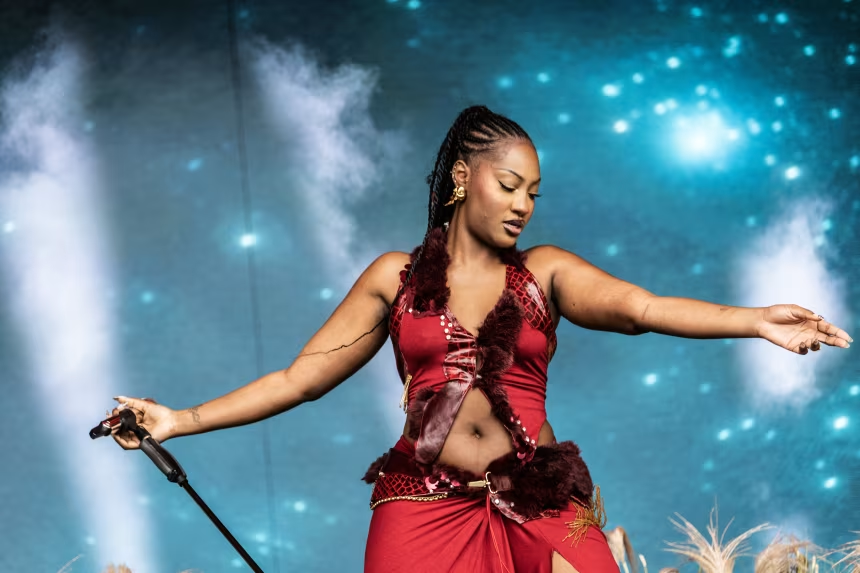
From the bustling streets of Lagos to the glimmering spotlight of the Grammys, Nigerian singer-songwriter Tems has scaled the world stage, steadfast in staying true to herself. “Authenticity is everything to me,” she insists. “That’s the one thing I cannot compromise on because that’s all I have — who I really am.” When Tems stepped onto the stage at New York’s MetLife Stadium for the FIFA Club World Cup halftime performance in July, she knew millions were watching. Though the pressure and nerves were real, she replays that moment with pride: “It was an honor to just be there,” she reflects. Early Fears, Unseen Struggles, and Finding Voice In interviews, Tems has candidly discussed a time when she felt overshadowed and undervalued in the music industry. As she shared with The Nation, “I didn’t feel safe, I didn’t feel seen, and I didn’t feel supported for a very long time.” These emotions didn’t just vanish once success came. Rather, they became guiding forces in her resolve. The challenges she endured—being underestimated as a producer, feeling invisible amid male-dominated spaces—helped shape her conviction that she must create space not just for herself, but for those who come behind her. Staying True While Stepping into the Light Even amid international acclaim, Tems refuses to dilute the essence of who she is. She’s repeatedly stated that she won’t let stardom alter her inner compass. In a conversation with GRAMMY.com, she described her debut album Born in the Wild as a narrative about survival, embracing inner complexity, and accepting every part of oneself. This balancing act—of growth without self-erasure—is rare in a landscape where labels, collaborators, and the public often demand conformity. Breaking Barriers for Other Women in Music Tems isn’t merely content to succeed as an individual: she’s actively building bridges for other African women in the music industry. She launched the Leading Vibe Initiative (LVI)—a mentorship and development program targeting women between 18 and 35 who aspire to work in music (as artists, producers, managers, or executives). The initiative offers workshops, networking support, legal insights, and funding — all with the goal of making the invisible visible. In her words, “there are so many talented women who can be producers, managers, audio engineers — but they’re not even visible.” To date, LVI has made waves not just in Nigeria, but is expanding to Kenya and other African hubs. Observers see this as a turning moment in the push for equity in music across the continent. The Stage, the Awards, the Legacy Tems’s trajectory is dazzling. After releasing her debut EP For Broken Ears in 2020, she became internationally known via her feature on Wizkid’s hit “Essence” (which charted globally). In 2023, her collaboration with Drake and Future (“Wait for U”) earned her a Grammy win, making her the first African woman to win in that category. In 2025, she added a second Grammy (for Love Me JeJe) to her shelf—cementing her position as one of Africa’s most decorated artists. Through it all, she continues to operate with purpose. She sees her platform not just as a means for personal success, but as a lever to shift power, visibility, and opportunity across the African music ecosystem.
