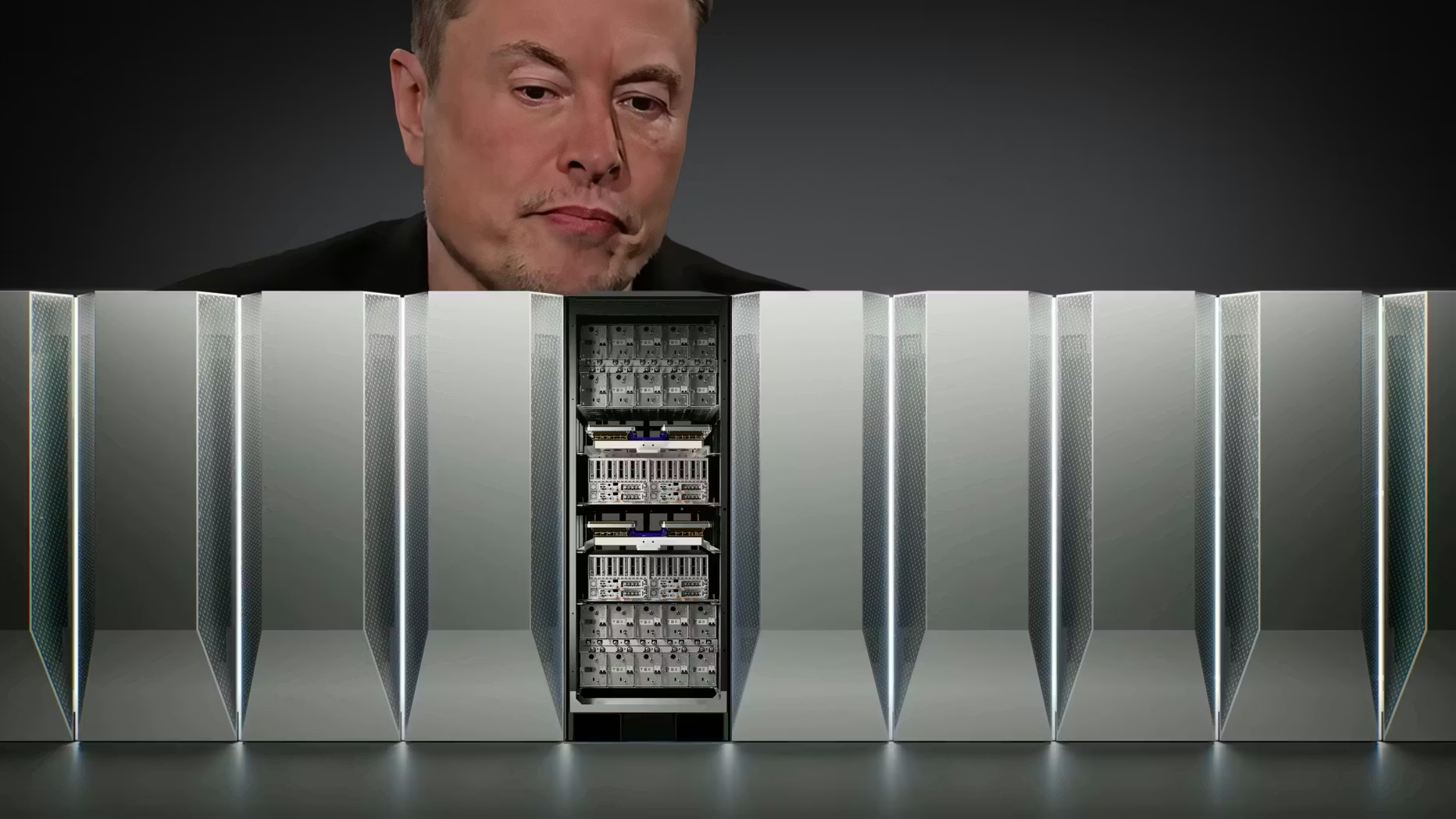
Elon Musk has revealed that Tesla’s newly restarted Dojo 3 supercomputer will be focused entirely on space-based artificial intelligence computing, a move designed to support next-generation AI models and future mission-level operations.
The Dojo project itself has long been associated with Tesla’s ambition to build custom AI hardware capable of handling enormous volumes of data. With the introduction of Dojo 3, the focus shifts toward orbital and space-centric computation, where latency, reliability, and autonomy are critical. By dedicating the system to off-planet use cases, Tesla aims to push AI processing closer to where data is generated, rather than relying solely on Earth-based infrastructure.
Musk’s statement also suggests that upcoming AI models will be designed with space deployment in mind, requiring training systems that can simulate or directly support mission-scale operations. This includes handling complex decision-making processes, continuous learning, and adaptive responses in environments where human intervention may be delayed or impossible.
The restart of Dojo 3 signals a renewed commitment to Tesla’s in-house computing strategy. Instead of depending entirely on third-party cloud platforms, the company is reinforcing its belief that purpose-built supercomputers offer greater control, efficiency, and scalability for advanced artificial intelligence tasks. In the context of space missions, this control becomes even more significant, as systems must operate with minimal margin for error.
By dedicating Dojo 3 to space-based AI compute, Tesla positions itself at the intersection of high-performance computing, autonomous intelligence, and future exploration technologies. While Musk did not introduce new mission details, the announcement underscores a broader vision in which AI plays a foundational role in supporting next-generation models and long-term objectives beyond Earth.
Kindly Share:

Discover more from LMSINT STORE
Subscribe to get the latest posts sent to your email.


